



Content Curator
A combustion reaction is a chemical reaction in which fuel is oxidized by reacting with an oxidizing agent, releasing energy (usually in the form of heat). Combustion reactions are redox reactions between an oxidant and a fuel and are typically very exothermic.
Introduction to Combustion Reactions
[Click Here for Sample Questions]
Combustion Reactions involve burning of fuels to produce energy. A combustion reaction normally produces oxidized fuel as a byproduct (which is mostly liberated in the gaseous state). Smoke is a common term for this. The presence of flames in combustion processes is not unusual. However, it's vital to keep in mind that not all combustion reactions end in fires.
The conversion of hydrogen and oxygen into water vapour, which is often used to fuel rocket engines, is a simple example of combustion. Hydrogen is employed as a fuel and oxygen is used as an oxidizing agent in this experiment. Per mole of fuel subjected to burning, this combustion reaction is known to emit over 242 kilojoules of heat. This heat is then utilised for power generation.
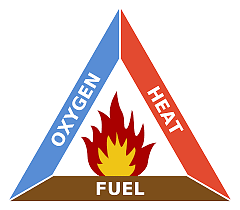
Combustion Triangle
Types of Combustion Reactions:
[Click Here for Sample Questions]
- Complete Combustion: When a fuel burns completely to produce carbon dioxide and heat with a sufficient supply of oxygen, it is called complete combustion.
- Incomplete Combustion: When oxygen is scarce or unavailable, the fuel burns inefficiently, creating carbon monoxide instead of carbon dioxide.
Complete Combustion Reactions
Complete combustion reactions, also known as clean combustion reactions, occur when the fuel is completely oxidized (usually a hydrocarbon). Water and carbon dioxide are frequently the only results of such reactions. The combustion of wax candles is a good example of a clean combustion response. Wax is a hydrocarbon that when burned cleanly produces just carbon dioxide and a small amount of water as a byproduct. It's also worth noting that when the candle is completely burned out, no ash or byproducts are left behind.
Incomplete Combustion Reactions
The combustion reactions that result in the generation of by-products such as ash and soot are known as incomplete combustion reactions (also known as "dirty" combustion reactions). Carbon monoxide (a very deadly gas with the molecular formula CO) is frequently released as a byproduct of such combustion reactions. The burning of wood is a common example of an incomplete combustion reaction.
Read More: The Refractive Index
Difference Between Combustion and Oxidation Reaction
[Click Here for Sample Questions]
In a nutshell, we can say that all the combustion reactions are oxidation reactions. However, the converse is not true. The table below will illustrate this point better:
| Combustion | Oxidation |
| It involves the oxidation of organic compounds into CO2 and H2O in the presence of O2 | It involves the addition of oxygen to any compound (not necessarily an organic compound), in the presence of O2 (Also defined as a reaction involving loss of e- |
| It involves the evolution of heat and light. | It does not necessarily involve the evolution of heat and light. |
| It is always exothermic | It is not necessarily exothermic |
Combustion Reactions in our daily life
[Click Here for Sample Questions]
The following are some typical examples of combustion reactions that occur frequently in people's daily lives:
- The burning of LPG fuel in gas stoves for food preparation requires interaction between ambient oxygen and liquefied petroleum gas.
- The combustion reaction between petrol (or diesel) and oxygen powers the engines of cars, motorcycles, and other fossil-fuel-powered vehicles.
- Matchsticks also use a combustion reaction to ignite themselves. By striking the matchstick on a rough surface, the red phosphorus at the tip is heated, causing a combustion reaction between the phosphorus and the oxygen in the air.
- A combustion reaction occurs when fireworks explode. Certain ions are integrated into the fuel during these redox processes to give the flame color.
Aside from these basic combustion reactions, many more are used in a variety of sectors. The space industry, for example, is known to use the hydrogen-oxygen combustion reaction in rocket ships to generate clean energy.

Examples of combustion in daily life
Read More: Tyndall Effect
Combustion Reaction Chemical Equations
[Click Here for Sample Questions]
The chemical formulae for some of the most important combustion processes are listed below.
Methanol combustion (also known as "wood alcohol") is the result of a chemical reaction between methanol and oxygen. This reaction's chemical equation is as follows:
4H2O + 2CO2 = 2CH3OH + 3O2
Methane's combustion processes are known to produce water and carbon dioxide as byproducts. The following chemical equation can be used to depict this reaction:
2H2O + CO2 = CH4 + 2O2
The chemical equation for propane combustion, which is extensively used in culinary sets such as fire grills, is as follows:
8H2O + 6CO2 = 2C3H8 + 7O2
The combustion of ethane is another major combustion reaction involving the oxidation of a hydrocarbon. Below is the chemical equation for the reaction between ethane and oxygen, which produces carbon dioxide and water.
6H2O + 4CO2 = 2C2H6 + 7O2
In the presence of oxygen, naphthalene also burns to produce carbon dioxide gas and water. This reaction's chemical equation is as follows:
4H2O + 10CO2 = 12O2 + C10H8
Read More: Electric Current and Circuit
Combustion & its Harmful Effects
[Click Here for Sample Questions]
The chemical energy held in fuel is transformed to heat and light during combustion. Combustion is used to move trains, vehicles, and industrial machines, among other things. The smoke produced by burning pollutes the environment. The number of industries is growing all the time. As a result, the constant burning of fuels, as well as the production of smoke from chimneys and vehicle exhausts, contribute to the increase in carbon dioxide in the atmosphere, causing it to change its original composition.
Carbon dioxide and other combustion products act as greenhouse gases, trapping solar radiation and raising the earth's temperature, resulting in a significant problem known as global warming. When combustion isn't done properly, hazardous chemicals including carbon monoxide and particulate matter are generated. Sulfur dioxide, nitrogen dioxide, and other organic molecules combine to generate ozone and smog at ground level. The most significant source of air pollution is the combustion of fossil fuels. Installing catalytic converters can improve the efficiency of internal combustion engines. Electrostatic precipitators should be installed in chimneys so that the emitted smoke does not pollute the environment as much as it would otherwise.

Harmful Effects of Combustion
Things to remember
- A combustion reaction is a chemical reaction in which fuel is oxidized by reacting with an oxidizing agent, releasing energy (usually in the form of heat). Combustion reactions are redox reactions between an oxidant and a fuel that are typically very exothermic. A combustion reaction normally produces oxidized fuel as a byproduct (which is mostly liberated in the gaseous state).
- Endothermal pyrolysis is known to occur in solid fuels like coal and wood, resulting in the production of gaseous fuels. The heat generated by the burning of these gaseous fuels is known to be sufficient to cause further combustion. It's also relatively uncommon for combustion to reach a temperature high enough to produce incandescent light in the form of a flame or flickering.
- The conversion of hydrogen and oxygen into water vapour, which is often used to fuel rocket engines, is a simple example of combustion. Hydrogen is employed as a fuel and oxygen is used as an oxidizing agent in this experiment. Per mole of fuel subjected to burning, this combustion reaction is known to emit over 242 kilojoules of heat.
- Carbon dioxide and other combustion products act as greenhouse gases, trapping solar radiation and raising the earth's temperature, resulting in a significant problem known as global warming. When combustion isn't done properly, hazardous chemicals including carbon monoxide and particulate matter are generated.
Sample questions on Combustion Reaction
Ques: Which forms of combustion are responsible for forest fires? Why? (1 mark)
Answer: Because of the following conditions, forest fires are caused by spontaneous combustion:
- There is a combustible material present.
- The correct ignition temperature is present.
- In the air, there is a supporter of combustion.
Ques: Which of the two: dry and moist leaves catch fire more easily? (1 mark)
Answer: Dry leaves easily catch fire since they do not contain water, hence it takes less time for them to catch fire. Wet leaves, on the other hand, take longer to catch fire due to the presence of water. Wet leaves ignite at a higher temperature when exposed to water.
Ques: What makes fuel more flammable than kerosene? (1 mark)
Answer: Because the ignition temperature of petrol is lower than that of kerosene, it is more easily ignited. With only a modest quantity of heat, petrol catches fire.
Ques: Why is coal combustion a combustion reaction? (1 mark)
Answer: Coal combustion is referred to as a combustion process. The reason for this is that burning necessitates chemical change, resulting in the formation of new substances. This is a permanent alteration, and the makeup of the substance is also altered. As a result, this only happens when coal is burned, even though both create energy in the form of heat and light.
Ques: What is the difference between LPG and wood as fuel? (2 mark)
Answer: Wood has long been a popular fuel for both home and industrial purposes. It does, however, emit a lot of smoke, which might cause respiratory issues. Wood is also obtained from trees. As a result, utilizing wood as a fuel results in deforestation. As a result, wood is being phased out in favor of LPG, a liquefied petroleum gas. It is a cleaner fuel because it does not emit smoke or other impurities. LPG has a higher fuel efficiency than wood. LPG has a calorific value of 55000 kJ/kg, whereas wood has a calorific value ranging from 17000 to 22000 kJ/kg. As a result, LPG is preferred over wood.
Ques: Is it possible to terminate the rusting process of combustion? Discuss. (1 mark)
Answer: Combustion is a chemical reaction that occurs when a substance combines with oxygen and releases energy in the form of heat, light, or both. Because heat is generated during rusting, it is an exothermic process. As a result, it's a type of sluggish combustion.
Ques: An alcohol lamp can run on ethanol as a fuel source. Ethanol's chemical formula is C2H5OH. Create a balanced equation for ethanol combustion. (5 mark)
Answer: Step 1: Make a plan for the problem.
The reactants are ethanol and oxygen. An alcohol's burning produces carbon dioxide and water, just as a hydrocarbon.
Step 2: Find a solution.
Fill in the blanks with the following skeleton equation:
C2H5OH(l)+O2(g)→CO2(g)+H2O(g)(11.6.3)
The equation must be balanced.
C2H5OH(l)+3O2(g)→2CO2(g)+3H2O(g)(11.6.4)
Step 3: Consider your outcome.
Oxygen is required as a reactant in combustion reactions. Because of the high temperatures associated with a combustion event, the water produced is in the gaseous state rather than the liquid condition.
Ques: Ethane (C2H6) combustion is described by the equation (2 mark)
Answer: 2C2H6(g) + 7O2(g) 4CO2(g) + 6H2O. (l)
In this reaction CO2 is produced at a rate twice that of ethane use.
Ques: Determine whether each equation is a composition, decomposition, or neither. (3 mark)
Fe2O3 + 3SO3 → Fe2(SO4)3
NaCl + AgNO3 → AgCl + NaNO3
(NH4)2Cr2O7 → Cr2O3 + 4H2O + N2 (3 marks)
Answer: (a) Two compounds unite to form a single substance in this equation. This is an example of a composition reaction.
(b)Two separate substances combine to form two new ones. This is neither composition nor a decomposition reaction because it does not fit the definitions. This reaction is known as a double-replacement reaction.
(c)Multiple compounds are created when a single material interacts. Hence, this reaction is a decomposition reaction.



Comments