



Content Curator
Active transport is a type of cellular transport in which molecules (such as ions, glucose, and amino acids) are transferred across a biological membrane to a place where there are already plenty of them. As a result, molecules are moved across concentration gradients using chemical energy (for example, ATP). Root hair cells and the small intestine wall are frequent active transport sites (villi).
| Table of Content |
Key Takeaways: Active transport, Electrochemical gradient, Primary active transport, Secondary active transport, Plants
Active Transport
[Click Here for Sample Questions]
Substances (such as ions, glucose, and amino acids) travel across a membrane from a lower concentration zone to a higher concentration region in active transport. As a result, they migrate in the opposite direction of the concentration gradient. As a result, active transport uses cellular energy (e.g. ATP) rather than passive transport, which uses kinetic and natural energy. Cellular respiration is one way to create ATP.
Types of Active Transport
There are two types of active transportation mechanisms, Primary active transport and Secondary active transport.
-
Primary Active Transport
The sodium-potassium pump, which transports Na+ and K+ into animal cells, is one of the most essential pumps. The transport process is classified as primary active transport since it uses ATP as an energy source.
The sodium-potassium pump is responsible for maintaining proper Na+ and K+ contents in living cells as well as creating a voltage across the cell membrane in animal cells. Electrogenic pumps are pumps like this that are involved in the establishment and maintenance of membrane voltages. Hydrogen ions are pumped via the principal electrogenic pump in plants (rather than sodium and potassium).
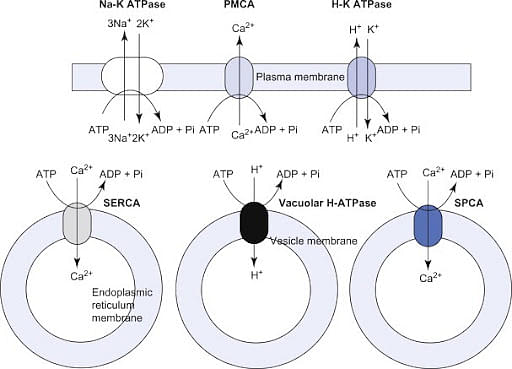
Primary Active Transport
Types of Primary Active Transporters
- P-ATPase: sodium-potassium pump, calcium pump, proton pump
- F-ATPase: mitochondrial ATP synthase, chloroplast ATP synthase
- V-ATPase: vacuolar ATPase
- ABC (ATP binding tape) Transporter: MDR, CFTR and so on.
-
Secondary Active Transport
Primary active transport creates electrochemical gradients that store energy that can be released as the ions descend their gradients. Secondary active transport harnesses the energy stored in these gradients to move other substances in the opposite direction of their own gradients.
Let's say the extracellular space contains a large concentration of sodium ions (thanks to the hard work of the sodium-potassium pump). If a pathway, such as a channel or a carrier protein, is open, sodium ions will move along their concentration gradient and return to the cell's interior.
The movement of sodium ions down their gradient is connected with the upward transport of other substances via a common carrier protein in secondary active transport (a cotransporter). A carrier protein, for example, sodium ions flow down their gradient while simultaneously bringing a glucose molecule up the gradient and into the cell. The sodium gradient fuels the carrier protein, which pushes glucose molecules forward.
Read About: Calcium Deficiency: Causes & Symptoms
Types of Secondary Active Transporters
The two molecules being transported may move in the same direction (i.e., both into the cell) or in different directions in secondary active transport (i.e., one into and one out of the cell). The protein that transports them is called a symporter when they travel in the same direction, and an antiporter when they move in opposite ways.
The sodium-calcium exchanger in cardiac muscle cell membranes is an example of an antiporter. The glucose symporter SGLT1 is located in the interior lining of the small intestine, the heart, the brain, and the S3 region of the proximal tubule in each nephron as an example of a symport mechanism.
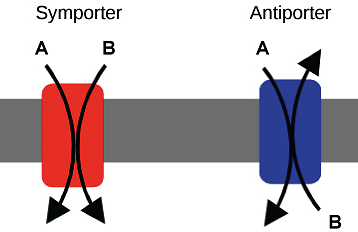
Secondary Active Transporter
Active Transport in Plant
[Click Here for Sample Questions]
Plants' roots, stems, and leaves have cells that are always working, even if they don't appear to be extremely busy. Minerals from the soil, carbohydrates from the sun, and water molecules must all pass through the plant's cell walls. Active transport occurs when energy (such as ATP) is required for the process to take place.
Plants use active transport in the following ways:
- Ions flow from the soil to the roots of plants
- Chloride and nitrate transport from the cytosol to the vacuole
- Photosynthesis sugars make their way from the leaves to the fruit.
- Calcium moves between cells with the use of ATP energy.
- Minerals pass via a stem on their way to different areas of the plant.
- Root pressure transports water from plant roots to other plant cells.
Electrochemical Gradient
Whenever there is a net contrast in the charges, electrochemical gradients can be found existing. A cell has both positive and negative charges that are separated by a membrane and where there are more negative charges present inside the cell than outside. The capacity of the cell membrane is between -40 to -80 millivolts.
The cell contains a high amount of potassium concentration within the cell but the concentration is less in case of sodium than the extracellular fluid. There is an inward flow of the sodium ions within the cell based on the concentration gradient and voltage present throughout the membrane.The voltage within the membrane helps potassium to move into the cell whereas the concentration gradient moves it out of the cell. Hence when the concentration gradient that helps in the movement of the ions and voltage within the cell membrane is combined it is called the electrochemical gradient.
Importance of Active Transport
[Click Here for Sample Questions]
Active transport is an important part for a variety of biological functions and is used in a lot of biological processes (e.g. proton gradient generation in chloroplasts and chemosynthesis in mitochondria). Plants use active transport when they absorb nutrients (such as chlorine and nitrates) from the soil into the vacuole. Active transport is used in numerous metabolic actions in humans and animals, such as glucose absorption. Proteins such as enzymes, peptide hormones, and antibodies are secreted by diverse cells. The White Blood Cells' function is to safeguard our bodies by attacking disease-causing bacteria and other outside intruders.
Points to Remember
- The process of transporting chemicals into, out of, and between cells using energy is known as active transport.
- Passive transport, which requires no energy, can be used to transfer substances in some instances. The cell, on the other hand, frequently has to move molecules against a concentration gradient. Active transportation is essential in these situations.
- Primary active transport, also known as direct active transport, uses metabolic energy to transfer molecules across a membrane.
- Secondary active transport, also known as coupled transport or cotransport, uses energy to transport particles across a membrane. Unlike primary active transport, however, there is no immediate coupling of ATP; instead, it relies on the electrochemical potential difference created by pumping particles in and out of the cell.
- Active transport always causes molecules and ions to accumulate on one side of the membrane. Membrane proteins carry out this way of transportation in plants, transporting the material from a lower concentration to a higher concentration.
Also Read:
Sample Questions
Ques. What mechanism is used to transmit energy from sodium ions to the sodium/glucose symporter? (2 Marks)
Ans. The "sodium/glucose symporter," also known as SGLT (sodium-glucose linked transporter), gets the energy it needs to transfer sodium and glucose from the sodium/potassium pump's electrochemical gradient. The SGLT is able to execute its function due to a difference in sodium concentration (between the inside and outside of the cell) and an electrical potential differential (between the inside and outside of the cell).
Ques. Explain the concept of Active Transport - Moving Against a Gradient. (2 Marks)
Ans. To move molecules against a concentration or electrochemical gradient, a cell must use energy. Active transport systems achieve this by spending energy in the form of ATP to keep ion and molecule concentrations in living cells in check. In fact, active transport systems require a significant amount of energy generated during metabolism. A red blood cell, for example, expends the majority of its energy to maintain internal sodium and potassium levels that differ from those in the surrounding environment.
Ques. How is a cell negatively charged if it contains more potassium ions? Isn't it supposed to be positively charged? (2 Marks)
Ans. Although there are more potassium ions in the cells, keep in mind that there are more sodium ions outside the cell (because two potassium ions enter the cell for every three sodium ions transferred out), resulting in a net positive charge outside the cell and a net negative charge inside the cell.
Ques. Why does the solute release energy as it diffuses along its concentration gradient? (1 Marks)
Ans. Because the movement of a solute along its concentration gradient is natural. Non-spontaneous activity (such as moving something against a concentration gradient) needs energy, whereas spontaneous activity releases it.
Ques. What are the two different types of active transportation? (2 Marks)
Ans. Active transportation can be divided into two categories:
- Primary (direct) active transport entails the direct application of metabolic energy (e.g., ATP hydrolysis) to transport.
- Secondary (indirect) active transport entails the coupling of one molecule to another that is travelling along an electrochemical gradient.
Ques. What is active transportation and what are some examples? (2 Marks)
Ans. The accumulation of large concentrations of substances that the cell requires, such as ions, glucose, and amino acids, is frequently accompanied by active transport. The uptake of glucose in the intestines of humans and the uptake of mineral ions into root hair cells of plants are both examples of active transport.
Ques. What is the difference between a Symporter and an Antiporter in Secondary Active Transport? (2 Marks)
Ans. In secondary active transport, the symporter and antiporter each have their unique purpose. Secondary active transport allows two molecules to flow in opposite directions (i.e., both entering the cell) or in the same direction (i.e., both leaving the cell) (i.e., one into and one out of the cell). The protein that transports them is known as a symporter when they travel in the same direction; when they travel in different ways, the protein is known as an antiporter.
Ques. What is the mechanism through which the sodium-potassium pump generates a membrane potential? (3 Marks)
Ans. The sodium-potassium pump establishes a voltage across the membrane in a very specific way. It's easy to establish a stoichiometric argument: for every three sodium ions that move out, only two potassium ions flow in, resulting in a more negative cell interior. While this charge ratio causes the cell's interior to become slightly more negative, it only accounts for a small portion of the sodium-potassium pump's effect on membrane potential.
Instead, the sodium-potassium pump works by accumulating a large concentration of potassium ions inside the cell, resulting in an extremely steep potassium concentration gradient. Despite an increasing negative charge on the interior, the gradient is steep enough for potassium ions to migrate out of the cell (through channels). This process is repeated until the voltage across the membrane is high enough to balance the potassium concentration gradient. The inside of the membrane is negative in relation to the exterior at this equilibrium point. This voltage will be maintained as long as the cell's K concentration is high, but it will vanish if K+ is not imported.



Comments