



Content Writer-SME
The difference between active and passive transport depends upon the transporting molecules that are transferred to the cell membrane. The cell is in charge of all of the actions that take place within our body. It is basically the fundamental unit of life. Chemicals, nutrients, and other substances are transported to other cells in the body via the transport system. This transport mechanism is classified into two types: active and passive transport.
- The difference between active and passive transport systems depends upon the forces of molecules against the concentration gradient, which is done with the help of ATP energy.
- A cell membrane is a multi-tasking component that gives the cell shape. It will also protect the cytosolic material from the outside environment.
- The phospholipid bilayer guides the passage of chemicals into and out of the cell. It allows the cell to maintain a delicate homeostasis state.
Difference between Active and Passive Transport
[Click Here for Sample Questions]
The difference between active and passive transport are as follows:
| Active Transport | Passive Transport |
|---|---|
| In active transport, ATP is required | In passive transport, no ATP is required |
| It flows from lower to the higher concentration gradient | It flows from higher to lower concentration gradient |
| Active transport involves the movement of all molecules, including complex carbohydrates, proteins, huge cells, ions, and so on. | Passive transport is commonly used to transfer soluble molecules such as water, oxygen, carbon dioxide, monosaccharides, lipids, and sex hormones. |
| It is involved in the movement of several substances within the cell. | It is involved in maintaining the cell's equilibrium level. |
| This is an energetic process | This is a physical process |
| It requires extremely selective transfusion | It requires partially nonselective transfusion |
| This is a quick Process | This is a moderately slow process |
| It occurs in one direction | It is bidirectional process |
| Active transport is affected by temperature | Passive transport is not affected by temperature |
| In this carrier proteins are involved in transportation. | In this carrier proteins are excluded in transportation. |
| As the oxygen content decreases, this procedure slows or stops. | The oxygen content does not affect this operation. |
| Metabolic inhibitors in active transport halt active transport. | In passive transportation, passive transport is unaffected by metabolic inhibitors. |
| Example: Endocytosis, exocytosis, cell membrane, or the sodium-potassium pump, are different types of Active Transport. | Example: Osmosis, diffusion, and facilitated diffusion are different types of Passive Transport |
Active Transport
[Click Here for Sample Questions]
Active transport transports molecules from the lower concentration gradient zone to the upper concentration gradient region. It is a unidirectional process; the molecules are pumped upward, necessitating the use of energy in the form of Adenosine triphosphate.
- Active transport is required to gather molecules like amino acids, glucose, and ions.
- The process takes place inside the cell in high concentrations.
- It requires energy to move cells inside and outside the system.
- Phagocytosis, sodium-potassium pump and pinocytosis are examples of active transport.
Types of Active Transport
Active transport aids in the movement of bigger cells and molecules such as proteins, lipids, carbohydrates, and so on. It is divided into two groups.
Primary Active Transport
The primary active transport identifies the material to be carried with the help of the proteins present in the transmembrane. It then pumps these molecules to their specific location utilizing chemical energy ATP.
- In this process, the transmembrane proteins on the cell membrane identify the cell's need for extracellular fluid.
- It pumps the molecules to be transferred.
- The hydrolysis of ATP provides the energy for the molecules' movement.
- As a result, three sodium ions are forced out of the cell, and two potassium ions are pushed in.
- The sodium/potassium pump, for example, is carried by an active primary transport pathway.
Secondary Active Transport
Secondary active transport, which is aided by pore-forming proteins, helps in the movement of ions. Channels are generated in the cell membrane during this process using an electromagnetic gradient.
- It aids in the movement of additional molecules against the concentration gradient.
- This gradient is referred to as cotransporters.
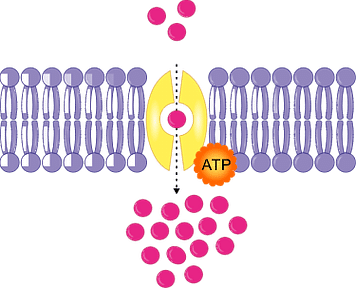
Active Transport
Read More:
| Related Topics | ||
|---|---|---|
| Nerve Impulse | Synapse | Receptors |
| Hypothalamus | Corpora Quadrigemina | Paralysis Symptoms |
Passive Transport
[Click Here for Sample Questions]
Passive transport involves molecules which are transferred from the higher concentration gradient region to the lower concentration gradient region. The molecules in this process are bi-directional.
- Due to the lack of resistance, the molecules go downhill, and there is no need for energy.
- The primary goal of passive transport is to maintain concentration equilibrium.
- This transportation is present in the body's liver, kidneys, and lungs.
It keeps the cell in balance. Wastes such as carbon dioxide and water are diffused out and expelled, while nutrients and oxygen diffuse in and are utilized by the cell.
- It also permits the cytosol and extracellular fluid to maintain a delicate equilibrium.
- Osmosis, diffusion and facilitated diffusion are examples of passive transport.
Types of Passive Transport
Passive transport is further classified into four categories;
Osmosis
Water and other molecules or substances are transported through the selectively permeable cell membrane during the osmosis process. Numerous factors influence this kind of transportation.
- One of the most important aspects is that the cell has a lower negative water potential.
- Other factors include a molecule's solute potential and the pressure potential of the cell membrane.
Simple Diffusion
Simple diffusion is the process of transfer of a molecule of solute through a permeable membrane. Non-polar molecules primarily use simple diffusion.
- The distance between molecules should be kept as short as possible to ensure a better flow of molecules.
Facilitated Diffusion
Facilitated diffusion is the natural passive movement of molecules or ions across the cell membrane via the specific-trans membrane of integral proteins.
- The molecules, which are large and insoluble, require a carrier molecule to transfer them over the plasma membrane.
- This process does not necessitate the use of any cellular or external energy.
Filtration
The human body's cardiovascular system (CVS) generates hydrostatic pressure, which allows water and other soluble biochemical molecules or substances to pass across the cell membrane. This process is known as filtration.
- The process only requires the cell membrane to allow soluble molecules to flow easily through the membrane's hole.

Passive Transport
Things to Remember
- In layman's terms, active and passive transport are two fundamental biological processes.
- The system helps in giving nutrients, water, oxygen, and other vitals to cells as well as eliminating waste materials.
- Both the transport system transfer work for the same reason, but in opposite ways.
- ATP is employed as an energy source in main active transport.
- The primary distinction between active and passive transport involves transferring molecules across the membrane.
- Active transport necessitates the movement of molecules, whereas passive transport does not necessitate the movement of molecules.
- The principle of active transport governs glucose uptake in the human gut.
- Passive transport is exemplified by simple diffusion, enhanced diffusion, osmosis, and filtration.
- The electrochemical gradient is employed to transport molecules across the membrane in secondary active transport.
Sample Questions
Ques. What distinguishes active transport from passive transport? (2 marks)
Ans. Active transport uses energy in the form of ATP to transfer molecules and ions from low concentration to high concentration. Passive transport, on the other hand, transfers molecules and ions from a higher concentration to a lower concentration without using any energy.
Ques. What role does ATP play in active transport? (2 marks)
Ans. ATP hydrolysis provides energy for molecules and ions to travel across a concentration gradient. Molecules travel either into the cells (endocytosis) or outside the cells (exocytosis) (exocytosis).
Ques. What is the difference between active and passive transportation? (2 marks)
Ans. Ion and molecule entry and departure in a cell are controlled by active and passive transport. These procedures allow only specified elements to pass past the cell membrane on their own. To pass through the membrane, the rest require a carrier.
Ques. What are the two prerequisites for active transportation? (2 marks)
Ans. Active transport necessitates the use of cellular energy in order to move. Active transport is classified into two types: primary active transport, which employs adenosine triphosphate (ATP), and secondary active transport, which uses an electrochemical gradient.
Ques. What are the prerequisites for passive transport? (2 marks)
Ans. Lipid diffusion (simple diffusion) Because chemicals can move freely across the membrane-based solely on a favourable concentration gradient, passive transport requires no energy input.
Ques. What is the difference between primary and secondary active transport? (3 marks)
Ans. The difference between primary and secondary active transport are as follows:
| Primary Active Transport | Secondary Active Transport |
|---|---|
| Primary active transport involves transportation of molecules against concentration gradient. | Secondary active transport involves transportation of molecules with the concentration gradient. |
| In this only single molecule is transported. | In this two molecules are transported. |
| Example: Sodium potassium pump | Example: Glucose sodium pump |
Ques. What is the function of active and passive transport system? (4 marks)
Ans. Active and passive transport systems are used to move molecules across the cell membrane. A cell membrane is a multi-tasking component that gives the cell shape while also protecting the cytosolic material from the outside environment.
- The phospholipid bilayer guides the passage of chemicals into and out of the cell, allowing the cell to maintain a delicate homeostasis state.
- The phospholipid bilayer is semi-permeable, allowing certain molecules to freely traverse the membrane through a concentration channel, while others utilize unique structures to transit the membrane and consume cellular energy to do so.
- The exterior layer is composed of phospholipid bilayers, which maintain the cell's homeostasis and regulate the admission of materials.
Ques. What is simple diffusion? (2 marks)
Ans. The transfer of a molecule of solute through a permeable membrane is known as simple diffusion in the process of simple diffusion. Non-polar molecules primarily use simple diffusion; therefore, the distance between molecules should be kept as short as possible to ensure a better flow of molecules.
Ques. What is Exocytosis? (3 marks)
Ans. Exocytosis drives molecules out of the cell, serving a counter-function. By ensuring that the quantity of molecules entering a cell through endocytosis equals the number of molecules leaving a cell through exocytosis, the process of homeostasis promotes an equal flow of molecules into and out of a cell. Both procedures guarantee that nutrients and wastes are in balance to support the cells' normal operations.
Ques. What are different typs of primary active transporters? (2 marks)
Ans. The different types of primary active transporters are as follows:
- P-ATPase: It include sodium-potassium pump, proton pump and calcium pump.
- F-ATPase: It include mitochondrial ATP synthase and chloroplast ATP synthase.
- V-ATPase: It include vacuolar ATPase.
- ABC (ATP binding tape) Transporter: It include MDR and CFTR.
Ques. What is the importance of active transport? (3 marks)
Ans. Active transport plays a crucial role in many biological processes and functions, such as the production of proton gradients in chloroplasts and chemosynthesis in mitochondria.
- When nutrients (such nitrates and chlorine) are taken up by plants and placed inside their vacuoles, they do so through active transport.
- Many metabolic processes in both humans and animals, including the absorption of glucose, depend on active transport.
- Many types of cells release proteins, including enzymes, peptide hormones, and antibodies.
- The process of white blood cells is to protect our bodies from external invaders and disease-causing microorganisms.



Comments