



Education Journalist | Study Abroad Lead
Air Resistance Formula aims at measuring the force of air resistance which is implied by the air on the objects or bodies moving against it. In simple words, air resistance is defined as the resistance created by the air or say, the obstruction created by air that hampers the speed of bodies moving across it. Air resistance is produced by the air in the opposite direction to that of the movement of the body. For instance, aeroplanes take their flight in the troposphere, however, the presence of air reduces their speed. In this article, we will discuss the air resistance, the formula of air resistance and the other important details of the same.
| Table of Content |
Key Terms: Air Resistance, Atmosphere, Force, Air, Movement, Speed, Wind Direction, Troposphere, SI Unit, Newton, Aeronautics, Motion, Velocity
What is Air Resistance?
[Click Here for Sample Questions]
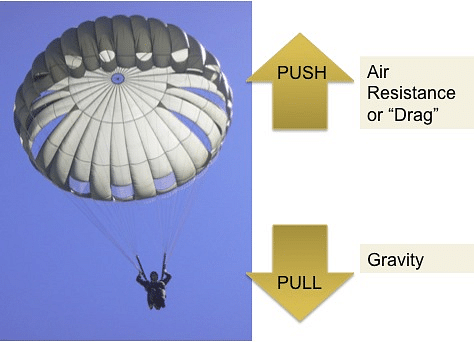
Air Resistance is a force acting upon anybody that moves across the air. It can be defined as the force of friction that acts upon an object, reducing its speed of movement. Air resistance is produced by the air in the opposite direction to that of the movement of the body.
For instance, aeroplanes are known to have a streamlined shape body which helps them to cut through the air, reducing the frictional force. It has been said that the best pilots always take their flights along with the jet streams which are the most powerful upper circulations. These jet streams allow the pilot to exert the least effort and in turn generate the maximum speed. However, these jet streams may prove to be helpful only if the direction of the winds is the same as the direction of movement of the aeroplane, otherwise, it may generate air resistance in the opposite direction.
Air Resistance
Read More: Kinematics equations
What is Air Resistance Formula?
[Click Here for Sample Questions]
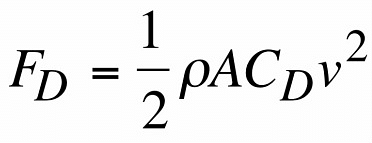
Air resistance, also known as ‘drag’ in Physics, depends upon various factors such as air density, area of the body, its velocity and the drag coefficient, which involves other prevailing conditions like roughness or turbulence. The SI unit for this force of air resistance is Newton.
The formula for calculating the air resistance is widely used in the field of aeronautics for calculations and applications. The formula is as follows.
Air Resistance = (constant k) (velocity)2 = (air density) (drag) (area) / 2 * (velocity)2
F = kv2 = ρCDA / 2 * (v2)
Here,
- F = force of air resistance
- k = a constant of density, drag, and area (kg/m)
- v = velocity of the moving object (m/s)
- ρ = density of the air the object moves through (kg/m3)
- CD = the drag coefficient
- A = area of the object (m2)
Air Resistance Formula Used in Aeronautics
F = - cv2
Here,
- F = the force of air resistance
- c = the force constant
- v = the velocity of the object
The negative sign denotes the opposite direction of the air resistance to that of the direction of the motion of the object.

Air Resistance Formula
Read More: Frames of Reference
Solved Examples
[Click Here for Sample Questions]
Example 1: Find the air resistance if the velocity of a plane is 40 ms-1 and the force constant is 0. 05.
Solution: Given,
Velocity of air, v = 40 ms-1,
Force constant, c = 0.05
The air resistance =
F = – cv2
F = 0. 05 × 1600
F = – 80 N
Example 2: The velocity of an aeroplane flying at an altitude is 250 m/s and the air density is 0.4500 kg/m3. The area of the aeroplane's wings facing the wind is 500 m2. The drag coefficient is 0.025. Calculate the force of air resistance acting on the aeroplane.
Solution: The force of air resistance can be calculated as,
F = PcDA / 2 * (v2)
F (0. 4500 kg/m3) (0.025) (500 m2) / 2 (250 m/s)2
F = 168750 N
Therefore, the force of air resistance acting on the aeroplane is 168750 N.
Example 3: Find the force constant if the velocity of a plane is 20 ms-1 and the force of air resistance acting upon it is 50N.
Solution: Given,
Velocity of air, v = 20 ms-1
The air resistance = 50N
Force constant = F = – cv2
C = F / v2
c = 50 / 202
c = 0.125
Read More: Velocity
Things to Remember
- Air resistance is simply understood as a force or drag which creates restrictions in the movement of an object or body and reduces its velocity by working in the opposite direction.
- There is an inverse relationship between the movement of the body and the force of resistance acting upon it.
- Generally, this resistance or friction is avoided by the pilots during their flights due to which they try to fly in the tropopause.
- Air resistance formula helps in defining the velocity of the body and the force acting upon the body to help the applicant in determining the levels of safety while flying.
- This air resistance force also acts upon other objects or bodies such as motors, bikes, trucks, cars, etc. on road.
Sample Questions
Ques. What is the air resistance acting on a car with a velocity of 250 m/s and the air density is 0.4500 kg/m3? The area of the car is 500 m2. The drag coefficient is 0. 025. (3 Marks)
Ans. The force of air resistance can be calculated as,
F = PcDA / 2 (v2)
F (0. 4500 kg/m3) (0.025) (500 m2) / 2 (250 m/s)2
F = 168750 N
Therefore, the force of air resistance acting on the car is 168750 N.
Ques. What can be the air resistance if the velocity of a plane is 25 ms-1 and the force constant is 0. 05.(3 Marks)
Ans. Given,
Velocity of air, v = 25 ms-1,
Force constant, c = 0.05
The air resistance =
F = – cv2
F = 0. 05 × 625
F = – 31. 25 N
Ques. A toy van is moving with a velocity of 250 m/s and the air density is 0.4500 kg/m3. The area of the car is 500 m2. Find the air resistance acting on it if the drag coefficient is 0. 025. (3 Marks)
Ans. The force of air resistance can be calculated as,
F = PcDA / 2 (v2)
F (0. 4500 kg/m3) (0.025) (500 m2) / 2 (250 m/s)2
F = 168750 N
Therefore, the force of air resistance acting on the car is 168750 N.
Ques. What can be the air resistance if the velocity of a plane is 15 ms-1 and the force constant is 0. 05. (3 Marks)
Ans. Given,
Velocity of air, v = 15 ms-1,
Force constant, c = 0.05
The air resistance =
F = – cv2
F = 0. 05 × 225
F = – 11. 25 N
Ques. Calculate the velocity of a truck if the air resistance is – 31.25N and the force constant is 0. 05. (3 Marks)
Ans. Given,
Force constant, c = 0.05
The air resistance = - 31. 25N
F = – cv2
C = f / v2
V = 25 ms-1
Ques. What is the drag coefficient acting on a plane with the velocity and resistance of 250 m/s and 168750 N respectively? The air density is 0.4500 kg/m3. The area of the car is 500 m2. (3 Marks)
Ans. The force of air resistance can be calculated as,
Let x be drag coefficient
F = PcDA / 2 (v2)
168750 N = (0. 4500 kg/m3) (x) (500 m2) / 2 (250 m/s)2
x = 0. 025
Therefore, the drag coefficient acting on the plane is 0. 025.
Ques. Find the air resistance if the velocity of a bike is 50 ms-1 and the force constant is 0. 05. (3 Marks)
Ans. Given,
Velocity of air, v = 50 ms-1,
Force constant, c = 0.05
The air resistance =
F = – cv2
F = 0. 05 × 2500
F = – 125 N
Check More:



Comments