



Education Journalist | Study Abroad Lead
Electrical resistance is the obstruction offered by the conductor to the electric current that flows through it in an electrical circuit. Every material has an electrical resistance due to which the conductors give out heat when current passes through it. Electrical resistance is denoted by R and is measured in Ohms, symbolized by the Greek letter omega (Ω). The larger the resistance, the greater the obstruction against the flow of current.
The current flows through a circuit when a potential difference is applied to the conductor. When the free electrons start moving, they collide with the atoms and molecules of the conductor. Due to this collision, an obstruction is created for the electric current. This opposition to the flow of electric current is known as electrical resistance.
Read Also: Uses of Resistor
Key Terms: Ohm, resistivity, resistor, resistance in series and parallel, electrical circuit, electrical resistance, electric current.
What is Electrical Resistance?
[Click Here for Sample Questions]
Electrical resistance is any obstruction in the path of the flow of the electric current. The resistance provided by a conducting material against the current flowing through it depends on the nature of the material itself and temperature.
- On the application of potential difference, an electric field is set up, and the electrons of the material get accelerated and start moving.
- These free electrons collide with the ions and atoms and their motion gets opposed.
- This electrical resistance also causes the conductor to heat up.
| V ∝ I V = IR |
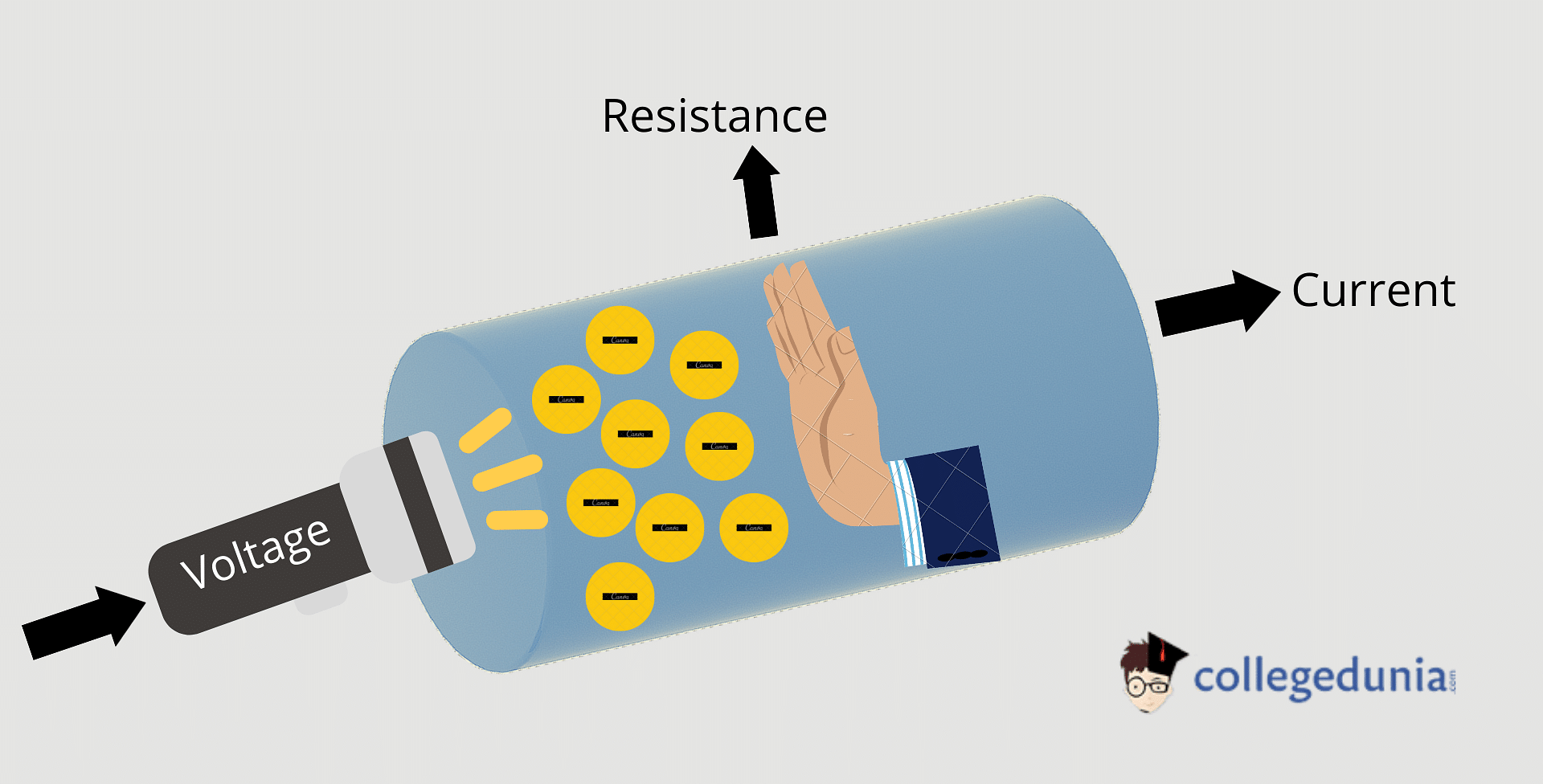
Illustration of Electrical Resistance
If a potential of 1 volt is applied across a conductor and if a current of 1 ampere flows through it, the resistance of the conductor is said to be one ohm.
All materials resist the flow of current to some extent. On the basis of their flow the materials can be classified as:
- Conductors: Materials that offer very little resistance are known as conductors. Electrons in conductors can move easily. Examples: silver, gold, copper, and aluminum.
- Insulators: Materials that offer high resistance and thereby restrict the flow of electrons are known as insulators. Examples: Rubber, glass, paper, wood, and plastic.
Electrical Resistance Symbol
Electrical resistance is defined by the most fundamental law of electricity i.e. Ohm’s Law. Ohm’s law helps in calculating the electrical resistance through a mathematical formula provided that the physical conditions remain unchanged. The most common symbol to denote a resistor is a zig-zag line.

Symbol of a Resistor
Read more:
Factors Affecting Electrical Resistance
[Click Here for Previous Year Questions]
Electrical resistance depends on the following factors –
- Length of the conductor: Electrical resistance is directly proportional to the length of the metallic conductor. i.e. R \(\propto\) L
- Cross-sectional area: Electrical resistance is inversely proportional to the cross-sectional area of the metallic conductor, i.e. R \(\propto\) 1/A . A denotes the cross-sectional area of the metal conductor. On the basis of the above two relations, electrical resistance can be represented as,
| R = \(\frac{\rho}{LA}\) |
Where \(\rho \) → Resistivity
- Nature of the material: The property of electrical resistance is dependent on the intrinsic qualities of the conducting material. Conductors like Aluminium, Gold have very low resistance. Insulators like wax, rubber, glass, etc have very high resistance to the flow of charge.
- Temperature of the conductor: Electrical resistance depends on the temperature of the conducting material. As the conductor gets heated, the thermal energy of the ions increases and they start moving vigorously. This results in more impedance in the path of the current.
Temperature dependence of resistance can be given as:
| R2 = R1 [1 + \(\alpha\) (T2 - T1) ] |
Where,
- R1 and R2 → Resistances at T1 and T2 temperatures respectively
- \(\alpha\) → Temperature coefficient
Read More: CBSE Class 12 PCMB Notes
Ohm’s Law
[Click Here for Sample Questions]
Ohm’s law states that if the physical conditions like temperature and length of the conductor, etc, are kept unchanged, then the current flowing across the conductor will be directly proportional to the applied potential difference.
The basic formula for resistance is:
- The relationship between Resistance, Voltage, and Current (Ohm’s Law)
- The relationship between Resistance, Power, and Voltage
- The relationship between Resistance, Power, and Current
Mathematically Ohm’s Law can be represented as,
| V ∝ I or V = RI |
Where,
- V → Potential difference (voltage)
- I → Current
- R → Electrical Resistance (constant of proportionality)
Ohms Law Explained
Ohms law video
Graphically Ohm’s law can be presented as:

Graphical representation of ohm’s law
Thus, from the Ohm’s law expression, we can mathematically represent Resistance as,
| R = V/I |
It is clear from the expression that Resistance is inversely related to electric current, which means if we increase the resistance, the current reduces.

Ohm's law pyramid
Electrical resistance is measured in ohm. It is denoted by the symbol \(\Omega\) . One \(\Omega\) resistance is said to be offered by the conductor if 1-ampere current passes through a potential difference of 1 volt across the conductor.
Hence,
| 1\(\Omega\) = 1 Volt/ 1 Ampere |
Relation between Electrical Resistance, Power, and Voltage
Power is the product of supply voltage and electric current.
P = V x I
Putting I = V/R in the equation, we get
P = V2/R
R = V2/P \(\Omega\)
Relationship between Resistance, Power, and Current
As P = V x I
Putting V = IR in the equation, we get
P = I2R
R = P/I2\(\Omega\)
Limitations of The Ohm’s Law
Ohm’s law has many exceptions. In cases of semiconductor and p-n junction diodes, the law fails to explain the non-linear relationship between current and potential difference.
- Ohm’s law shows a linear relation between V and I for metallic conductors. However, in most cases, the graph follows a curved path. This is because of the heating effect of the current. So when the temperature rises, resistance in the conductor also increases.
- For semiconductors and p-n junction diodes, the V-I relation is different and depends on the sign of applied potential difference.
Read More: Electrostatic Potential
What is Resistivity?
[Click Here for Previous Year Questions]
If we take a conducting wire of unit length and unit cross-sectional area, then the resistance provided by this wire will be called specific resistance or in simple words, resistivity. Similar to resistance, resistivity is directly proportional to the length of the metallic wire and inversely proportional to the wire’s cross-sectional area. It is denoted by the symbol \(\rho\).
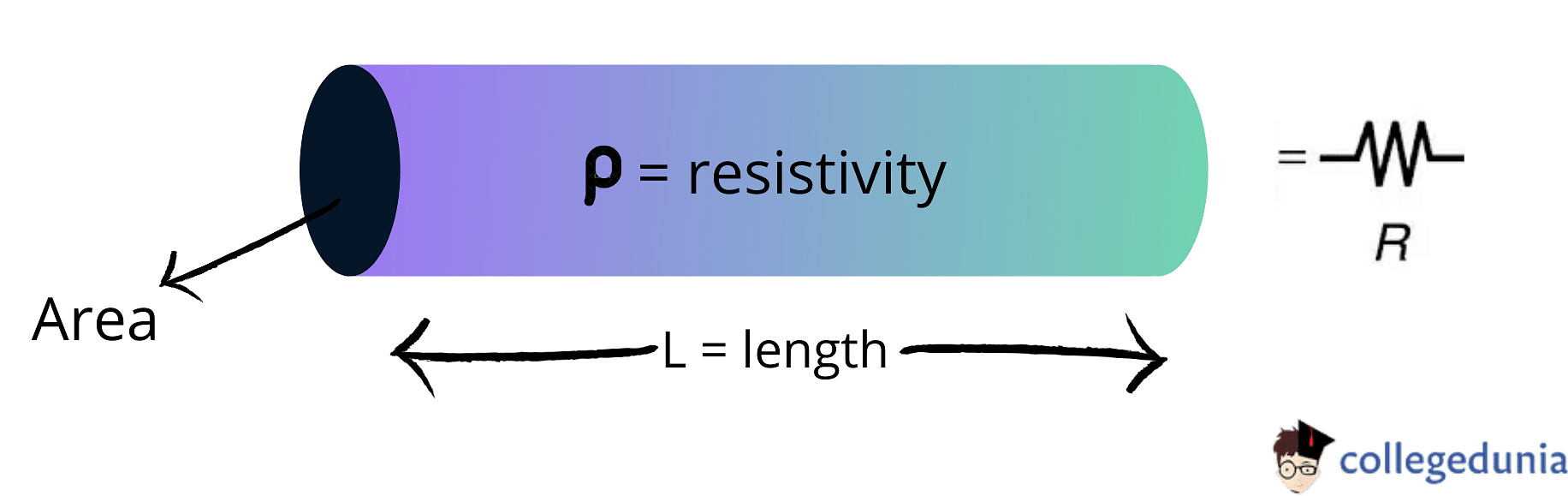
Resistivity
We already know,
R = \(\frac{\rho}{LA}\)
Hence,
\(\rho \) = \(\frac{RA}{L}\)
Putting unit cross-sectional area and unit length in the expression above, we get,
\(\rho \) = R
Electrical resistivity or specific resistance is measured in ohm-meter (\(\Omega\)m).
The resistivity of different classes of substances is shown in the table below:
| Conductors | Resistivity (\(\Omega\)m) |
|---|---|
| Silver | 1.6 X 10⁻⁸ |
| Copper | 1.7 X 10⁻⁸ |
| Aluminium | 2.7 X 10⁻⁸ |
| Iron | 10 X 10-8 |
| Alloys | Resistivity (\(\Omega\)m) |
| Manganin | 48 X 10-8 |
| Nichrome | 49 X 10-8 |
| Constantan | 100X 10-8 |
| Semiconductors | Resistivity (\(\Omega\)m) |
| Carbon | 3.5 X 10⁻⁵ |
| Germanium | 0.46 |
| Silicon | 2300 |
| Insulators | Resistivity (\(\Omega\)m) |
| Pure water | 2.5 X 10⁵ |
| Glass | 1010 to 1014 |
| Rubber | 1013 to 1016 |
Read More: Ampere’s Circuital law
Difference between Resistance and Resistivity
[Click Here for Sample Questions]
The differences between resistance and resistivity are tabulated below.
| Resistance (\(\Omega\)) | Resistivity (\(\Omega\)m) |
|---|---|
| Electrical Resistance is the opposition to the flow of current in a metallic conductor. | Resistivity or specific resistance is the resistance offered against the current flow by a conductor of unit cross-section and unit length. |
| SI unit of resistance is ohm (\(\Omega\)) | SI unit of resistivity is ohm-meter (\(\Omega\)m) |
| Resistance is represented by the symbol R. | Resistivity is denoted by the symbol \(\rho \) |
| The property of resistance is used in several places like heaters, fuses, stabilizers, etc. | The electrical resistivity measurement concept is used as a quality control test for calcareous soil. |
| Electric Resistance Formula: R =\(\frac{V}{I}\) or R =\(\frac{\rho}{LA}\) | Resistivity Formula: \(\rho \)= RAL or \(\rho \) = E where E = electric field and J = current density |
| Temperature dependence of resistance can be shown as R2 = R1 (1 + \(\alpha\)(T2 - T1) ) | Temperature dependence of resistivity can be shown as \(\rho \)= \(\rho \)0 (1 +\(\alpha\theta\)) |
Discover about the Chapter video:
Current Electricity Detailed Video Explanation:
Things To Remember
- Electrical resistance is the obstruction in the path of the flow of the electric current.
- Ohm’s law states that if the physical conditions are kept unchanged then the current flowing across the conductor will be directly proportional to the applied potential difference.
- Resistivity or specific resistance is the resistance offered against the current flow by a conductor of unit cross-section and unit length.
- Temperature dependence of resistance can be shown as R2 = R1 (1 + \(\alpha\)(T2 - T1) )
- The free electrons which are present in the conducting material are responsible for the conduction of electric current.
- The resistivity of a material is inversely proportional to the number of free electrons present per unit volume.
- The phenomenon under which a substance loses all its resistance, when it is at its critical temperature is called superconductivity.
- Alloys have a very weak dependence on temperature and they have a high resistivity.
Also check:
Previous Years Questions
- If now we hav.e to change the null point at 9th wire, what should we do?… [ DUET 2007 ]
- The electrical permittivity and magnetic permeability of free space are… [ DUET 2003 ]
- Just after key K is pressed to complete the circuit, the reading will be …. [ KEAM 1999 ]
- The resistance between any two terminals is when connected in a triangle is…. [ NEET 1993 ]
- potential drop through 4Ω resistor is… [ NEET 1993 ]
- The potential difference per unit length of the wire will be… [ NEET 1999 ]
- Value of R for which the power delivered in it is maximum is given by... [ NEET 1992 ]
- If power dissipated in the 9Ω resistor in the circuit shown is 36 watt, the potential difference…? [NEET 2011]
- If voltage across a bulb rated 220V- 100W drops by 2.5% of its rated value, the percentage of…? [NEET 2012]
- In the circuit shown below, the current in the 1Ω resistor is…? [NEET 1988]
- In the network shown in the figure, each of the resistance is equal to…? [NEET 1995]
- Kirchhoff's first and second laws of electrical circuits are consequences of…? [NEET 2006]
- Two wires of the same metal have same length, but their cross-sections are in the ratio…? [NEET 1995]
- In the following network potential at ′O′….[KCET 2016]
- Column - I gives certain physical terms associated with flow of current through a metallic conductor. Column - II gives…?
- For a cell terminal potential difference is 2.2 V when circuit is open and reduces to 1.8 V when…?
Sample Questions
Ques. State Ohm’s law. Give a few cases where the law fails. (3 marks)
Ans. Ohm’s law states that if the physical conditions like temperature, mechanical strain, length of the conductor etc are kept unchanged then the current flowing across the conductor will be directly proportional to the applied potential difference. Mathematically it is represented as :
V \(\propto\) I or V = RI
V = Potential difference (voltage)
I = Current
R= Resistance (constant of proportionality)
The following cases illustrate the failure of Ohm’s law:
- Ohm’s law shows a linear relation between V and I for metallic conductors. However, in most cases, the graph follows a curved path. This is because of the heating effect of the current. So when the temperature rises, resistance in the conductor also increases. This can only be represented correctly by a curve.
- For semiconductors and p-n junction diodes, the V-I relation is different and depends on the sign of applied potential difference.
Ques. What is meant by electric current? Name and define its SI unit. What is the direction of conventional current in a conductor where electrons flow from B to A? Give justification for your answer. (3 marks)
Ans. Electric Current is the amount of charge ‘Q’ flowing through a particular area of a cross-section in unit time ‘t’, i.e.
Electric current, I = Q/t
The SI unit of electric current is Ampere. One ampere of current is that current which flows when one coulomb of electric charge flows through a particular area of cross-section of the conductor in one second, i.e.
1A = 1 Cs-1.
If the electron flow is from B to A then the conventional current flows from A to B. This is because the conventional current is the flow of positive charge i.e movement of charge from higher potential to a lower potential. In metals free electrons carry current. So electron movement is opposite to the movement of conventional charge.
Ques. A battery of 100 Volts connected to a material induces a current of 0 milliamperes in the conductor. Find the resistance of the conductor. (2 marks)
Ans. The resistance of conductor is given by the relation,
R = V/I
Given:
V = 20V
I = 0mA = 0 A
Putting the values in the relation,
R = V/I
⇒ R = (20)/(0)
The resistance is closest to infinity, which means the material is an insulator.
Ques. A wire carries a current of 1.2 A when a potential difference of 1.8 Volt is applied across it. What is its conductance? If the wire is of length 3 m and the area of cross-section 5.4 * 10-6 m2, calculate its conductivity. (2 marks)
Ans. Here,
V = 1.8 V ; I = 1.2 A ;
L= 3m ; Area of cross section = 5.4 * 10-6 m2 .
The resistance of the wire is given as : R = V/I = 1.8/1.2 = 1.5 ohm
So conductance = (resistance)-1 = 1/R = 0.67 Siemen
We know for conductivity :
\(\sigma\) = length/(R*A) = 3 / (1.5 * 5.4 * 10-6) = 3.7 * 105 Sm-1
Ques. A battery of 20 Volts connected to a conductor induces a current of 50mA in the conductor. Find the resistance of the conductor. (2 marks)
Ans. The resistance of a conductor is given by the relation,
R = V/I
Given:
V = 20V
I = 50mA = 0.05 A
Plugging in the values inside the relation,
R = V/I
⇒ R = (20)/(0.05)
⇒ R= 400 Ohms.
Ques. Define the term electrical conductivity. Write its SI unit. (CBSE 2014) (2 marks)
Ans. Denoted by \(\sigma\), conductivity is the reciprocal of resistivity. It can be expressed as
\(\sigma\) =\(\frac{j}{E}\)
The SI unit of conductivity is ( ohm-1metre-1 ) or (\(\Omega\)m)-1
Ques. The given figure shows a piece of pure semiconductor S in series with a variable resistor R and a source of constant voltage V . Would you increase or decrease the value of resistance R To keep the reading of the ammeter(A) constant, When the semiconductor S is heated? Give reasons. (2 marks)

Ans.
We know that the resistance of a semiconductor decreases with an increase in temperature. So to keep the reading of the ammeter unchanged or constant the total resistance in the circuit must remain unchanged.
Therefore to keep the ammeter reading constantly while the semiconductor is heated, the value of R which is the resistance in the resistor will have to be increased.
Ques. If a copper wire is stretched to make it 0.1% longer, Then what is the percentage change in the resistance of the copper wire? (3 marks)
Ans. Let \(\rho \) be the resistivity of the wire. Further, suppose that the initial length and area of the cross-section of the wire are l1 and A1 respectively.
On stretching the wire by 0.1 % the values of length and cross-section area become l2 and A2 respectively.
Now if R1 and R2 are the resistances of the wires in the two cases, then,
R1 = \(\rho \) ( l1/ A1) and R2 =\(\rho \) (l2 / A2)
Since the volume of the wire must remain constant after the elongation, so we can write :
A1l1 = A2l2
A2 = (A1l1) / l2
Therefore R2 =\(\rho \) * (\(\frac{(1_2)^2}{A_1I_1}\))
As the wire has been stretched by 0.1 %
l2 = l1 * \(\frac{100.1}{100}\) ; So substituting the value of l2 in the expression for R2 we get R2 = 1.002 R1.
Therefore percentage % increase in the resistance of the wire = \(\frac{R_2 -R_1}{R_1}\) * 100
\(\frac{1.002R_1 -R_1}{R_1}\) * 100 = 0.2 %.
Ques. Explain the factors affecting the electrical resistance of a metallic conductor. (5 marks)
Ans. The factors affecting the electrical resistance of a metallic conductor are discussed below:
Length of the conductor: Electrical resistance is directly proportional to the length of the
metallic conductor i.e. R \(\propto\)L .
Cross-sectional area: Electrical resistance is inversely proportional to the cross-sectional area of the metallic conductor. i.e R\(\propto\) 1A . A denotes the cross-sectional area of the metal conductor. On the basis of the above two relations, electrical resistance can be represented as
R =\(\frac{\rho}{LA} \), \(\rho \) denotes resistivity.
Nature of the material: The property of electrical resistance is dependent on the intrinsic
qualities of the conducting material. Conductors like Aluminium, Gold have very low resistance. Insulators like wax, rubber, glass, etc have very high resistance to the flow of charge.
Temperature of the conductor: Electrical resistance depends on the temperature of the conducting material. As the conductor gets heated, the thermal energy of the ions increases and they start moving vigorously. This results in more impedance in the current’s path.
Temperature dependence of resistance can be given as :
R2 = R1 (1 + \(\alpha \)(T2 - T1) )
R1 and R2 are resistances at T1 and T2 temperatures respectively. \(\alpha\)denotes the temperature coefficient.
Ques. Four resistors of 12 ohms each are connected in parallel. Three such combinations are connected in series. Find the total resistance in the circuit. If a battery of 9-volt emf and negligible internal resistance is connected across the network of resistors, then find the current flowing through each resistor. (3 marks)

Ans.
Let I be the total current in the circuit. If R’ is the effective resistance of the 4 resistors connected in parallel of 12 \(\Omega\) each, then
1/R’ = (1/12) +(1/12) +(1/12) +(1/12)
Or R’ = 3 \(\Omega\)
Therefore the effective resistance of the entire circuit network R = R’ + R’ + R’ = 3R’ = 9\(\Omega\)
The current of the circuit , I = E/R = 9/9 = 1 Ampere .
Since all the four resistors are of the same resistance, the same current will pass through each resistor. Therefore the current through each resistor. Therefore the current through each resistor
I’ = ¼ I = 0.25 Ampere
Ques. Three resistors of 3\(\Omega\), 4\(\Omega\) and 6\(\Omega\) are connected in parallel. The combination is connected to a cell of emf 2 V and internal resistance of \(\frac{2}{3}\) \(\Omega\). Find the current drawn through the cell and the current drawn through the 3\(\Omega\) resistor. (3 marks)
Ans. The resistors 3\(\Omega\), 4\(\Omega\) and 6\(\Omega\) are connected in parallel across the emf of 2 V.

Let Rp the effective resistance of the parallel combination of 3\(\Omega\), 4\(\Omega\) and 6\(\Omega\).
Then , 1/Rp = 1/3 +1/4 +1/6 = 9/12 Therefore Rp = 4/3 \(\Omega\)
Total resistance of the circuit , R = RP + r = 4/3 + \(\frac{2}{3}\) = 2\(\Omega\)
Therefore the current in the circuit is :
I = E/R = 2/2 = 1 Ampere.
Now the potential difference across the parallel combination = I * RP = 1 * 4/3 = 4/3 V
As the potential difference across all the 3 resistors is the same = 4/3 V.
Therefore the current through the 3\(\Omega\) resistor = (4/3) / 3 = 4/9 Ampere.
Ques. A wire of resistance 5\(\Omega\) is drawn out so that its length is increased to twice its original length. Calculate its new resistance. (3 marks)
Ans. Let l be the length, A be the area of cross-section of the wire and \(\rho \) be the resistivity of the material
Then R =\(\frac{\rho}{LA} \)
Suppose when the length of the wire gets doubled it becomes 2l = l’
Its area of cross-section becomes A’
As the volume of the wire must remain constant after elongation
Therefore Al = A’l’
A’ = (Al) / (2l) = A/2
Let R’ be the new resistance of the wire. Then,
R’ = \(\frac{\rho}{L'A'}\)' = 4 \(\frac{\rho}{LA} \)
Comparing the equations for R and R’ we get R’ = 4R = 4*5 = 20 \(\Omega\)
Ques. What happens to the resistance of insulators if the temperature is increased? (3 marks)
Ans. The resistance of insulators decreases as the temperature increases. This is due to the electron movement from the conduction band to the valence band increases as the energy gap between these two bands is large. Therefore, conductance increases and the resistance decreases.
Ques. What happens to the resistance of pure metals with an increase in temperature? (2 marks)
Ans. As the temperature increases, the resistance of pure metals also increase. This is due to the increase in the number of electrons in the conduction band which reduces the mobility thereby increasing the resistance.
Ques. A 2.55 kΩ resistor and a 2.15 μF capacitor are connected in series across a 41.5-Hz AC generator. What is the impedance of the circuit? (4 Marks)
Ans. We are given:
- The value of the resistance of the resistor is R=2.55 kΩ=2.55×10³ Ω.
- The value of the capacitance of the capacitor is C=2.15 μ F=2.15×10⁻⁶ F.
- The value of the frequency of the generator is f=41.5 Hz.
The formula for the capacitive reactance is:
XC=1/2πfC
Substitute the required values in the above formula and solve it.

Using the formula of impedance and the required values, we have:

Ques. Does an electronic device have a resistance of 20 ohms and a current of 15 A. What is the voltage across the device? (2 marks)
Ans. Resistance, current, and voltage are related together by Ohm's law as V=IR. Thus, the voltage of the device is obtained as
V=IR
=15×20
=300V
Ques. A current of0.2A passes through a 1.4kΩ resistor. What is the voltage across it? (2 marks)
Ans. Using Ohm's law, V=I R, we have
V=IR
=(0.2A)(1.4×1000 Ω)
=280V
Ques. A student conducts an experiment and measures the current and voltage across two unknown resistors. Then she plots her finding in a current-voltage coordinate, as shown in the figure. What can be said about resistors A and B? (3 Marks)
Ans. Ohmic materials are the ones that have constant resistance over a wide range of applied voltages. In other words, in an ohmic conductor, the ratio of the voltage across it to the current through it, which is defined as resistance, is always a constant.
Thus, ohmic materials have a linear current-voltage relationship, and its curve passes through the origin. In contrast, the materials having a resistance that changes with a potential drop or current are called non-ohmic. The curve of a non-ohmic material is not linear. Examples of non-ohmic materials that violate Ohm's law are diodes and transistors.
With these explanations, as the curve of (A) is linear, and passes through the origin, it is an ohmic conductor whose slope gives the reciprocal of the resistance. As in the previous problem, its resistance is calculated as RA=5Ω.
The resistor (B) has a nonlinear relationship between the voltage across it to the current, so it is a non-ohmic conductor with variable resistance.



Comments