



Content Curator
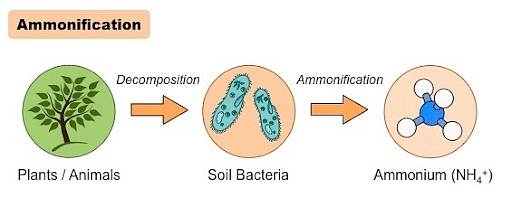
Ammonification is the process of converting organic nitrogen (the form of nitrogen found in living organisms) into inorganic ammonia (NH3) or ammonium ions (NH4+) It is a phase in the five-step nitrogen cycle, which is critical for delivering vital nitrogen to living organisms. The process of ammonification is enhanced by the presence of decomposers, which break down animal and plant cells into simpler compounds, releasing nutrients into the ecosystem. Different bacteria and fungi feed on these chemicals, producing ammonia, which is then converted into ammonium compounds in the soil, which are then taken up by plants.
| Table of Content |
Read More: Nitrogen Fixation
Key Takeaways: Ammonification, Nitrogen, Nitrate, Ammonia, Amino acids
Ammonification
Ammonification is a process that allows organisms to ingest nitrogen in order to survive. Microorganisms such as bacteria and other decomposing bacteria work together to transform nitrogen from dead organic materials to simple ammonia. Ammonification is the term for the process of converting nitrogen into ammonia. By ingesting these simple forms of Nitrogen, organisms are able to survive and thrive.
Plants are unable to directly utilize nitrogen from the atmosphere. A few bacteria aid in the conversion of atmospheric nitrogen into forms that plants can use. Plants take nitrates from the soil and convert them to proteins through their roots. Proteins are ingested by animals when they eat these plants. The nitrogen molecules in these creatures' bodies break down into ammonia after they die, a process is known as ammonification.
Functions of Ammonification
Our atmosphere is made up of a variety of gases, with nitrogen accounting for the majority (78%) of the total. However, because this nitrogen is in organic form, i.e. N2, it is unsuitable for living organisms, and the ammonification process is required just for this conversion. N2 (organic form) is transformed into NH3 (inorganic form) during the ammonification process, which is required by plants. This inorganic form was reintroduced into the ecosystem and is acceptable for all living things.
A dead animal or plant body, as well as its wastes, contains organic nitrogen, which is used in ammonification. Here nitrogen must be returned to the ecosystem in forms that living things can utilize; this is where ammonification comes in to return nitrogen to soil or water in a form that plants can absorb and transfer up the food chain.
Ammonification, like all other parts of the nitrogen cycle, is crucial to ecosystem health. Organic forms of nitrogen would accumulate in huge amounts in the absence of ammonification. Because growing plants require inorganic nitrogen, mainly ammonium and nitrate (NO3-), the oxidation of organic nitrogen from dead biomass by ammonification is required to maintain species and ecosystem productivity.
Read More:
Ammonification Process Implications
The ammonification process plays a number of significant roles, as noted below:
- Since nitrogen is present in organic form in all living organisms, this form cannot be directly utilized. So, nitrogen is transformed into ammonia, which is then turned into ammonium by plants for absorption. Nitrogen in the form of ammonia is inorganic.
- Ions, proteins, vitamin B, urea, and other nitrogen-containing substances in living organisms are examples.
- Ammonification is the process of converting dead plants or animals into nitrogen-rich waste products.
- Nitrogen in the ecosystem should be available in a form that living organisms can use. Ammonification is vital in this situation because it provides nitrogen to the soil in a way that allows plants to use it and send it through the food chain.
- Ammonification is the greatest technique of obtaining nitrogen for many types of plants that live in acidic soils.
- When fertilizers are used to raise ammonia levels in the soil, it is possible that algae can overgrow, resulting in soil toxicity and ecosystem imbalance.
Also Read:
Steps involved in Ammonification Process
The Nitrogen cycle's third phase is ammonification. Many chemical reforms happen as a result of this process.
- The NH3 groups are changed to (NH4+) in this ammonification process, and ammonia is the end product.
- Urea, uric acid, and organic nitrogen from faeces are the substrates for the ammonification process.
- Following this conversion, ammonia can be digested and mixed to generate a variety of amino acids, which are crucial in a variety of metabolic processes.
- Proteins, nucleic acid, DNA, vitamins, urea, and other nitrogen-carrying molecules are found in living organisms.
Read More: Difference Between DNA and RNA
During Ammonification, what do Bacteria do?
When a living organism dies, the nitrogen in its cells and tissues is released in the form of nitrogen (organic form) such as amino acids and DNA. Additionally, microorganisms such as fungus, prokaryotes, and others collaborate to degrade the tissue and convert organic nitrogen to inorganic nitrogen. Each microbe utilizes this inorganic form.
Bacillus, Proteus, Clostridium, Pseudomonas, and Streptomyces are a few ammonifying bacteria that can be found.
Read More:
Points to Remember
- Ammonification is a step in the nitrogen cycle that provides organisms with the nitrogen they require to exist.
- Ammonification is the breakdown of nitrogen-containing compounds from decaying organic materials by tiny organisms such as bacteria or other types of decomposing organisms into simple substances such as ammonia. These less complex compounds aid in the maintenance of the ecosystem.
- Ammonification leads to the release of ammonium which is then oxidized to form nitrate, which then can be turned into dinitrogen gas through denitrification, resulting in a net loss of fixed nitrogen.
- Bacillus, Proteus, Clostridium, Pseudomonas, and Streptomyces are all ammonifying bacteria.
Read More:
Sample Questions
Ques 1. What is the process for ammonification? (2 marks)
Ans. It is the end product of a chemical reaction in which the NH3 group is transformed to ammonia or its ionic form ammonium (NH4+). Bacteria and other microbes are extremely important in this process. The oxidation of organic nitrogen to ammonium provides them with biologically usable energy.
Ques 2. What role does ammonia play in the nitrogen cycle? (2 marks)
Ans. During the nitrogen fixation process, cyanobacteria convert nitrogen to ammonia and ammonium before converting it back to nitrogen. Ammonia can be used by plants as a nitrogen source. The generated ammonia and ammonium will be transferred further during the nitrification process after ammonium fixation.
Ques 3. Ammonification is a reaction of which type? (2 marks)
Ans. Any chemical reaction that produces ammonia (NH3) (or its ionic form, ammonium, NH4+) as a byproduct is known as ammonification. Ammonification can be caused by a variety of inorganic reactions as well as the metabolic operations of microbes, plants, and animals.
Read More: Food Adulteration
Ques 4. What is the purpose of ammonia in plants? (2 marks)
Ans. Ammonia is a nitrogen source for plants that can be found in soil, water, and the air. Nitrogen enhances plant growth and fruit and seed production, resulting in a higher yield. It's also necessary for photosynthesis, which is the conversion of light energy into chemical energy in plants.
Ques 5. Explain the Ammonification Process' Importance. (2 marks)
Ans. Organic nitrogen is transformed into inorganic ammonia and its ion form, much as it is in the ammonification process. Ammonification is important for this reason because it provides nitrogen to the soil in a form that is easily absorbed by all plants, and plants then distribute this nitrogen to all living things via the food chain.
Ques 6. Is ammonification oxidation or a reduction process? (2 marks)
Ans. Ammonification leads to the release of ammonium which is then oxidized to form nitrate, which then can be turned into dinitrogen gas through denitrification, resulting in a net loss of fixed nitrogen.
Read More: Calcium Deficiency
Ques 7. In ammonification, what role do bacteria play? (2 marks)
Ans. The ammonification process is carried out by a variety of soil fungi and bacteria, known as decomposers. The organic matter is consumed by the decomposers, who convert the nitrogen in the dead organism to ammonium ions. All ammonifying bacteria are Bacillus, Proteus, Clostridium, Pseudomonas, and Streptomyces.
Also Read:



Comments