



Content Writer
Angular acceleration is defined as the rate of change of angular velocity per unit time. It is an important concept of physics, especially for the laws of motion.
- Angular acceleration is also called rotational acceleration.
- It is a vector quantity, which means it has magnitude as well as direction.
- The direction of acceleration is perpendicular to the plane of rotation.
- It means that an increase in angular velocity in a clockwise direction will result in angular acceleration points away from the observer.
- The SI unit of angular acceleration is radians per second squared, i.e. rad/s2.
- Throwing a frisbee and bullets coming out of a rifled barrel are some real-life applications of angular acceleration.
- Mathematically it can be represented as:
α = dω/dt
- Where, ω → Angular speed
- t → Time
Key Terms: Angular Acceleration Formula, Angular Acceleration, Angular Velocity, Rotational Motion, Vector, Acceleration, Angle of Rotation, Circular Motion
What is Angular Acceleration?
[Click Here for Sample Questions]
Angular acceleration is defined as the rate where angular velocity changes with respect to time. It is associated with rotational motion and analogous to the linear acceleration of an object having a linear motion.
- The Greek symbol α is used to denote the required quantity.
- For a fixed axis of rotation, the angular acceleration becomes a scalar quantity since its direction is fixed.
- For a clockwise increase in angular speed, it is taken as negative.
- In case of anti-clockwise increase in angular speed, angular acceleration is taken as positive.
- It is inversely proportional to the moment of inertia of the body and directly proportional to the torque applied on the body.
- This is represented by the equation τ = I α.
Read More:
Angular Acceleration Formula
[Click Here for Sample Questions]
The formula of angular acceleration can be given in three different ways.
α = dω/dt
- Where, ω → Angular speed
- t → Time
α = d2θ/dt2
- Where, θ → Angle of rotation
- t → Time
Average angular acceleration can be calculated by the formula below. This formula comes in handy when angular acceleration is not constant and changes with time.
αavg = ω2 - ω1t2 - t1
- Where, ω1 → Initial angular speed
- ω2 → Final angular speed
- t1 → Starting time
- t2 → Ending time
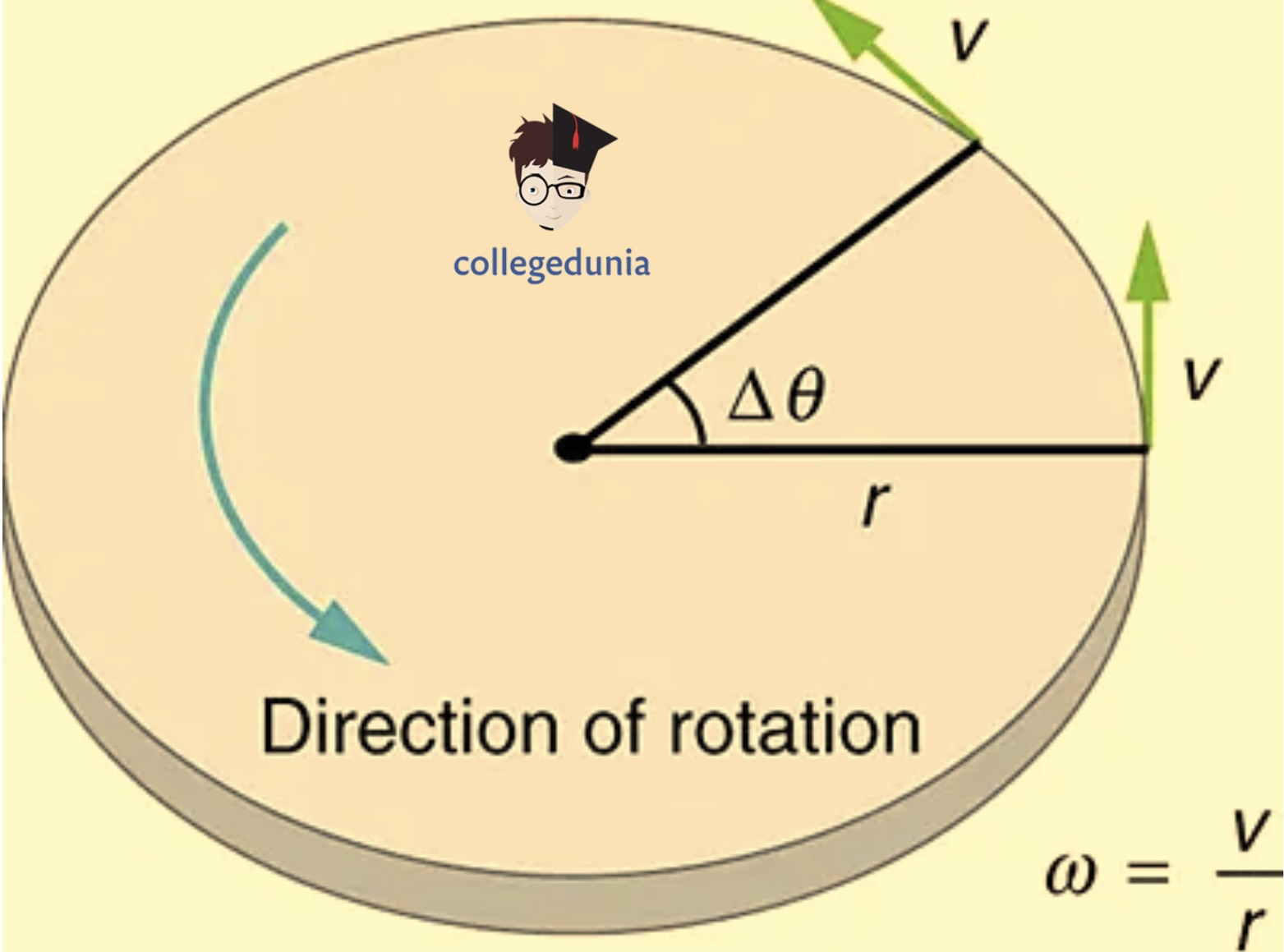
Angular acceleration formula
Angular Acceleration Formula ExampleExample: Calculate the angular acceleration of an object if its angular velocity changes at the rate of 40 rad/s for 5 seconds. Ans: dω = 40 and dt = 5 Using the formula: α = dω/dt |
Derivation of Angular Acceleration
[Click Here for Sample Questions]
Consider an object that is moving in a circular motion with a linear velocity v and angular velocity ω on a circular path with radius r in time t. As we know the, angular acceleration is the first derivative of angular velocity with respect to time.
- This gives us our first and second equation as:
α = dω/dt ……. (1)
ω = dθ/dt ……. (2)
- Substituting the value of equation (2) in equation (1), we will get
α = d(dθ/dt)/dt
α = d2θ/dt2
- This derives the angular acceleration formula.
Things to Remember
- When an object undergoes non-uniform circular motion, its angular velocity changes.
- This is the reason why objects in non-uniform circular motion possess angular acceleration.
- Average acceleration is given by the formula αavg = ω2 - ω1t2 - t1
- There are two types of angular acceleration: spin angular acceleration and orbital angular acceleration.
- It is a pseudovector quantity that focuses on the path along the turning pivot.
Read More:
Sample Questions
Ques. If the angular speed of a motor wheel is increased from 1200 rpm to 3120 rpm in 16 seconds, then what is its angular acceleration, assuming the acceleration to be uniform? (3 marks)
Ans. Given: Initial angular speed (ω0) = 1200 rpm
Final angular speed (ω) = 3120 rpm
Time (t) = 16 secs
We can use the formula
ω = ω0 + αt
Where α is the angular acceleration
ω0 = 1200 rpm
ω0 = 2π × angular speed in rev/s
ω0 = 2π × angular speed in rev/min60 s/min
ω0 = 2π x 1200/60rad/s
ω0 = 40π rad/s
Similarly,
ω0 = 2π x 3120/60rad/s
ω0 = 10 4π rad/s
Rearranging the formula ω = ω0 + αt we get
α = ω - ω0t
α =104π - 40π 16rad/s2
α = 4π rad/s2
∴ The angular acceleration of the motor wheel = 4π rad/s2.
Ques. A cord of negligible mass is wound around the rim of a flywheel of mass 20 kg and radius 20 cm. A force of 25 N is applied to the cord attached to the flywheel. The bearings used to mount the flywheel on a horizontal axle are frictionless. Compute the angular acceleration of the wheel? (3 marks)
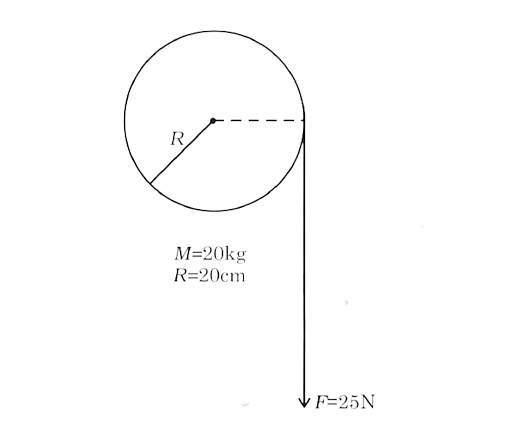
Ans. Given:
Mass of the flywheel (m) = 20 kg
Radius of the flywheel (r) = 20 cm = 0.2 m
Force acting on the flywheel (F) = 25 N
It is known that
I x α = τ…(1)
Where,
I is the moment of inertia of the flywheel about its axis
α is the angular acceleration
τ is the torque acting on the flywheel
The torque is given by the formula
τ = F x r
τ = 25 N × 0.2 m
τ = 5.0 Nm...(2)
The moment of inertia is given by the formula
I = mr22
I = 20 kg x 0.2 m x 0.2 m2
I = 0.4 kgm2...(3)
Substituting values obtained in (2) and (3) in equation (1)
0.4 kgm2 x α = 5.0 Nm
α = 12.5 s-2
∴ The angular acceleration of the motor wheel is 12.5 s-2.
Ques. A rotating wheel has an angular speed of 60 rad/s for 10 seconds. Calculate the angular acceleration of this wheel during this time? (3 marks)
Ans. We are given,
Change in angular velocity of the wheel (dω) = 60 rad/s
Change in time (dt) = 10 secs
We know that
α = dωdt
Substituting the given values in the above formula, we get:
α = 60/10rad/s2
α = 6 rad/s2
∴ The angular acceleration of the rotating wheel is 6 rad/s2.
Ques. When we switch our room’s fan from medium speed to high speed, the blades accelerate at 1.2 rad/s2 for 1.5 secs. The initial angular speed of the blades of the fan is 3.0 rad/s. Find the final angular speed of the blades of the fan? (3 marks)
Ans. We are given:
Angular acceleration of the blades of fan (α) = 1.2 rad/s2
The initial angular speed of the blades of the fan (ω0) = 3.0 rad/s
Change in time (t) = 1.5 secs
We know that
ω = ω0 + αt
Where ω is the final angular speed of the blades of a fan
Substituting given values in the above equation, we get:
ω = 3.0 rad/s + (1.2 rad/s2 x 1.5 secs)
ω = 4.8 rad/s
∴ The final angular speed of the fan is 4.8 rad/s.
Ques. The radius of the tire of a car is about 0.35 meters. A car is accelerating into a straight line at 2.8 m/s2.Find the magnitude and direction of the angular acceleration of the passenger-side tire of the car? (5 marks)
Ans. It is given:
The radius of the tire of the car (r) = 0.35 m
Linear acceleration of the car (a) = 2.8 m/s2
It is known that
α = a x r
Where α is the angular acceleration
Substituting given values in the above formula
α = 2.8 m/s2 x 0.35 m
α = 8.0 rad/s2
∴ The angular acceleration of the tire of the car is 8.0 rad/s2.
- This is the magnitude of the angular acceleration. To find the direction of angular acceleration, the right-hand thumb rule should be applied.
- By applying the right-hand thumb rule, it is found that the direction of angular acceleration when the car is moving in a particular direction lies towards the left-hand side of the car.
- Thus, the magnitude of angular acceleration is 8.0 rad/s2 and the direction is towards the left.
Ques. If the angular velocity of a body in rotational motion changes from π2 rad/s to 3π4 rad/s in 0.4 s. Find the angular acceleration? (3 marks)
Ans. It is given that
Initial angular velocity of the body in rotational motion (ω0) =π2 rad/s
Final angular velocity of the body in rotational motion (ω) = 3π4rad/s
Time (t) = 0.4 s
It is known that
α = dωt
α = ω0 - ωt
α = π2 rad/s - 3π4rad/s0.4
α = 5π8 rad/s2.
∴ The angular acceleration of the body in rotational motion is 5π8 rad/s2.
Ques. The angular displacement of an object in rotational motion depends on time t according to the relation θ = 2πt3 − πt2 +3π − 6, where θ is in radians and t in seconds. Find its angular acceleration at t = 2 secs? (5 marks)
Ans. It is given:
Angle of rotation (θ) = 2πt3 − πt2 +3π − 6 rad
Time (t) = 2 secs
It is known as
ω = dθdt
Where ω is angular velocity.
ω = d(2πt3 − πt2 +3π − 6 )dt
ω = 6πt2 − 2πt + 3π rad/s
So the angular velocity of the object is 6πt2 − 2πt + 3π rad/s
It is also known that
α = dωdt
Where α is the angular acceleration
α = d(6πt2 − 2πt + 3π)dt
α = 12πt −2π rad/s2
So the angular acceleration of the object is 12πt −2π rad/s2
αt at t = 2 secs is calculated as
αt = 12π(2) −2π
αt = 24π −2π
αt = 22π rad/s2
∴ The angular acceleration of the object in rotational motion at t = 2 secs is 22π rad/s2.
Ques. A merry-go-round has an angular acceleration of 0.30 rad/s2. After accelerating from rest for 2.8 secs, through what angle in radians does the merry-go-round rotate? (3 marks)
Ans. It is given:
Angular acceleration of a merry-go-round (α) = 0.30 rad/s2
Time (dt) = 2.8 secs
Initial angular speed of the merry-go-round (ω0) = 0 rad/s
It is known that
θ = ω0t + 12αt2
θ = [0 rad/s x 2.8 secs] + [12x 0.30 rad/s2 x (2.8 secs)2 ]
θ = 1.2 rad
∴ The angle at which the merry-go-round rotates is 1.2 rad.
Ques. Define Angular acceleration? (2 marks)
Ans. Angular acceleration is defined as the rate of change of angular velocity per unit time. The Greek symbol α is used to denote angular acceleration. Angular acceleration is also called rotational acceleration. Angular acceleration is associated with rotational motion. It is analogous to the linear acceleration of an object having a linear motion. The SI unit of angular acceleration is radians per second squared i.e. rad/s2.
Ques. What are the types of Angular acceleration? Explain? (2 marks)
Ans. There are two types of angular acceleration.
- Orbital angular acceleration
- Spin angular acceleration
Spin angular acceleration is associated with the change of spin angular velocity whereas orbital angular acceleration is associated with the change of orbital angular velocity.
Ques. Calculate the angular acceleration of an object if its angular velocity changes at the rate of 100 rad/s for 10 seconds? (2 marks)
Ans. dω = 100 and dt = 10
Using the formula: α = dω/dt
= angular velocity = 100/10
= angular velocity = 10 rad/s2
Read More:
| Class 11 Physics Study Guides | ||
|---|---|---|
| NCERT Solutions for Class 11 Physics | Topics for Comparison in Physics | Formulas in Physics |



Comments