



Education Journalist | Study Abroad Lead
Gravitational acceleration is the acceleration gained by an object due to the force of gravity acting on it. Have you ever wondered when you throw a stone high in the air, why it comes back to you? This is due to the gravitational force exerted by the earth on that stone. Acceleration due to gravity is the uniform acceleration gained by a free-falling object (body) due to the gravitational force of the earth. The gravitational acceleration formula helps in finding the value of g which is denoted by the unit m/s2.
Key terms: Gravitational Acceleration Formula, Gravity, Acceleration, Vector Quantity, Laws of Motion, Freefall
Gravitational Acceleration Formula
[Click Here for Sample Questions]
The acceleration due to gravity is approximately constant when objects are close to the surface of the Earth. However, for the larger distances from the Earth or around other planets, it varies. Therefore, gravitational acceleration formula can be denoted as –
Gravitational Acceleration = Universal Gravitational Constant * Planet Mass / Planet Radius
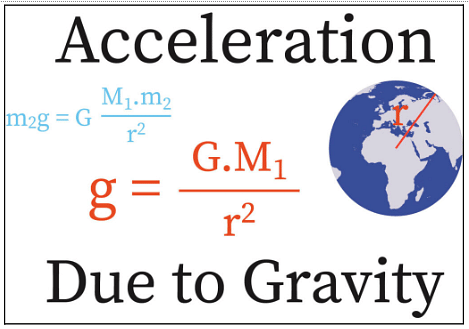
g = GM/r2
- Where, G = Universal Gravitational Constant (G = 6.673×10⁻¹¹ Nm2/Kg2)
- M = Mass of the body whose gravitational force acts on the given object
- r = Distance from the center of mass of the large body
Variation of g with Height
Acceleration due to gravity changes with the height of the object from the surface of the earth. The formula for gravitational acceleration for an object at h height can be therefore denoted by:
gh = \(GM \over (r + h)^2\)
Solved ExampleProblem: Calculate the acceleration due to gravity for an object that is placed at the surface of the Earth. The radius of the moon is given as 1.74 × 10⁶ m and its mass is 7.35 × 10²² kg. Solution: Given – The radius of the moon, r = 1.74 × 10⁶m = 1740000 m r2 = 3.0276 × 10¹²m The mass of moon = 7.35 × 10²² kg The gravitational acceleration formula, g = GM/r2 Adding the given values in the equation, we get g = (6.673 x 10-11)*(7.35 × 1022)/3.0276 × 1012 g = (4.905 ×10¹²)/(3.0276 × 1012) g = 1.620 m/s2 Therefore, the acceleration due to gravity is 1.620 m/s2. |
Read More:
| Gravitational Acceleration Formula – Related Topics | ||
|---|---|---|
| Archimedes Principle | Central Force | Global Positioning System |
| Earth satellites | Escape speed | Gravitational potential energy |
What is Gravitational Acceleration?
[Click Here for Sample Questions]
An object located on earth experiences a gravitational pull. Gravitational acceleration is the acceleration due to gravity received by an object by the force acting on it.
- Acceleration due to gravity is a vector quantity, that is it has both magnitude and direction.
- It is denoted by the symbol ‘g’ and is measured in ms².
- The gravity value is greater at the poles than at the equator.
| Example: Rahul throws a small stone high in the air. The same stone falls back towards him and then finally falls on earth.
|
Gravitational Acceleration
Read More: Difference between Gravitation and Gravity
Derivation of Gravitational Acceleration Formula
[Click Here for Sample Questions]
According to Newton’s Second Law of Motion, we can say that F = ma, where ‘f’ refers to the force acting on the object, ‘m’ is the mass, and ‘a’ is the acceleration.
Also, as per Newton’s Law of Gravity, Fg = GMm/(r+h)2
It denotes the gravitational force acting between two bodies lying next to each other in a gravitational field. The force acts inwards and is attractive in nature. Both bodies experience the same force directed towards the other.
To find out the acceleration of the body under this condition, we will be using Newton’s Second Law of Motion
a = Fg/m
Here m refers to the mass of the object for which the gravitational acceleration is to be calculated
a = g = GMm/(r+h)2m
g = GM/(r+h)2
Since the value of g is constant when the object is on or near the surface and there would be no considerable change with the height, so we can say that
g = GM/r2

Derivation of Gravitational Acceleration Formula
| For Example: Suppose you have a ball and a feather.
What do you think? Which will fall on the earth first, ball or feather, in both cases? Solution: Acceleration due to gravity acts on both objects equally when there is no air resistance.
This means g is independent of the mass of an object falling from a certain height (no air resistance). |
Read More:
| Gravitation – Related Topics | ||
|---|---|---|
| Weightlessness | Neptune | Relation between G and g |
| Density of Air | Specific Gravity | Value of g on Moon |
Things to Remember
- Acceleration due to gravity is defined as the uniform acceleration gained by a free-falling object (body) due to the gravitational force of the earth.
- This gravitational force will not only be exerted on stone (which is at a certain height from the earth) but also act on an object present on the surface of the earth.
- The value of g will not depend on the mass of the small object but depends upon the mass of the large object.
- The value of g is greater at the poles than at the equator.
- The formula for finding the acceleration due to gravity is g = GM/r2.
Previous Year Questions
- Two equal masses separated by a distance d attract each other with a force (F)… [COMEDK UGET 2000]
- Which of the following is the evidence to show that there must be a force acting… [COMEDK UGET 2000]
- Intensity of gravitational field inside the hollow spherical shell is… [COMEDK UGET 2000]
- Weight of a body… [COMEDK UGET 2010]
- A body of mass m is raised through a distance equal to the radius of the earth… [COMEDK UGET 2010]
- Escape velocity from Earth is about 11 km/s. The escape velocity from a planet… [COMEDK UGET 2007]
- Average density of the earth… [COMEDK UGET 2000]
- If Fg and Fe are gravitational and electrostatic forces between two electrons… [COMEDK UGET 2000]
- If G is the universal gravitational constant and p is the uniform density of a… [COMEDK UGET 2000]
- If the gravitational force of earth suddenly disappears, then which of the… [COMEDK UGET 2000]
- The value of g at a height equal to half the radius of the earth from the earth's… [COMEDK UGET 2014]
- If the Earth shrinks in its size (radius) mass remaining the same, the value of g… [COMEDK UGET 2009]
- If the Earth shrinks in its radius by 4%, mass remaining the same, the value… [COMEDK UGET 2008]
- A stone weighs 100N on the surface of the Earth. The ratio of its weight at a… [COMEDK UGET 2015]
- The gravitational field strength at the surface of a certain planet is g… [COMEDK UGET 2015]
- A particle is projected with a velocity so that height attained becomes equal to… [COMEDK UGET 2005]
- Escape velocity for a projectile at Earth's surface is v. A body is projected from… [COMEDK UGET 2005]
- A hollow spherical shell is compressed to half its radius… [COMEDK UGET 2000]
- Law of gravitation is not applicable if A) Velocity of moving objects are… [COMEDK UGET 2000]
- Out of the following interactions the weakest is… [COMEDK UGET 2000]
Solved Questions
Ques. The mass of the earth is 6×1024 kg and that of the moon is 7.4×10²² kg. If the distance between the earth and the moon is 3.84×10⁵ km, calculate the force exerted by the earth on the moon. G = 6.673×10⁻¹¹ Nm2/Kg2 . (3 Marks)
Ans. Given, Mass of the earth (Me) = 6×1024 kg
Mass of moon (Mm) = 7.4×10²²
Distance (d) between the earth and the moon = 3.84×10⁵ km = 3.84×10⁸m
G = 6.673×10⁻¹¹ Nm2/Kg2
Formula of Gravitational force
F = G(m1m2)/r2
Put the values at respected places,
= 6.673×10⁻¹¹ Nm2/Kg2 X 6×1024 kg X 7.4×1022 /( 3.84×10⁸m)2
= 20.1×10¹⁹N
Ques. What is the magnitude of the gravitational force between the earth and a 2 kg object on its surface? Mass of the earth = 6×1024 kg and radius of the earth = 6.4 x 10⁶ m. (3 Marks)
Ans. Given, Mass of earth (Me)= 6×1024 kg
Mass of small object m= 2kg
radius of the earth = 6.4 x 10⁶ m
The magnitude of the gravitational force between the earth and a 2 kg object on its surface is given by formula
F = G(m1m2)/r2
G = 6.673×10⁻¹¹ Nm2/Kg2
Putting all values in formula
F= 6.673×10⁻¹¹ Nm2/Kg2 X 6×1024 kg X 2kg/(6.4 x 106 m)2
= 19.62 N
Ques. Both the moon and the earth are attracted towards each other by a gravitational force. Do you think that the moon will attract the earth with a force that is greater or smaller or the same as the force with which the earth attracts the moon? Explain with a suitable reason for the same. (2 Marks)
Ans. According to the universal law of gravitation, each body attracts the other body with some force and this force is the same for both the bodies. This means that both moon and earth will exert the same amount of force on each other.
Ques. Rahul purchased 10gm gram grains at the poles and handed them over to his friend standing at the equator. The friend told him that the weight of grains are greater than 10gm. How it can be possible? Give reasons. (3 Marks)
Ans. Weight of the body will be as per the given formula
W = mg
The weight of grains at poles = Wp = m × g (poles)
Since we know that the value of g at poles is more than the value of g at equator,
The weight of grains at equator = We = m × g (equator)
∴ Wp > We.
The weight at the pole of the same grain is found to be more as compared to the weight at the equator.
Ques. Suppose you have two sheets of paper. You crumpled one sheet into a ball and another sheet is remained as such. If you throw them both at the same distance from the top of the building, which will land faster on the ground? (3 Marks)
Ans. Both are thrown from the top of the building. It means they both will be affected by air resistance during free fall. However, it can also be said that the surface area of an object is directly proportional to the resistance faced by an object. The greater is the surface area of an object, the greater will be the resistance and vice-versa. In the given question, a sheet of paper has a larger surface area and while falling down it has to overcome the force exerted by air/wind. However, the crumpled paper has a smaller surface area, and it has to overcome a very less amount of air current. Hence, the crumbled paper will land faster.
Ques. Calculate the weight of an object of 100 kg both on the moon and on the earth? (3 Marks)
Ans. It is a fact that the gravitational force on the surface of the moon is only 1/6 of the gravitational force on the earth.
Mass of the object = 100 kg
Weight of the object on earth = W = m × g
∴ W = 100 × 9.8
W = 980 N
Weight of the object on the moon will be = 1/6th the weight on the earth.
∴ Weight of the object on moon =1/6 x 980 N
= 163.3 N
Ques. Calculate what will be the force of gravitation between the earth and the Sun, given that the mass of the earth = 5 x 1024 kg and of the Sun = 3 x 1030 kg. The average distance between the two bodies is given as 1.5 x 10¹¹m. (3 Marks)
Ans. Given, Mass of the earth (Me) = 5 x 1024 kg
Mass of the Sun (Ms) = 3 x 1030 kg
Average distance (R) between the earth and moon = 1.5 x 10¹¹m.
F = G(m1m2)/r2
G = 6.673×10⁻¹¹ Nm2/Kg2
Putting all values in formula
F=6.673×10⁻¹¹ Nm2/Kg2 X 5 x 1024 kg X 3 x 1030 kg/(1.5 x 1011m)2
= 4.46 x 10²² N
Ques. The mass of an object is 10kg. What is its weight on earth? (2 Marks)
Ans. Given,
Mass of object= 10Kg
Weight (W) = mass (m) of object x gravity (g)
= 10 x 9.8ms−2
= 98Kg
Ques. The weight of the man on earth is 140 N and on another planet is 25N. Take g=10ms−2 on earth. Calculate what will be the acceleration due to gravity on the planet. (3 Marks)
Ans. Given, Weight on the earth= 140 N
Weight on other planet= 25 N
Weight (W) = mass (m) x acceleration due to gravity (g)
25 N = m x 10m/s2
m= 25N/10m/s2
= 2.5 kg
Ques. The weight of the man on earth is 140 N and on another planet is 25N. Take g=10m/s2 on earth. Calculate what will be the mass of the man on earth and planet. (3 Marks)
Ans. Given, Weight of man on the earth= 140 N
Weight on other planet= 25 N
Weight (W) of man on planet = mass (m) x acceleration due to gravity (g)
25 N= m x 10m/s2
m= 25N/10m/s2
= 2.5 kg
Weight (W) of man on earth = mass (m) x acceleration due to gravity (g)
140 N = m x 10m/s2
m= 140N/10m/s2
= 14 kg
So, mass of the man on earth and planet is 14kg and 2.5 Kg respectively.
Check Out:



Comments