



Education Journalist | Study Abroad Lead
Angular motion is the motion of an object or body about a fixed axis or a fixed point. The value of angular motion is equal to the angle passed over at a fixed axis by a line drawn to the body. When a body moves along a curved path at a constant angular velocity, then the motion of the body is known as angular motion. Examples of angular motion include a car moving around a curve, a gymnast running in circular paths, spinning a stone when tied to a string, and many more.
Read Also: Angular Speed
One of the most common examples of angular motion is centrifugal force. During the centrifugal force, the body rotates in a circular path. In addition, it exerts an external force on the body, due to which the body tends to fall outwards.
Key Terms: Angular Displacement, Angular Velocity, Angular Acceleration, Angular Momentum, Torque, Moment of Inertia
Angular Displacement
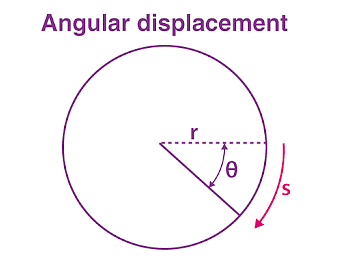
[Click Here for Sample Questions]Angular Displacement is the angle through which a line or point rotates about a specific axis. It is the angle formed when an object moves in a circular motion. For example, a pole dancer spinning on a pole makes 360o or 180o. Therefore, π or 2π will be the angular displacement of the pole dancer. It is measured in degrees or radians and is denoted by the Greek letter theta θ. Mathematically,
Angular displacement = θ = s/r
where r is the radius of the circle and s is the distance covered by the body.
Angular Velocity
[Click Here for Sample Questions]
Angular Velocity is the rate at which an object rotates or revolves relative to another point. It is a vector quantity since it possesses both magnitude and direction. It is represented by the Greek letter omega (ω). Mathematically,
Angular Velocity ω = Δθ / Δt
where θ is the angular displacement and t is the time. The unit of angular velocity is radian per second (rad s-1).

Angular velocity remains constant in a circular motion as it undergoes constant linear acceleration. That is because the angle formed in a circular motion is the same. Therefore, a constant angular velocity in a circular motion is known as a uniform circular motion.
Read More: Angular Speed Formula
Relation between Linear Velocity and Angular Velocity
[Click Here for Sample Questions]
Consider the formula of angular velocity, that is,
ω = Δθ / Δt
Multiplying both sides by radius r, we get,
r ω = r Δθ / Δt
We know the term r.Δθ is the distance an object travels in a circular path of radius r. Therefore, the equation becomes,
r ω = Δs / Δt.
The term on the right-hand side of the above equation denotes the ratio of distance and time, which is velocity. Therefore,
r ω = v
Δs / Δt = v
Therefore, linear velocity equals the product of radius and angular velocity.
Also Read:
Rotational Angles
[Click Here for Sample Questions]
When an object rotates around a central axis, a circular arc is followed by each point present on that object. Imagine a line drawn from the item's centre to its border. Along this line, every point moves through the same angle in the same time period. The amount of rotation is represented by the rotation angle, which is comparable to linear distance. The ratio taken of the arc length to the curvature’s radius is used to define the rotation angle.

Considering the figure above,
Δs is the arc’s length which is the distance travelled along a circular path. The radius of curvature of the circular route is denoted by r. The arc length equals the circumference of the circle when the radius of curvature of that circle is denoted by r for one full rotation. A circle's circumference is equal to 2πr. As a result, the rotation angle for one complete revolution is
Δθ = 2πr / r =2π
This finding is used to create the units for measuring rotation angles, which are radians (rad), which are defined as 2 rad = 1 revolution.
Read Further: Angular Velocity Formula
The following is a comparison of various relevant angles stated in both degrees and radians:
| Degrees | Radians Equivalent |
|---|---|
| 30° | π/6 |
| 60° | π/3 |
| 90° | π/2 |
| 120° | 2 π/3 |
| 135° | 3 π/4 |
| 180° | π |
Angular Acceleration
[Click Here for Sample Questions]
Angular Acceleration is the change rate of velocity respective to time. It is expressed in radian per (second)2 and is represented by the Greek letter alpha α. Mathemaically,
α = Δω / Δt
where angular velocity in radian per second and is denoted by the symbol ‘ω’, and t is time in seconds.
Angular acceleration can also be denoted as
α = a/r
where a is used as the symbol for linear acceleration and the circle’s radius is expressed with the help of r.

Angular Momentum
[Click Here for Sample Questions]
Angular Momentum is the rate of change of angular velocity with respect to the moment of inertia. The unit of angular momentum is kg m2/s2. It is represented by the symbol L with a bar over it to denote the direction of the angular momentum.
For a point object, angular momentum is denoted by
L = r x p
where r is the radius of the circle and p is the linear momentum. For an extended object, it is represented as
L = I x ω
where I denote the moment of inertia and ω denotes the angular velocity.
Angular momentum is also represented as
L = mvr = mr2ω
where m is the mass of the object.

Rotational Kinetic Energy
[Click Here for Sample Questions]
Rotational Kinetic Energy is defined as the kinetic energy due to the rotation of an object along a fixed axis. It is directly proportional to the square of the magnitude of the angular velocity and rotational inertia. Rotational kinetic energy is represented by
KR = ½ Iω2
where I denote a moment of inertia and ω denotes the angular velocity of the object. The unit of rotational kinetic energy is joule and is represented by J.

Torque
[Click Here for Sample Questions]
Torque is the rotational force applied on a body along an axis of rotation. It is represented by the Greek letter tau \(\tau\). The unit of torque is kg m2/s2, and the SI unit is Nm.
Torque is used in everyday lives for tightening screws, nuts and bolts. It is the product of rotational force and the lever arm. Therefore,
Torque (\(\tau\)) = F. r. sinθ
where θ is the angle between the lever arm and the direction of the resultant torque.

Moment of Inertia
[Click Here for Sample Questions]
Moment of inertia is the resistance of a body while undergoing angular acceleration. It is the sum of the product of masses with the square of the distance from the axis of rotation. It is also known as the angular mass or rotational inertia. The SI unit of moment of inertia is kg m2 and denoted by the symbol I. Mathematically,
Moment of Inertia (I) = m x r2
where m is the mass of the particle and r is the distance between the particle and the axis of rotation.

Relationship between Linear Motion and Angular Motion
[Click Here for Sample Questions]
The equations of motion are nearly the same for both motions but there are some substitutions that you are required to make. Those replacements in the equation are as follows:
- Employ the letter 's' to represent the linear distance covered in linear motion. Whereas, use ‘θ’ to measure the angular distance in angular motion, which is expressed in radians.
- Use the letter 'v' to express velocity in linear motion, but in angular motion, use the symbol ‘ω’. The number of radians covered per second is known as angular velocity.
- The letter 'a' stands for linear acceleration, whereas the letter ‘α’ stands for angular acceleration. Radians per (second)2 is the unit for angular acceleration.
Tabulated below is the difference between Linear Motion and Angular Motion
| Linear Motion | Angular Motion |
|---|---|
| Linear Motion Formulas: Linear Velocity: v = Δs / Δt Linear Acceleration: a = Δv / Δt Linear Displacement: s = vit + ½ at2 Linear Motion with time cancelled out: vf2 – vi2 = 2as | Angular Motion Formulas: Angular Velocity: ω = Δθ / Δt Angular Acceleration: α = Δω / Δt Angular Displacement: θ = vit + ½ αt2 Angular Motion with time cancelled out: ωf2 – ωi2 = 2αθ |
| Equations of linear motion: v = u + at s = ut + ½ at2 v2 = u2 + 2as | Equations of angular motion: ω = ωo + αt Δθ = ωot + ½ αt2 ω2 = ωo2 + 2α Δθ |
Read More: Motion
Difference between Angular Motion and Linear Motion
[Click Here for Sample Questions]
The differences between angular and linear motion are described in the table below.
| Linear Motion | Angular Motion |
|---|---|
| When a body moves from one point to another in a straight line, it is known as linear motion. | When a body rotates about an axis, it is known as angular motion. |
| The units of linear motion are kilometre, metre, feet, etc. | The units of angular motion are radian or degrees. |
| Linear motion is of two types: curve linear and rotatory motion. | Angular motion is of two types: visible axis and invisible axis. |
| Example: Athlete running on a straight path, pushing a block or stone, etc. | Example: Car moving along a curved path, Ingredients grinding inside a mixer, etc. |
Read More: Gravitation
Solved Examples
[Click Here for Sample Questions]
Example 1: A ball takes 3 seconds to complete a 2π radians circle. Find the angular velocity at which the ball is rotating.
Solution: From the formula of angular velocity, ω = Δθ / Δt
Therefore, ω = 2π / 3 = 0.6π rad/s.
Example 2: What is the angular velocity of the hour hand in the clock?
Solution: The hour hand rotates 360 degrees in 12 hours. Therefore, the angular displacement of the hour hand is 2π, and the time taken is 12 x 3600 seconds.
Therefore, angular velocity will be,
ω = Δθ / Δt
= 2π / (12 x 3600) = π / 21600 rad/s.
Example 3: What is the angular acceleration of a car moving on a circular path with angular velocity 5 rad/s and time 25 s?
Solution: The angular acceleration is given by α = Δω / Δt, where ω is the angular velocity and t is the time. Putting the values in the formula, we get,
α = 5/25 = 0.2 rad/s2.
Also Check:
Things to Remember
[Click Here for Sample Questions]
- Angular motion is the rotation of an object along a fixed axis.
- Uniform circular motion is the rotation of an object along a circular path with a constant angular velocity.
- Linear velocity is the product of the radius of the circle and the angular velocity.
- Linear motion is the movement of an object along a straight path.
- In angular motion, ω represents velocity, α represents acceleration and θ represents displacement.
Read More: Difference between Torque and Moment
Sample Questions
Ques. What are angular velocity and angular acceleration? (2 marks)
Ans. The rotation rate of an item or a particle around a centre or a specified point in a specific time period is called angular velocity. Rotational velocity is another name for it. Angle per unit time, or radians per second (rad/s), is the unit that is used for measuring angular velocity. Angular acceleration is the rate at which angular velocity changes. The SI unit of angular acceleration is radians per second squared (rad/s2).
Ques. What is meant by torque? State its difference from the force. (2 marks)
Ans. The force that may cause an item to twist along an axis is measured as torque. In linear kinematics, force is what causes an object to accelerate. Angular acceleration is caused by torque. The linear force's rotational equivalent is known as torque. The axis of rotation is the point at which the item rotates. N-m is the SI unit for torque. In rotational mechanics, torque is the opposite of force. Torque is the capacity of a force to cause a twist around an axis, which is the primary distinction between them.
Ques. State three applications of the moment of inertia. (4 marks)
Ans. Three applications of the moment of inertia are as follows:
- Each engine is made up of a massive, heavy wheel coupled to a shaft, with most of its mass distributed around its circumference. As a result, its moment of inertia is relatively large. A flywheel is a name for this type of wheel. The torque that powers the engine shaft continues to rise. As a result, the shaft's rotation may not be uniform, yet because of the existence of a rotating wheel with higher inertia, the shaft rotates at a nearly constant pace.
- Under the children's toy motor is a bit of a moving wheel. The engine continues to operate after rubbing this wheel on the ground and leaving it. This is due to the wheel's moment of inertia.
- The earth rotates on its axis with the same angular velocity due to its larger moment of inertia.
Ques. What is the angular velocity of Earth? (3 marks)
Ans. Earth takes 86400 seconds to rotate on its axis. To complete one rotation, the distance covered is 2π radians. Therefore, the angular velocity of Earth can be calculated as follows:
ω = Δθ / Δt
= 2π / 86400 = 7.2921 x 10⁻⁵ rad/s.
Hence, the angular velocity of Earth is 7.2921 x 10⁻⁵ radians per second.
Ques. A car having a mass of 1100 kg moves along a circular path of radius 60 m with a velocity of 60 m/s. What is the angular momentum of the car while travelling on the circular path? (4 marks)
Ans. The angular momentum is given by L = mvr, where m is the mass of the object, v is the velocity, and r is the radius of the circle.
Putting the values in the formula, L = 1100 x 60 x 60 = 3.9 x 10⁶ kg m2/s2.
Ques. What is the angular kinetic energy of a body whose moment of inertia is 1200 kg m2 and angular velocity 36 rad/s? (2 marks)
Ans. We know angular kinetic energy is given by KR = ½ Iω2. Putting the values in the formula, we get,
KR = ½ x 1200 x 36 = 21600J.
Ques. Find the torque applied on a 2 m screwdriver when a mechanic exerts a force of 120 N over it. (2 marks)
Ans. Since the force's line of action is straight, the angle formed between the resultant and the lever arm is 90 degrees. Therefore, sin 90 = 1.
Using the torque formula, \(\tau\) = F. r. sinθ and putting the values in it, we get,
\(\tau\) = 120 x 2 = 240 Nm.
Physics Related Links:



Comments