



Content Curator
A linear accelerator, also known as a linear particle accelerator (often shortened to Linac), is a type of particle accelerator that accelerates charged subatomic particles or ions by subjecting them to a series of oscillating electric potentials at high speed.
- The small accelerations join together in order to give the particles greater energy than could be achieved by the voltage that is used in one section alone.
- This linear particle accelerator in radiation therapy is used for medicinal purposes because it produces x-rays and electrons that have high energy.
- This is the reason why the linear particle accelerator is used for many therapeutic applications.
- Here, we will be discussing the linear accelerator in depth along with some important questions.
| Table of Content |
Key Terms: Accelerator, Ion, Electron, Proton, Positron, Kinetic energy, DNA, Cell, X-Ray, Intertia, Pulse modulator, Electromagnetic wave, Energy, Electric potential, Radiations.
Read more: Wave Nature of Electromagnetic radiation
What is a Linear Accelerator?
[Click Here for Sample Questions]
A linear particle accelerator (often abbreviated as linac) is a type of particle accelerator that significantly increases the kinetic energy of charged elementary particles or ions by exposing them to a series of oscillating electric potentials along a linear beamline.
- A linac machine creates X-rays and high-energy electrons for medicinal uses in radiation treatment, acts as particle injectors for higher-energy accelerators, and is employed directly to reach the maximum kinetic energy for light particles (electrons and positrons) for particle physics.
- A linear particle accelerator (often abbreviated as linac) is a type of particle accelerator that significantly increases the kinetic energy of charged elementary particles or ions by exposing them to a series of oscillating electric potentials along a linear beamline.
- The principle for such machines was proposed in 1924 by Gustaf Adolf Ising.
- In 1928, Rolf Wideroe constructed the first machine that worked at the RWTH Aachen University.
- Depending on the type of particle to be accelerated i.e. electrons, protons, or ions, a linac's design will differ.
- Medical linear accelerators deliver high-energy x-rays or electrons that conform to the shape of tumors and destroy cancer cells.
-
The MR Linac machine combines two technologies, which are an MRI scanner and a linear accelerator. It can precisely locate tumors, tailor X-ray beam shapes in real-time, and accurately deliver radiation doses even to moving tumors.

Linear Accelerator
Working Principle of Linear Accelerator
[Click Here for Previous Year Questions]
Patients are usually prescribed therapy doses and volumes by radiation oncologists. In addition, a dosimetrist and a medical physicist will determine the dose quantity and duration, as well as the time for acceleration. Linear acceleration is included in radiation treatment, and therapists may provide radiation medicine to patients on a regular basis.
The working principle of a linear accelerator is as follows:
- The ion source produces a large number of electrons, which are subsequently driven toward the first drift tube due to their negative potential and the positive potential of the drift tube.
- When electrons enter the tube, the polarity of the RF source is shifted.
- After then, the first drift tube becomes negatively charged, while the second drift tube becomes positively charged.
- Because of the tube's inertia, electrons exit the tube, where they are pushed by the first drift tube and attracted by the second in the same direction.
- As electrons accelerate, their velocity increases and they traverse a greater distance in the same amount of time. Because of the increased velocity of electrons as they approach the target, drift tubes must be longer.
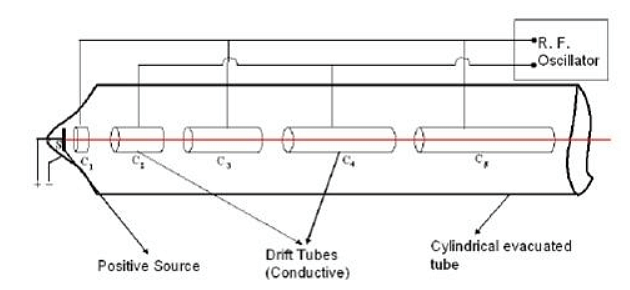
Working Principle of Linear Accelerator
Due to the lengthy drift tubes and a large number of drift tubes, the linac must be quite long if a high velocity is required. Higher kinetic energy is created by hitting the object with electrons or protons with energies greater than 18 MeV. The particles in a tungsten target emit bremsstrahlung radiation in the same way as they do in an X-ray convectional tube. Because of the increased energy, the LINAC machine's architecture differs from that of an X-ray tube.

Working Principle of Linear Accelerator
Also Read:
| Related Articles | ||
|---|---|---|
| Atoms and Molecules | Properties of Matter | Blackbody Radiation |
| Thermal Expansion | Uses of Electricity | Centripetal Acceleration |
How is Safety ensured?
[Click Here for Sample Questions]
The safety of the patient is paramount, and it is ensured in a variety of methods. The following are some of the safety features of a linear accelerator:
- The radiation oncologist, in consultation with the radiation physicist and dosimetrist, designs and approves a treatment plan before therapy begins.
- Before treatment, the plan is extensively examined, and quality processes guarantee that the therapy is carried out as intended. There are a number of devices incorporated into the accelerator that ensure that the radiation dosage is not exceeded.
- Every morning, before treating any patient, the radiation therapist examines the machine with "tracker" technology to confirm that the radiation intensity is consistent across the beam and that it is functioning correctly. The linear accelerator is also checked weekly and monthly by the radiation physicist.
- A tracker is a specific machine that is used to ensure that the machine is working properly, and a radiation therapist will examine the device every morning before the treatment. The tracker keeps track of the radiation velocity and intensity to guarantee that the beams are all working simultaneously.
Also check: Speed-time Graphs
Components of Linear Accelerator
[Click Here for Previous Year Questions]
The components of Linear Accelerator are as follows:
- Electron-generating component: Generate and guide electrons in an accelerating waveguide.
- The electron acceleration component: accelerates electrons comparable to the speed of light.
- Beam transport: moves electrons to a target
- Before applying the beam, it is modified using a flattering filter, collimation, and an ionization chamber.
- Pulse modulator: Produces a timed energy pulse for the electron gun and RF generator.
- Electromagnetic waves are generated by a radiofrequency generator.
- The control panel is where the linear accelerator's functions are managed.

Components of Linear Accelerator
Also check: Displacement Current
Things to Remember
- The linear accelerator, also known as a linac, is a type of particle accelerator that accelerates charged subatomic particles or ions.
- This linear particle accelerator in radiation therapy is used for medicinal purposes because it produces x-rays and electrons that have high energy.
- In particle physics, a linear accelerator is used to increase the kinetic energy of electrons and protons.
- The principle for such machines was proposed in 1924 by Gustaf Adolf Ising.
- LINAC devices are used to treat cancer and produce a lot of radioactive energy.
- The drift tube has a positive potential in a linear particle accelerator, whereas electrons have a negative potential. Because of the potential difference, a large number of electrons are propelled to the drift tube.
Read more: Electromagnetic spectrum
Sample Questions
Ques: What is a Linear Accelerator's functioning principle? (2 marks)
Ans: The Linear Particle Accelerator is also known as LINAC. It's a type of particle accelerator that employs an oscillating electric potential to accelerate the charge of a subatomic particle through a linear beam.
Ques: What does it mean to have linear acceleration? (2 marks)
Ans: If the velocity of any item traveling in a straight line changes within a certain time period, the acceleration increases as well. As a result of this, the rate of acceleration will grow or decrease in accordance with the increasing or decreasing velocity. As a result, we call it Linear Acceleration.
Ques: Who Invented the LINAC (Linear Accelerator)? (3 marks)
Ans: A linear accelerator is the greatest example of the product of translational research that aids in the successful treatment of cancer patients. Gustav Icing invented the linear particle accelerator idea in 1924. Rolf Wideroe created the real equipment that reaches the perceptible greater energy of electrons after four years, in 1928. This machine was created by him at RWTH Aachen University. This machine primarily provides the maximum kinetic energy for medicinal applications.
Ques: What is the purpose of a linear accelerator? (3 marks)
Ans: A LINAC, or linear particle accelerator, is a cancer therapy device that delivers external beam radiation to cancer patients. Radiation oncologists collaborate with medical physicists and dosimetrists to create tailored radiation treatments for various cancer patients with successful outcomes. Radiation therapists also include the technique of radiation administration, the duration of the drug, and the dose. A linear accelerator, on the other hand, can be used to treat cancer in any organ of the body. Depending on the cancer kind and organ of the cancer tumor, different methods are employed for different body sections.
Ques: How can you get X-rays from an accelerator? (3 marks)
Ans: When a charged particle undergoes acceleration, electromagnetic waves are produced. Magnetic fields divert electrons in a circular accelerator, such as a synchrotron or a storage ring. The radial force (i.e. radial acceleration) that draws the electrons toward the center of the ring causes this divergence. Synchrotron radiation is the light released by electrons in a synchrotron or a storage ring. Its broad spectrum only reaches the X-ray range when the electrons' energy is sufficiently great (of the order of several billion electronvolts - GeV).
Ques: In a beamline, when should platinum-coated reflecting mirrors be used and when should crystal monochromators be used? (2 marks)
Ans: Mirrors, particularly those coated with platinum, are mostly employed for one of two purposes: as 1D or 2D focusing elements (when the surface is not plain) or as elements to shut out higher energies (then it is used with a flat surface). A crystal monochromator, on the other hand, is used to isolate a small energy band from a polychromatic or even "white" beam.
Ques: Why is the X-ray diffraction pattern a reciprocal image rather than a genuine one, as in electron microscopy? (3 marks)
Ans: The dispersed electrons in an electron microscope are refocused to generate a picture by the microscope's optical lenses. Electromagnets can concentrate the electron since it is a charged particle. Converting the reciprocal to the real is the equivalent of focusing. X-rays cannot be focused in general, thus staying as the reciprocal. (Note that X-ray lenses are now available, but they have very narrow apertures and focusing powers, making them unsuitable for X-rays scattered by diffraction from a crystal.
Ques: What is the linear accelerator used for? (4 marks)
Ans: Linear particle accelerator or LINAC is used in the treatment of cancer to provide the radiation of external beam to the cancer patient. In radiation therapy, radiation oncologists join medical physicists and dosimetrists to prepare personalized radiation treatment for various cancer patients to get effective outcomes. The radiation therapist also comprises the delivery method of radiation, time of the medication, and dosage. And cancer in the organ of the body can be treated with a liners accelerator. A multitude of ways is used for the different body parts based on the type of cancer and the organ of the cancer tumor. Various techniques for radiation delivery are as follows:
- Conventional external beam radiation therapy
- Intensity-modulated radiation therapy
- Image-guided radiation therapy
- Stereotactic body radiation therapy
For Latest Updates on Upcoming Board Exams, Click Here: https://t.me/class_10_12_board_updates
Do Check Out:



Comments