


Auxins are a type of plant hormone (or plant growth regulator) that resembles morphogens. Auxins are necessary for the development of the plant body and play a key role in the coordination of numerous developmental and behavioural activities in plant life cycles. Auxins with their role in plant growth were initially discovered in the 1920s by Dutchman biologist Frits Warmolt Went.
Also Read: Movement Due to Growth
| Table of Content |
Key Takeaways: Cell division, hormones, gravity, dormancy, molecules, monocot, fertilization, amino acids, phototropism.
What is Auxin?
[Click Here for Sample Questions]
To grow and develop, plants require sunlight, water, oxygen, and minerals. There are external influences at work. Aside from these factors, plants' growth and development are influenced by internal factors. Plant hormones, also known as phytohormones, are a type of hormone that plants generate. Plant hormones control all growth and development processes, including cell division, enlargement, flowering, seed generation, dormancy, and abscission.
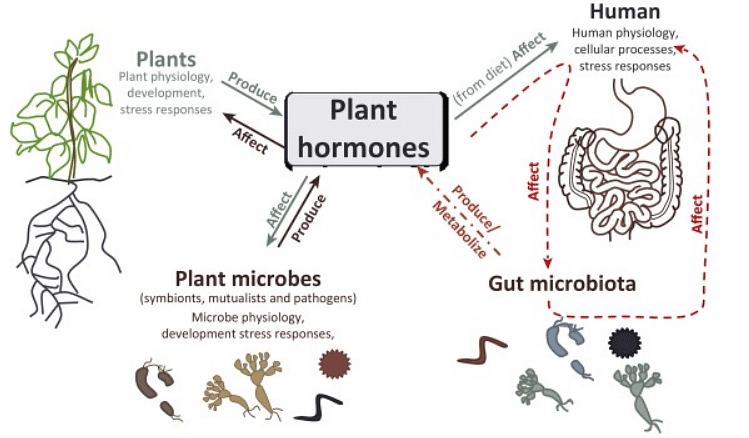
Plant Hormones
Plant hormones are divided into two categories based on how they work:
- Plant Growth Promoters
- Plant Growth Inhibitors
Read More:
The term "auxin" implies "to rise." They are commonly employed in agricultural and horticultural applications. Before travelling to other areas of the plant to accomplish their duties, they are found in the rising apices of roots and stems.
- Natural: Indole-3-acetic acid (IAA), Indole butyric acid (IBA)
- Synthetic: 2,4-D (2,4-Dichlorophenoxyacetic acid), NAA (Naphthalene acetic acid)

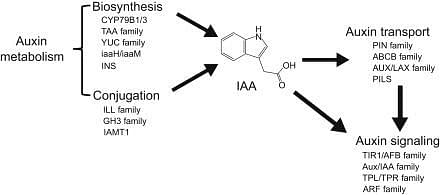
Auxin - Structure
In the coleoptile of canary grass, Charles Darwin noticed phototropism movement (plants bending towards light). He saw that near the tip of the coleoptile, there was an influencer that caused the bending towards the light.
The chemical responsible for phototropic movement in the oat coleoptile was later isolated and termed "Auxin" by Frits Went.
Read More:
Mechanism of Action of Auxin
[Click Here for Sample Questions]
- Apical meristem of shoots, immature leaves and seeds produces the majority of auxin.
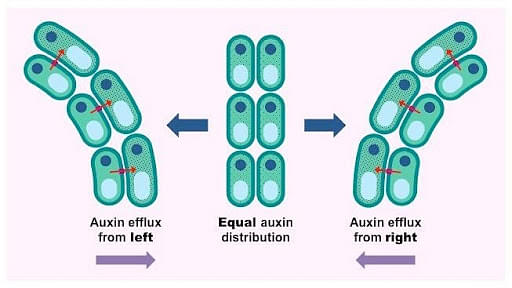
- Auxin is a unidirectional or polar protein that goes down from its source of production.
- Auxin concentration gradients emerge from polar transport, which drives particular responses.
- The flow of auxin out of the cell is controlled by auxin-specific transport proteins in the plasma membrane.

Mechanism of Action of Auxin
- Signal transduction is how plant hormones work, triggering many cellular responses.
- Auxin interacts with enzyme-linked receptors, promoting reaction catalysis.
- When auxin connects to a receptor, it causes a repressor protein for particular genes (auxin response gene) to bind to ubiquitin, causing the repressor protein to be degraded and the transcription of auxin response genes to progress, resulting in cellular growth and development.
Read Also:
Auxin Function
[Click Here for Sample Questions]
- Auxin increases the elongation of cells in shoots and coleoptiles.
- Callus Formation and Morphogenesis: Auxin enhances morphogenesis and produces callus formation in explants when combined with cytokinin.
- Secondary Growth: In the vascular cambium, auxin promotes secondary growth and drives cell division.
- Root Initiation on Cuttings: NAA is used to stimulate root formation in stem cuttings for asexual propagation.
- Apical Dominance: Apical dominance occurs when the expansion of the apical meristem suppresses the growth of axillary buds. The growth of lateral buds is induced when the shoot tip is removed. This is used to encourage branching in plants, such as hedges and tea plantations.
- Auxin causes parthenocarpy, in which the ovary enlarges and develops into a seedless fruit when administered to some flowers (unfertilized). This procedure is extensively used to make seedless tomatoes.
- Auxin is produced by seeds and works with gibberellins to accelerate fruit development and delay senescence.
Function of Auxins
- Flowering: It prevents blooms from becoming senescent. In some plants, a high quantity of auxin promotes femaleness. It encourages the blossoming of litchi and pineapple trees.
- Synthetic auxins, such as 2,4-D and 2,4,5-T, are commonly employed to destroy weeds. It does not affect grasses (monocotyledons)
- Auxin promotes tropism by causing phototropism, gravitropism, and thigmotropism, or movement in reaction to light, gravity, and touch.
- Cell elongation caused by auxins can explain phototropic movement (bending towards light). Due to auxin migration, auxin concentration rises on the shaded side. The shaded side experiences higher cell elongation than the light-exposed side.
Read More:
Things to Remember
- Auxins are powerful growth hormones, naturally emitted by plants.
- They are found in shoot and root tips, where they promote cell division, stem, and root growth.
- There are external influences at work. Aside from these factors, plants' growth and development are influenced by internal factors.
- Plant hormones, also known as phytohormones, are a type of hormone that plants generate.
- Plant hormones control all growth and development processes, including cell division, enlargement, flowering, seed generation, dormancy, and abscission.
- When auxin connects to a receptor, it causes a repressor protein for particular genes (auxin response gene) to bind to ubiquitin, causing the repressor protein to be degraded and the transcription of auxin response genes to progress, resulting in cellular growth and development
Read More:
Sample Questions
Ques. What exactly is a glycoside? (2 marks)
Ans: Glycoside is a naturally occurring molecule in which a carbohydrate component, consisting of one or more sugars or a uronic acid (i.e., a sugar acid), is coupled with a hydroxy compound. The hydroxyl molecule, which is normally a non-sugar entity (aglycon), such as a phenol or alcohol derivative, can also be a carbohydrate, such as cellulose, glycogen, or starch, which contain multiple glucose units.

Ques. What is polar auxin transport, and how does it work? (2 marks)
Ans: The controlled transport of the plant hormone auxin in plants is known as polar auxin transport. It is a dynamic process in which the hormone is transferred from cell to cell, with asymmetry and directionality being two of the most prominent elements of transport (polarity). The polar auxin transporter coordinates plant development; the spatial auxin distribution that follows supports most plant growth responses to its environment, as well as plant growth and development in general.

Ques. What is the difference between a plant hormone and a human hormone? (3 marks)
Ans: Plant hormones (also known as phytohormones) are signal molecules produced by plants and found in very low amounts. From embryogenesis to organ size regulation, pathogen defense, stress tolerance, and reproductive development, plant hormones regulate every aspect of plant growth and development. Unlike animals, which have specialised glands for hormone production, each plant cell can produce hormones. The term "phytohormone" was coined by Went and Thimann in 1937 and has been used as the title of their publication.
Ques. What is Meristem? (2 marks)
Ans: Plants have meristems, which are a form of tissue. Meristematic cells (undifferentiated cells) capable of cell division make up this type of cell. All of the additional tissues and organs found in plants can emerge from cells in the meristem. These cells keep dividing until they are differentiated, at which point they lose their ability to divide.

Ques. In plants, what is the role of Nitric Oxide (NO)?(2 marks)
Ans: The hormone and defence responses use nitric oxide (NO) as a signal (e.g. closure of stomata, root development, germination, nitrogen fixation, cell death, stress response). NO is created by a yet-to-be-identified NO synthase, a type of nitrite reductase, nitrate reductase, mitochondrial cytochrome c oxidase, or non-enzymatic mechanisms, and it regulates plant cell organelle functioning (e.g. ATP synthesis in chloroplasts and mitochondria).
Ques. What are the functions of plant peptide hormones? (2 marks)
Ans: All tiny secreted peptides involved in cell-to-cell signalling are referred to as plant peptide hormones. Defense mechanisms, cell division and expansion regulation, and pollen self-incompatibility are all regulated by these tiny peptide hormones. Water stress perceived in the roots is sent to the stomata in the leaves via the short peptide CLE25.
Ques. How does Auxin help in phototropism? (3 marks)
Ans: Phototropism is a phenomenon in which plants bend or move towards light. Auxins play a role in this. Because auxins are located in the shoot tip, it is responsible for the plant's directional movement in reaction to sunlight. Auxin is destroyed by sunshine, therefore the region of the plant's shoot tip that receives direct sunlight will have the least amount of auxin. After this lop-sided growth, the excess auxin present on the shaded side promotes greater cell division and elongation, causing the plant to bend towards the sunshine.
Ques. Differentiate between auxin, gibberellins, and cytokinins? (3 marks)
Ans: Auxins are a type of protein that promotes cell growth. It aids the development of roots. It aids in the following functions: breathing, motility, apical dominance, preoccupation inhibition, fruit growth, fruit sweetening, and parthenocarpy.
Gibberellins aid in fruit output and growth. It assists in the production of malt by overcoming dormancy. Flowering and parthenocarpy are both aided by it.
Cell division requires the presence of cytokinins. Cell differentiation is aided by this aid. They act as a deterrent to aging. They aid in the movement of phloem. They aid in the development of disease resistance and temperature tolerance. They aid in the elimination of apical dominance and the emergence of Lateral buds.
Ques. What might work against auxins' effects? (3 marks)
Ans: In roots, auxins have the opposite effect. This is referred to as negative phototropism. The shadowed side of a root has more auxin but grows slower. The root bends away from the light as a result of this.
Auxins are largely involved in stem elongation and apical dominance maintenance. Auxins are suppressed or neutralised by anti auxins. PCIB (p-Chlorophenoxy isobutyric acid) is a potential antiauxin that competes for binding sites with auxins.
Ques. Is Auxin helpful in promoting or delaying leaf abscission? (2 marks)
Ans: Auxin is involved in the abscission of leaves and fruits as well. Young leaves and fruits produce auxin and stay linked to the stem as long as they do. A specific layer of cells called the abscission layer arises at the base of the petiole or fruit stalk when auxin levels drop. At this time, the leaf or fruit breaks free from the petiole or fruit stalk and falls to the ground. It means that Auxin promotes leaf abscission.
Read Also:



Comments