



Content Curator
Movement in plants occurs in response to external stimuli and leads to the growth of plants. Plants do not show locomotion (i.e movement from one place to another) but they still show some movements in different parts, in response to environmental changes. These movements also contribute to the growth of plants.
| Table of Content |
Key Takeaways: Locomotion, Stimulus, Phytohormones, Phototropism, Thigmonasty, Thermonasty
Plant Hormones
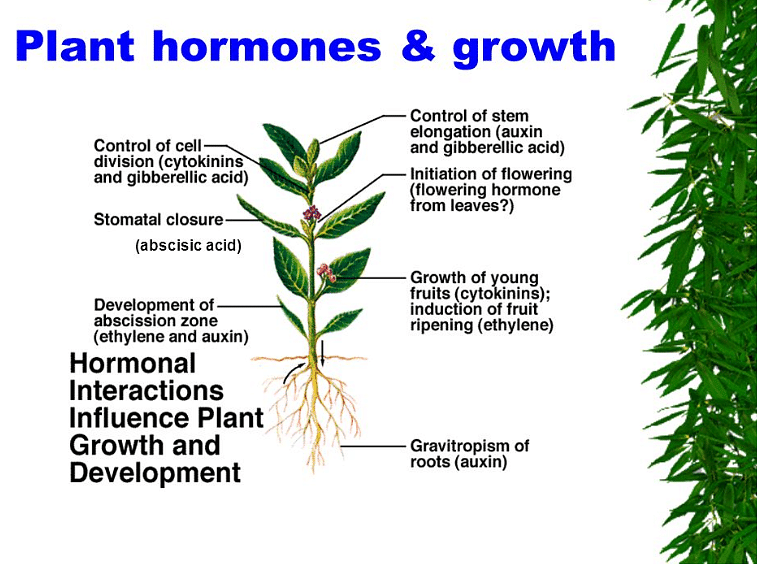
Plants lack a proper nervous system but they still sense stimuli and respond to them. They do so with the help of chemical messengers present in them called Hormones. The hormones in plants are termed Phytohormones.
Plant Hormones
These chemical substances are active in plants even at low concentrations. They coordinate the movement and growth of plants in response to environmental stimuli. This process is slow because plants do not have a well-developed nervous system. Phytohormones are responsible for their growth and development.
The main types of plant hormones are:
- Auxin
- Gibberellins
- Cytokinins
Read More:
Auxin
Auxin is a plant growth-promoter hormone. It controls the response of a plant towards light and gravity. Plant moves away from light and towards gravity due to the presence of auxin. Auxin is involved in cell enlargement, cell differentiation and fruit growth. Auxin is synthesized by plants at the tips of roots and stems.

Auxin
Gibberellins
It promotes cell differentiation and cell enlargement. It works in the presence of auxin. It plays a major role in plant growth and development. Gibberellin is involved in processes like seed germination, root and shoots elongation, breaking seed dormancy, development of flowers in plants etc.
Read More:

Gibberellic Acid helps in seed germination
Cytokinins
Cytokinins (CK) promote cytokinesis i.e cell division in plants. They also play an important role in cell growth and differentiation. They promote the opening of stomata and also delay ageing in leaves. They are present in the rapidly dividing cells of growing stems and roots.

Cytokinesis
Abscisic Acid
Abscisic acid is the growth-inhibitor hormone. It promotes seed dormancy, closing of stomata and ageing of leaves (i.e wilting and falling of leaves). It is also responsible for the detachment of fruits and flowers from the plant.
Read Also:
Types of Movements in Plants
Plants cannot move from one place to another. They can only show directional or non-directional movements in response to external factors like light, gravity, water, touch etc. These movements may or may not be growth-dependent. Thus, movements in plants are classified into two main categories:
Tropic Movements: They are growth-dependent. They may be towards or away from a stimulus.
Nastic Movements: They are growth-independent. They are independent of the direction of the stimulus.
These movements result in unequal growth in different regions of plants.
Read More: Receptors
Tropic Movements
Plants show tropic movements in response to external stimuli. This movement results in the growth of various parts of the plant. It is a directional movement which can be towards the stimulus or away from the stimulus.
Depending upon the direction, tropic movements can be positive or negative.
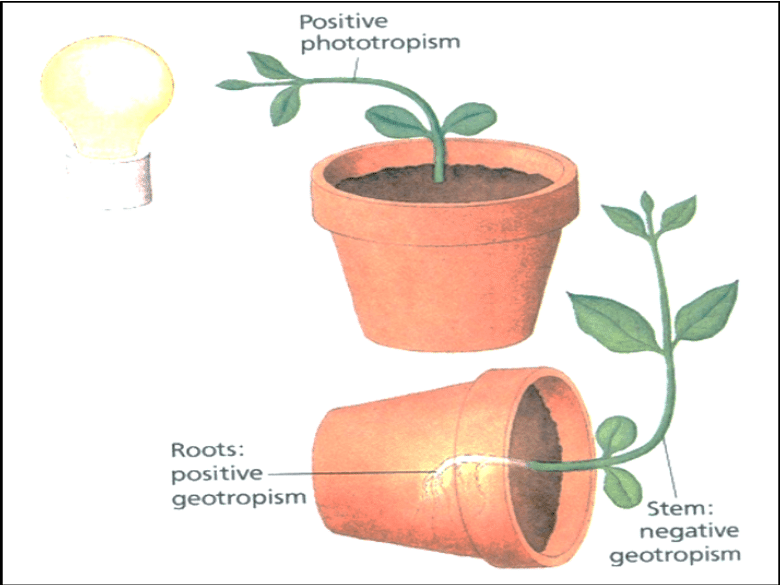
Positive Tropism: When the movement or growth of a plant is towards the stimulus, it is called Positive Tropism.
Positive and Negative Tropism
Negative Tropism: When the movement of plants is away from the stimulus, it is called Negative Tropism.
Read More: Respiration and Combustion
There are different factors in the environment to which plants respond. Depending on these external stimuli, five types of tropic movements are exhibited by plants which are discussed below.
Phototropism
When plants show movement in response to light, it is called phototropism. Auxin is synthesised in the root and shoot tips of the plant. In response to light, the auxin present in the shoot tip diffuses on the side away from light. It elongates the cells on that shady portion of the stem. This cell growth on one side causes the stem to bend to the other side i.e towards the light. This is positive phototropism. The roots of plants move away from light, so they show negative phototropism.

Plant showing positive phototropism
Geotropism
When plants show movement in response to gravity, it is called Geotropism. The roots grow downwards towards the gravity, so they exhibit positive geotropism. The stem of the plant grows upward, so it shows negative geotropism.

Geotropic Movement in Plants
Chemotropism
When a part of a plant grows in response to a chemical stimulus, it is called Chemotropism. This is seen in plants when a pollen tube grows towards the ovule for fertilisation.

Movement of Pollen Tube towards Ovule
Read More:
Hydrotropism
In hydrotropism, the stimulus is water. The movement of plants takes place in response to water. For example, the roots of the plants move in the direction of water so they show positive hydrotropism.

Hydrotropism in Plants
Thigmotropism
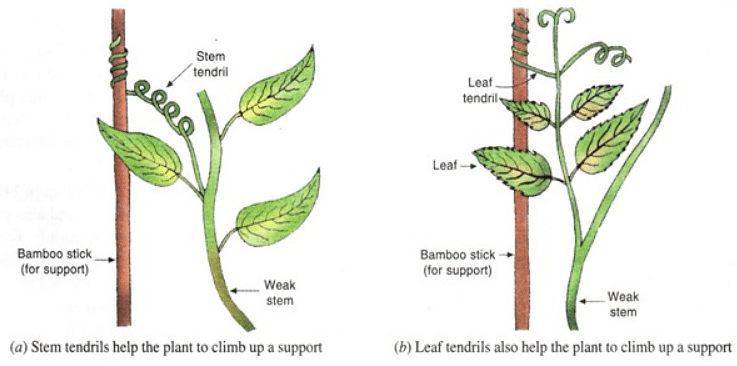
It is the movement and growth of a plant in response to touch. An example of thigmotropism is the coiling of tendrils of the plant when they come in contact with objects for support. This is positive thigmotropism. Negative thigmotropism is shown by the roots of plants. The roots grow away from the object when they come in contact with them. This is how they navigate in soil and grow.
Coiling of Tendrils is an example of Thigmotropism
Read More:
Nastic Movements
Nastic movements are the movements seen in plants which are not dependent on the direction of stimulus. It is a non-directional movement. In this type of movement, the parts of the plant move in the same direction irrespective of the stimulus. This may or may not result in plant growth.
The different types of nastic movements depending upon stimulus are,
- Thigmonasty
- Photonasty
- Thermonasty
Thigmonasty
It is the non-directional movement in response to touch. The leaves of the plant mimosa pudica fold upon touch. This plant is also called ‘touch-me-not’ plant. The plant has pulvini at the base of each leaf which contains water and keeps the leaves upright. When they are touched, the water is lost from pulvini and leaves fold.

Mimosa Pudica shows Thigmonasty
Photonasty
The non-directional movement of plant parts in response to light is called photonasty. This is observed in plants like Dandelion and Moonflower. The opening and closing of flower petals in response to light is an example of Photonasty.

Opening and Closing of Leaves is characterized by Photonasty
Thermonasty
The non-directional movement of plants in response to variation in temperature is called Thermonasty. This is observed in some Rhododendron species.

Opening and Closing of Flowers due to Temperature Change
Read Also:
Things to Remember
- Plants do not show locomotion. They exhibit movements of their parts in response to external stimuli.
- Plants lack a well-developed nervous system but sense stimuli and respond to them with the help of chemical messengers called Phytohormones.
- Auxin, gibberellins and cytokinins are plant growth-promoter hormones whereas abscisic acid is a growth-inhibitor hormone.
- Tropic movements are growth-dependent and directional depending upon the direction of stimulus.
- Nastic movements are growth-independent and non-directional independent of the direction of the stimulus.
- When the movement of plants is towards stimulus, it is called Positive Tropism.
- When the movement of plants is away from stimulus, it is called Negative Tropism.
Read More:
Sample Questions
Ques. What are phytohormones? (3 marks)
Ans. Phytohormones are the chemical messengers present in plants and are responsible for coordinating growth and movement in plants. They are crucial for plants to perform necessary functions. The main types of plant hormones are:
- Auxin - It is a growth-promoter hormone. It is involved in cell differentiation, cell enlargement and fruit growth.
- Gibberellins - It works in auxin presence. It is involved in processes like seed germination, flower development, root and shoot elongation etc.
- Cytokinins - It promotes cytokinesis in plants. It is also responsible for opening the stomata.
- Abscisic Acid - It is a growth-inhibitor hormone. It promotes wilting and falling of leaves, detachment of fruits and flowers from the plant, closing of stomata etc.
Ques. How do auxins promote the growth of a tendril around a support? (2 marks)
Ans. When the tip of the tendril comes in contact with an object, the auxin in its tip diffuses to the side away from the support. It promotes cell growth in that region. This side grows faster than the other and becomes longer. Due to this, the tendrils coil around the object and use it as a support.
Ques. What are the different pathways for the movement of water through the roots of a plant? (3 marks)
Ans. There are three different pathways for the movement of water through the roots:
- Apoplast Pathway - In the apoplastic route, water moves through the spaces present between the cells and in the cell walls themselves.
- Symplast Pathway - In the symplastic route, water passes from the cytoplasm of one cell to the cytoplasm of another cell through connections called Plasmodesmata.
- Transmembrane Pathway - In this pathway, water passes through the plasma membrane of each cell. Water in this route moves through both symplastic and apoplastic pathways.
Ques. How does transportation in plants take place? (5 marks)
Ans. Transportation in plants is the process of the transfer of nutrients and water from roots to the entire plant. Water and minerals are transported in plants with the help of two types of tissues:
- Xylem - It is a long, non-living tube extending from roots to leaves through the stem. The water absorbed by the root hairs transfer from cell to cell and reach the xylem. Through xylem vessels, water is transported to the leaves.
- Phloem - Phloem contains living cells. It is responsible for the transport of nutrients and sugars produced by the leaves to other areas of the plant.
There are three ways by which transportation occurs:
- Diffusion - In this process, the substances move from regions of higher concentration to that of lower concentration, without the use of energy. This is a passive process. In plants, transport of gases takes place through diffusion only.
- Facilitated Diffusion - Facilitated diffusion is also a passive process but it involves protein channels through which molecules pass. These channels are: Uniport, Symport and Antiport. Uniport facilitates the transport of a single solute from one side to another. Symport transports two molecules in the same direction whereas antiport transports two molecules in opposite directions.
- Active Transport - Active transport is the process of transfer of molecules against their concentration gradient by the use of energy. The energy is utilised in the form of ATP and substances are transferred from the region of lower concentration to higher concentration.
Read More:
Ques. What is Positive Phototropism? Explain with an example. (2 marks)
Ans. The movement of plant parts towards the light is called positive phototropism. In this case, the stimulus is light.
Positive phototropism is shown by plants in the presence of light. Auxin present in the shoot tips diffuses to the side away from light. As auxin promotes cell growth, the side in the shady portion grows longer than the side in front of light. Due to the cell growth, this side bends towards the light. Since the response (movement) is in the direction of stimulus, it is called positive phototropism.
Ques. What are the important factors affecting plant growth? (5 marks)
Ans. The main factors affecting the growth of plants are-
- Light - Plants are autotrophic in nature. They produce food on their own by the process of Photosynthesis. This process requires light in an appropriate amount. Without light, photosynthesis cannot occur. Also, other processes like opening and closing of stomata and chlorophyll synthesis also require light.
- Water - Water is important for the survival of plants. Water is absorbed by the roots of the plant and transported to other parts through xylem vessels. The extra water is lost from the plants by the process of transpiration. Water helps in keeping plants hydrated.
- Temperature - Plants require an optimal temperature for the process like photosynthesis, transpiration to occur. Temperature lower than the threshold value will slow down the growth of plants.
- Nutrients - Like animals, plants also require nutrients for their growth and development. Nitrogen, potassium, calcium, sulphur, magnesium etc. are the macronutrients required by plants in large amounts. And nutrients like iron, copper are required by plants in small amounts. Deficiency of these essential nutrients can make plants vulnerable to different diseases and result in stunted growth.
Read Also: Mendel’s experiment
Ques. What is Transpiration and what are its types? (5 marks)
Ans. Transpiration is the process by which a plant loses water in the form of water vapours through small openings in different parts. This maintains the level of water in the body of the plant. This process also helps in keeping plants cool in hot weather conditions.
Depending upon the part through which plant loses water, transpiration is of three types:
- Stomatal Transpiration - When water is lost through stomatal openings, it is called Stomatal Transpiration. A large amount of water is lost by the plants through this route.
- Lenticular Transpiration - In this type, water is lost through openings called Lenticels present in the bark and twigs of plants.
- Cuticular Transpiration - In cuticular transpiration, water is lost by plants through cuticles. Cuticle is a wax-like covering on the surface of leaves. When the stomata are closed, transpiration occurs mainly through cuticles.
Ques. What are some essential nutrients required for plant growth? (3 marks)
Ans. The nutrients essential for growth of plants are mentioned below:
- Nitrogen - Plants convert nitrogen in the form of nitrate and use it for various processes. Nitrogen is also required during chlorophyll production.
- Phosphorus - Phosphorus helps in the growth of roots and flowers in plants. It also helps plants cope up with harsh environmental conditions.
- Sulphur - Sulphur is involved in the production of amino acids, enzymes, seeds etc. It also makes plants disease-resistant.
- Calcium - Calcium is required in processes through which plants uptake nitrogen. It is also necessary for the development of cell-walls in plants.
- Potassium - Potassium is required by plants for growth and strength. It also prevents loss of extra water from plants.
Read More:
Ques. What is heterospory? Briefly comment on its significance. Give two examples. (3 marks)
Ans. The occurrence of two kinds of spores in the same plant is called heterospory. Among them, the smaller spore is called microspore and the larger spore is called megaspore. Heterospory first evolved in pteridophytes.
Significance of Heterospory
- Heterospory is associated with the sexual differentiation of gametophytes. A microspore develops into a male gametophyte whereas a megaspore develops into a female gametophyte.
- In homosporous pteridophytes spores have to germinate on soil thus face more environmental problems. In heterosporous pteridophytes, spores germinate within the sporangium and the gametophytes are retained inside for variable periods of time. Hence, germinating gametophyte has better chances of survival. This lays the foundation of complete retention of gametophytes within sporophytes in angiosperms and gymnosperms.
- Heterospory is the basis of development of seed habit in higher plants.
Read More:



Comments