



Content Writer
Transpiration is defined as the movement of water through the plants. In this process, water is first transported to the roots and then transferred to the xylem. Transpiration is a type of passive process that does not require any energy.
- Transpiration is responsible for evaporating the water from aerial plants.
- Aerial plants include roots, stems and leaves.
- The process removes the excess water received by the roots from the plant body.
- Stephen Hales (1677–1761), an English botanist and biologist, was the first to measure transpiration.
- According to recent studies, 99 per cent of the water a plant's roots take is discharged into the air as water vapour.
- Though the roots collect a lot of water from the soil, the plant uses only 2-5 per cent of it.
- Transpiration and the process of absorption of water is a cyclic process.
- It is a crucial function in plants that aids other processes and maintains water and nutrient balance.
- Transpiration is responsible for changing the osmotic pressure of cells.
Read More: Difference between photosynthesis and respiration
Key Terms: Transpiration, Excretion, Digestion, Growth, Plants, Xylem, Roots, Absorption, Water Vapour, Stomatal Transpiration, Lenticular Transpiration, Cuticular Transpiration
What is Transpiration?
[Click Here for Sample Questions]
Transpiration is the process by which the plant body releases water in the form of vapours through its aerial portions. It evaporates water from the plant and provides a number of benefits for the plant's body.
- Stephen Hales discovered that plants "imbibe" and "perspire" significantly more water than mammals.
- He developed a new method for monitoring plant water vapour emission.
- Hales discovered that transpiration occurs from the leaves, allowing for a constant upward flow of water.
- Transpiration dissolves nutrients from the roots.
- Water is absorbed by roots from the soil and transported to plant parts for photosynthesis.
- The transpiration pull is responsible for the upward movement of water against gravity.
- This upward pull is caused by the interaction of two forces: cohesive and sticky.
- Excess water received by roots is lost to the atmosphere in the form of water vapours.
- Plant roots receive water from the earth.
- It is then transferred to all parts of the plant for diverse processes such as food preparation, growth, and metabolism.
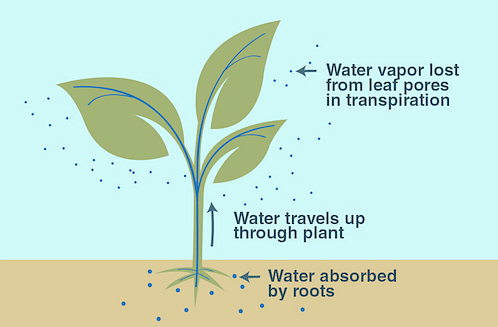
Transpiration
Read More:
Types of Transpiration
[Click Here for Sample Questions]
Plants only have three specific structures that allow them to breathe. There are three forms of transpiration, depending on how it occurs.
Stomatal Transpiration
Stomatal Transpiration is the evaporation of water from a plant's stomata. The majority of the water from the plants is lost through transpiration. When the stomata open, the water at the surface of the leaves turns into vapor and evaporates.
Lenticular Transpiration
Lenticels are tiny openings in the bark of branches and twigs that allow light to pass through. Lenticular transpiration is the process of water evaporating from a plant's lenticels. Lenticels aren't found in every plant. Through lenticels, only a small amount of water is lost.
Cuticular Transpiration
Cuticular Transpiration is the evaporation of water from a plant's cuticle. The cuticle is a waxy layer that covers the surface of the plant's leaves. Cuticular transpiration loses about 5-10 percent of the water from the leaves. More water is transpired via the cuticles during dry conditions when the stomata are closed.
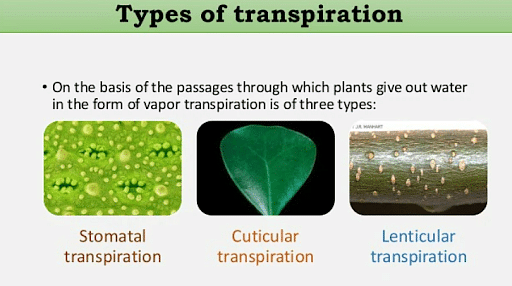
Types of Transpiration
Read More: Components of Ecosystem
Significance of Transpiration
[Click Here for Sample Questions]
The significance of transpiration is as follows:
- Transpiration helps in the regulation of temperature.
- The process has a cooling impact on the surface of leaves, resulting in a constant temperature in plants.
- The plant is insulated from the heat that is lost through transpiration.
- During passive absorption, the mass flow of water is discovered in mineral absorption.
- As a result, it's considered that minerals enter the roots via the water supply.
- Transpiration helps in the distribution of absorbed salts and gaseous exchange.
- It helps in controlling the hydrological cycle.
- Transpiration aids in the transport of xylem sap, which boosts mineral nutrient absorption by the roots.
- It creates suction pressure for absorption, sap ascent, mineral translocation, and mineral dispersion.
- Transpiration reduces the amount of heat that solar radiation heats the leaves.
- It assists in the hydrological cycle while also maintaining turgidity.

Trabspiration
Read More:
Mechanism of Stomatal Transpiration
[Click Here for Sample Questions]
The mechanism of stomatal transpiration is as follows:
- The intercellular spaces are exposed to the surfaces of spongy mesophyll cells in the leaf.
- These cells emit a thin coating of water where water is evaporated.
- Water vapor forms in the intercellular gaps saturates the air, and diffuses through connected intercellular spaces.
- It eventually reaches the sub-stomatal region.
- Finally, it is carried away by air into the atmosphere.
- Water absorbed by roots travels up the stem and into the tissues of the leaves.
- The turgor pressure on the cell wall is exerted by the cell sap in each cell.
- This pressure pushes some water out of the cell wall and into the intercellular space, which is the air space between the cells.
- The water vapour from intercellular spaces diffuses into the sub-stomatal region, eventually diffusing through the stomata.

Transpiration
Read More: Living & Non-living thing
Factors affecting Transpiration
[Click Here for Sample Questions]
Internal and external factors affect the process of transpiration, which is discussed in the below section.
External Factors
The external factors affecting the rate of transpiration are as follows:
Light
Light has an indirect effect on transpiration. In light, the rate of transpiration is always higher than in darkness. The stomata remain open in the presence of light, allowing for transpiration, but the stomata close at night, preventing transpiration.
- During the night, only lenticular and cuticular transpiration occurs.
- Blue light causes effective transpiration, which is followed by red light.
- Stomata never open in the presence of green light, UV rays, or infrared light.
Atmospheric Temperature
The rate of transpiration is proportional to the temperature of the atmosphere. When the temperature is high, the leaf surface produces a lot of moisture, which causes rapid transpiration.
Read More: Biome
Moisture
The rate of transpiration is increased when the weather is dry and low in humidity. In a saturated atmosphere, the rate of transpiration decreases.
Wind Velocity
When the atmosphere is windy, the rate of transpiration increases; yet, when the atmosphere is calm, the rate of transpiration lowers due to moist air around transpiring plants.
Solar Radiation
The relationship between solar radiation and transpiration is complex. The temperature of the leaves rises as a result of sun radiation, boosting the rate of transpiration.
Soil Environment
Soil Environment has an indirect effect on transpiration. When the absorption of water from the soil is high, transpiration is higher, and vice versa.
Read More: Morphology of Flowering Plants
Internal Factors
The internal factors affecting the rate of transpiration are as follows:
Root system
When the roots are firmly sunk into the soil in moist layers, there is plentiful water absorption and, at the same time, increased transpiration. If the roots are restricted to the upper layers of the soil, water absorption and transpiration are reduced.
Stem
The diameter of the xylem vessels in the stem determines the rate of transpiration. Increased transpiration is associated with wider xylem vessels and vice versa.
Leaf structure
Plants have a number of characteristics that help them control transpiration. With the multiple divisions of leaves in xerophytes, the area of the leaves is reduced. The leaves are sometimes completely missing, and the stems are flat, angular, or rounded. These are referred to as phylloclades. Opuntia, ex-Ruscus
- The surface of phylloclades allows for less transpiration.
- Some plants have unique depressions on their leaves where stomata are located and are surrounded by hairs.
- It helps to control transpiration.
- Nerium, Banksia, and other similar plants are examples of transpiration.
Read More: Excretion in Plants
Disadvantages of Transpiration
[Click Here for Sample Questions]
The various disadvantages associated with transpiration are as follows:
- The energy expended during the absorption of transpiration is thrown away.
- There is an unwanted loss of water.
- Excessive transpiration promotes wilting in plants, which is damaging to them.
- It raises soil acidity, alkalinity, and aridity.
Read More: Productivity in Ecosystem
Things to Remember
- Transpiration is a process by which the plant body releases water in the form of vapours.
- During the passive absorption of water, the mass flow of water is discovered in mineral absorption.
- Stomatal transpiration is the evaporation of water from a plant's stomata.
- The majority of the water from the plants is lost through transpiration.
- Lenticular transpiration is the process of water evaporating from a plant's lenticels.
- Cuticular Transpiration is the evaporation of water from a plant's cuticle.
- More water is transpired via the cuticles during dry conditions when the stomata are closed.
Read More: Predation
Sample Questions
Ques. Transpiration is a necessary evil in plants. Explain? (3 marks)
Ans. Transpiration results in a significant loss of water. Photosynthesis is reduced, growth is slowed, and the plant may wilt. Despite these drawbacks, it is unavoidable. It causes water to rise in the trees by tugging on it.
- Transpiration keeps the temperature stable.
- It creates suction pressure for absorption, sap ascent, mineral translocation, and mineral dispersion.
- Transpiration reduces the amount of heat that solar radiation heats the leaves.
- It assists in the hydrological cycle while also maintaining turgidity.
Ques. What is transpiration? Where does it occur? (3 marks)
Ans. The evaporation of water from plants is known as transpiration. It mostly affects plants when their stomata are open, allowing CO2 and O2 to pass through during photosynthesis. It is the "engine" that draws water up from the roots to:
- It supply photosynthesis (1%-2% of total).
- Transpiration transport minerals from the roots to the leaf for biosynthesis
- It help in chiling the leaf.
- Moisture is transferred through plants from roots to microscopic pores on the underside of leaves.
- It is converted to vapour and released into the atmosphere by transpiration.
Ques. When transpiration in plants will be lowest? (3 marks)
Ans. Transpiration is the loss of water in the form of vapour through the stomata. Carbon dioxide content, temperature, light, humidity, and other factors all influence the rate of transpiration. The vapour pressure differential between the leaf mesophyll and the atmosphere is the most critical component that determines the transpiration rate. As a result, the humidity rises, the rate of transpiration decreases, and vice versa.
Ques. What is the significance of transpiration? (2 marks)
Ans. Transpiration is the loss of water from stomata and lenticels in the form of vapour. It is represented by the pulling force that causes sap to rise, leaves to chill on the surface, and minerals dissolved in water to enter the plant body when water replaces the gaps left by evaporation.
Ques. Does transpiration mainly occur through? (3 marks)
Ans. Stomata are tiny opening structures on plants that are typically found on the epidermis or outer leaf skin layer. Guard cells surround a tiny pore called a stoma and comprise two specialized cells called guard cells. In plants, water is ephemeral. Photosynthesis and plant growth utilize less than 1% of the water that reaches the leaves. Most of it is lost through the stomata in the leaves. Transpiration is the term for this water loss.
Ques. How does the opening and closing of stomata regulate the transpiration process? (3 marks)
Ans. Stomata are tiny holes on the leaves lower surface that help exchange gas and water vapor. The rate of transpiration increases when the stomatal holes open, and the rate of water loss decreases when the pores close.
- The interior wall of the cells are dense.
- The wall of stomata open when turgidity inside the plant cell increase.
- The orientation of the microfibrils also helps in the closing and opening of stomata.
- The interior walls of the plant will form a crescent shape and retrieve their original shape.
Ques. What are the disadvantages of transpiration? (4 marks)
Ans. The disadvantages of transpiration are:
- The energy expended during absorption is thrown away.
- Unwanted water loss.
- Excessive transpiration promotes wilting in plants, which is damaging to them.
- It raises soil acidity, alkalinity, and aridity.
Ques. Write the significance of transpiration? (5 marks)
Ans. The significance of transpiration is:
- Transpiration aids in the transport of xylem sap; it boosts mineral nutrient absorption by the roots from the soil.
- It has a cooling effect on the surface of the leaf and plant.
- It creates suction pressure for absorption, sap ascent, mineral translocation, and mineral dispersion.
- Transpiration reduces the amount of heat that solar radiation heats the leaves.
- It assists in the hydrological cycle while also maintaining turgidity.
Ques. Explain the internal factors affecting the process of transpiration? (4 marks)
Ans. The internal factors afftecting the process of transpiration are as follows:
- Root system: When the roots are firmly sunk into the soil in moist layers, there is plentiful water absorption and, at the same time, increased transpiration. If the roots are restricted to the upper layers of the soil, water absorption and transpiration are reduced.
- Stem: The diameter of the xylem vessels in the stem determines the rate of transpiration. Increased transpiration is associated with wider xylem vessels and vice versa.
- Leaf structure: Plants have a number of characteristics that help them control transpiration. With the multiple divisions of leaves in xerophytes, the area of the leaves is reduced. The leaves are sometimes completely missing, and the stems are flat, angular, or rounded. These are referred to as phylloclades. Opuntia, ex-Ruscus are examples of transpiration.
Ques. Explain the external factors affecting the process of transpiration? (5 marks)
Ans. The external factors afftecting the process of transpiration are as follows:
- Light: Light has an indirect effect on transpiration. In light, the rate of transpiration is always higher than in darkness. The stomata remain open in the presence of light, allowing for transpiration, but the stomata close at night, preventing transpiration.
- Atmospheric Temperature: The rate of transpiration is proportional to the temperature of the atmosphere. When the temperature is high, the leaf surface produces a lot of moisture, which causes rapid transpiration.
- Moisture: The rate of transpiration is increased when the weather is dry and low in humidity. In a saturated atmosphere, the rate of transpiration decreases.
- Wind Velocity: When the atmosphere is windy, the rate of transpiration increases; yet, when the atmosphere is calm, the rate of transpiration lowers due to moist air around transpiring plants.
- Solar Radiation: The relationship between solar radiation and transpiration is complex. The temperature of the leaves rises as a result of sun radiation, boosting the rate of transpiration.
- Soil Environment: Soil Environment has an indirect effect on transpiration. When the absorption of water from the soil is high, transpiration is higher, and vice versa.
Ques. What are different types of transpiration? (3 marks)
Ans. The different types of transpiration are as follows:
- Stomatal Transpiration: Stomatal Transpiration is the evaporation of water from a plant's stomata. The majority of the water from the plants is lost through transpiration. When the stomata open, the water at the surface of the leaves turns into vapor and evaporates.
- Lenticular Transpiration: Lenticels are tiny openings in the bark of branches and twigs that allow light to pass through. Lenticular transpiration is the process of water evaporating from a plant's lenticels.
- Cuticular Transpiration: Cuticular Transpiration is the evaporation of water from a plant's cuticle. The cuticle is a waxy layer that covers the surface of the plant's leaves. Cuticular transpiration loses about 5-10 percent of the water from the leaves.
Ques. Explain how Stephen Hales invented the concept of transpiration? (4 marks)
Ans. Stephen Hales, an English botanist and biologist, was the first to measure transpiration. He discovered that plants "imbibe" and "perspire" significantly more water than mammals, and developed a new method for monitoring plant water vapor emission.
- He discovered that transpiration occurs from the leaves, allowing for a constant upward flow of water and dissolved nutrients from the roots.
- According to recent studies, up to 99 percent of the water taken in by a plant's roots is discharged into the air as water vapor.
- Though the roots collect a lot of water from the soil, only 2-5 percent of it is used by the plant.
- The other 95-98 percent is lost through transpiration.
- Excretion, like all other life processes (feeding, digestion, growth, and so on), is a vital one.
- Plants are no exception; they must also expel excess water from their bodies.
Ques. What are the factors on which ascent of a sap depend? (3 marks)
Ans. The factors on which ascent of a sap depend are as follows:
- Cohesion: Cohesion is defined as the attraction between water molecules.
- Adhesion: In case of adhesion, water molecules are attached to the surface of the tracheary elements found in xylem.
- Surface Tension: With the property of surface tension water surface will behave like a stretched membrane.
Read Also:



Comments