



Content Curator
Balanced forces act on an object and don’t change the state of rest or of uniform motion. While unbalanced forces are opposite forces that act on an object and bring it in motion. Force is omnipresent, from the solar system, where the sun's gravitational attraction ties all elements together, to a child lifting a toy. Newton's First Law states that unless an external force is given to a body at rest or in motion, it will remain in its fixed position. This means that an object's velocity will remain constant only if no forces are applied to it. Applying a force is the only way to change its velocity.
| Table of Content |
Key Terms: Balanced Forces, Unbalanced forces, Motion, Velocity, Magnitude
Also read: Moment of Force
Balanced Forces
[Click Here for Sample Questions]
Two equal-sized forces acting in opposite directions on an item are known as balanced forces. It implies that any pushes and pulls in one direction are counterbalanced by a force in the opposing direction. A body or an item in a balanced force maintains its position, i.e., it may remain stationary or continue to travel in the same path at the same speed.
It's vital to remember that an object can move even if there are no forces acting on it. A balanced force is the same as or the same as no force at all. As a result, balanced force equals no acceleration. The object would either accelerate or decelerate if the force becomes imbalanced.
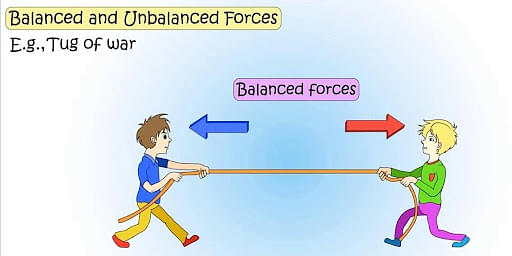
Balanced Forces
Also read: Balanced Force
Unbalanced Forces
[Click Here for Sample Questions]
Unbalanced force happens when the magnitude and strength of two forces operating in opposite directions on a body are not equal. A moving item alters its direction, either increasing or decreasing its speed, while a body at rest starts to move, and vice versa, in an imbalanced force.
This can happen when the forces acting on a body are unbalanced: a stationary item begins to move in the direction of the force acting. The speed and direction of a moving item shifts in the direction of the force applied.
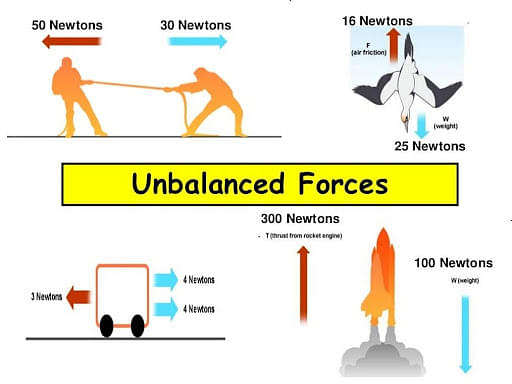
Unbalanced Forces Examples
Balanced and Unbalanced Forces: Characteristics
[Click Here for Sample Questions]
Characteristics of balanced and unbalanced forces are explained below:
Balanced Forces:
- The magnitude of balanced forces is the same.
- Forces in a balanced system are of equal size.
- In opposite directions, balanced forces act on an item.
- The condition of rest or movement of an object does not change while it is subjected to balanced forces.
- An object in motion cannot determine the movement or speed due to balanced forces.
- The net forces that act in balanced forces are zero.
Unbalanced Forces:
- When two or more items are pushed or pulled together in a push or pull movement, one of the forces is greater than the other.
- Unbalanced force can be applied in a variety of ways. Unbalanced force, for example, is employed to drive individuals through the air on numerous rides at an amusement park. Although air velocity has its own amount of force, if the propulsion, or push, of the thrill park ride is greater than the force of the air while it is travelling, the ride will continue to go ahead.
- An object can travel in the same path as another or in the opposite direction due to the motion created by an unbalanced force. This happens when more than one item applies force on an object at the same time.
Also read: Relation Between Pressure and Velocity
Balanced and Unbalanced Forces Examples
[Click Here for Sample Questions]
Examples are as follows:
- Balanced Forces-
- Each participant uses similar force but exerts in opposite directions in arm wrestling, which has no winner. The net force (net force) is zero.
- In a tussle, if the rope doesn't really move, the two teams are exerting balanced equal yet opposing forces. Yet again, the resultant force (net force) is negative.
- The forces acting on a suspended object are equal in size but operate in opposite directions. The weight pushes down, while the rope tension pulls up.
- It floats, when the mass of an object is balanced by the upthrust from the water. The thing will sink until the weight of the water it pushes out of the way matches the weight of the object.
- The reaction force of the surface balances the weight of an object sitting on a flat surface, like the earth. The thing is raised to the level of the stone. The response force is what you feel in your feet when you stand stationary. If you didn't have this balancing force, you'd plummet into the ground.
- Unbalanced Forces-
- In a tussle, if one side pulls more than the other, the result (net force) is that the rope reverses its momentum in the direction of the stronger force.
- When two people pull in the exact direction on an object at the same moment, the object's applied force equals the sum of their forces.
- An apple is exposed to an imbalanced force equal to its weight when it drops from a branch.
Also check:
Things to Remember
- A body in motion stays in motion with the same speed, and an item at rest stays at rest unless acted upon by an unbalanced force, according to Newton's first law. If the forces acting on an object are balanced, its velocity will remain constant.
- If its velocity is zero, it will remain so. If it's heading north at 10 miles per hour, it'll remain going north at 10 miles per hour. Applying an imbalanced force is the only way to adjust its velocity.
- An object in motion keeps moving in the same route and at the same speed. (Remember that while a force isn't required to keep an object in its current state, it is made to change an object's state of motion.)
- A body adapts its state of motion when it is subjected to an unbalanced force; we can see a shift in direction, or an increase or reduction in the speed of a moving item, and an object at rest begins to move, or a moving object may come to a standstill in the direction.
- According to the third law of motion, when one item force is exerted on another, the 2nd immediately creates a force on the first. The strength of these two forces is always equal, but their direction is always opposing. These forces are always applied to separate objects and yet never to the same one.
Read More:
Sample Questions
Ques. What happens when Unbalanced force acts on a body? (3 Marks)
Ans. When an imbalanced force is given to a body, the state of motion of the body changes, as does the direction in which the force is applied.
As a result, when an uneven force operates on a body, the following scenarios can occur:
- When an object is at rest, it begins to move in the direction of the motion.
- Under the influence of the force, an item in motion may come to a halt.
- The speed and direction of moving objects in motion can both vary.
Ques. How Can the Balanced forces be Demonstrated? (3 Marks)
Ans. The objects in the hanging and floating positions illustrate balanced forces.
When you gaze at a hanging glass bulb shade, you'll notice that the mass of the bulb shade pulls down, while the strain in the bulb shade's wire pulls up. The forces pressing down and up are in equilibrium here.
Picture a log adrift in a puddle of water. The log floats since the upthrust from the water balances the weight of the log. If you place more pressure on the log, the force pushing it down may be greater than the force pushing it up, causing it to sink.
Ques. What are the Types of Balanced Forces? (3 Marks)
Ans. The balanced forces are divided into two categories based on the direction of the force delivered to the body:
- Internal balanced force: The internal balanced force is a form of balanced force that functions in such a manner that it pushes the item inwards.
- External balanced force: The external balanced force is a form of balanced force that functions in such a manner that it pushes the item outwards.
Ques. How do Unbalanced Forces Cause Acceleration? (3 Marks)
Ans. When there is a loss of balance between two objects, unbalanced forces are generated, and the side with the greater applied force accelerates the side with the lesser force. The acceleration caused by an unbalanced force is exemplified by gravity.
Every item on Earth experiences a gravitational pull. Even though it is pushing harder than gravity, an aeroplane can stay in the air. If the plane's upward push suddenly stopped, gravity would push it downward, forcing the plane to accelerate as it approached the ground.
Ques. What is the Difference between Balanced Forces & Unbalanced forces? (3 Marks)
Ans. Difference is given in table below:
| Balanced Forces | Unbalanced Forces |
|---|---|
| The magnitudes of the forces are equal. | The magnitudes of the forces are uneven. |
| There is no change in the object's condition of motion as a result of it. | Allows the object's state of motion to change. |
| Example: The forces are balanced if the persons on each side of the rope are tugging with equal strength but in opposing directions. Hence, there is no motion. | Example: A tug-of-war game is an excellent approach to demonstrate an unbalanced force. The game will be won if the competitors on one side of the rope use more pressure than the other. |
Ques. What is the importance of Force in real life? (2 Marks)
Ans. The use of force is fairly widespread in our daily lives. To walk along the street, lift objects, toss a cricket ball, or propel a given body at a specific speed or direction, we employ force. The different impacts of force are well-known to humans. We have the ability to pull and push. Push must be applied through a hard connector, whereas pull can be applied throughout a non-rigid connector like a rope, string, or wire.
Ques. How Does Unbalanced forces help in Daily Life? (3 Marks)
Ans. Unbalanced force is responsible for moving things, with the direction of motion determined by the force with the greater magnitude. Unbalanced forces are capable of moving a stationary object, stopping a moving object, changing the speed of a moving object, and changing the shape of an object, among other things.
To get a non-moving item to move, unbalanced forces are required. Second, when unbalanced forces are applied to a moving object, the object's velocity changes.
Ques. A force of 5 N produces a mass m1 with a 10 m s–2 acceleration and a mass m2 with a 20 m s–2 velocity. What kind of acceleration would it produce if both masses were connected? (2 Marks)
Ans. F = ma = (20/1000) kg (– 0.02 m s–2 ) = – 0.0004 N is the pressure applied on the ball F.
The negative value indicates that the table's frictional force is directed in the reverse direction as the ball's velocity.
Learn about: Friction Force Formula



Comments