



Content Curator
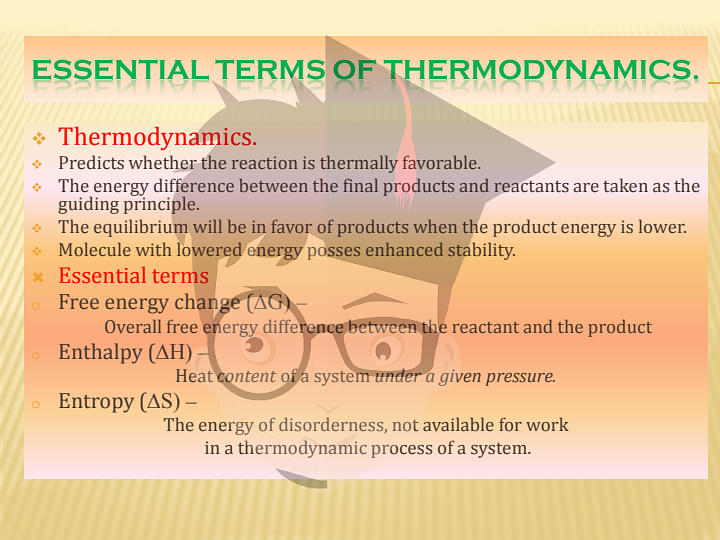
Enthalpy and Entropy are commonly used terms in the field of thermodynamics. Enthalpy is the measure of energy whereas entropy is the measure of degree of randomness of a system. Let us understand both these terms and the relationship between the two in detail.
What is Enthalpy?
[Click Here for Sample Questions]
In simple terms, Enthalpy is the product of pressure, the sum of internal energy, and the volume of a thermodynamic system. The best example of enthalpy is a fire or heated solution, freezing or boiling. During a chemical process, heat is emitted due to its reaction. To calculate this heat, we need enthalpy and it is considered very important. Enthalpy helps to determine whether a reaction was exothermic or endothermic. Endothermic means positive change in enthalpy and exothermic means a negative change in enthalpy. ‘E’ is the symbol used to denote enthalpy. Joules, Calorie, BTU (British thermal unit) are the units used to express enthalpy.
Read More: Celsius Scale
Important Terms Related to Enthalpy
[Click Here for Sample Questions]
- Enthalpy of formation - To produce a compound from a composition of elements a specific amount of energy is required. This required amount of energy is termed as enthalpy of formation. ΔHf is used to denote enthalpy of formation.
- Enthalpy of Solution - When we take a solution and put two substances into it, an amount of heat can be absorbed. This is termed an Enthalpy solution, which can either result as an exothermic reaction or an endothermic reaction. ΔHsolution is used to denote Enthalpy Solution.
- Enthalpy of Reaction - In any chemical reaction it is important to differentiate the product’s total enthalpy and reactant’s total enthalpy. This process of identifying the difference is known as the enthalpy reaction. ΔHRXN is used to denote the Enthalpy reaction.
- Enthalpy of Combustion - When we heat one mole of an element under a standard condition with excess oxygen, we can accomplish the enthalpy combustion. ΔHc is used to denote the Enthalpy combustion.
Read More: Applications of Thermodynamics
Formula of Enthalpy
[Click Here for Sample Questions]
E = U + PV
- E = Enthalpy
- P = Pressure
- V = Volume
- U = System’s internal energy
Read More: Heat Capacity
What is Enthalpy Change?
[Click Here for Sample Questions]
During a chemical reaction that is carried out in constant pressure, an amount of heat can be absorbed. This amount of heat is termed as Enthalpy change. We can use the term enthalpy change only for those reactions that are conducted under constant pressure. ΔH is the symbol used to denote enthalpy change and termed as ‘Delta H’.
Enthalpy Change Equation :
ΔH = ΔU + PΔV
Read More: Phase transition
What is Entropy?
[Click Here for Sample Questions]
The thermal energy of a system is measured per unit temperature and eventually disperse is termed entropy. Joules per kelvin is the SI Unit of Entropy and S is used to denote entropy. The best examples of entropy are a campfire, dissolving sugar or salt, melting ice, or boiling water. During a process, the entropy cannot be reversed, it either increases or remains constant.
Entropy Change equation :
ΔSsystem = q rev / T
- ΔS = Entropy’s change
- q rev = heat reverse
- T = Temperature in K
Entropy in an isothermal reaction
ΔS = Q/T
- ΔS = Change in Entropy
- Q = Change in Heat
- T = Temperature






Important Terms Related to Entropy
[Click Here for Sample Questions]
- In malleable solids, entropy is greater and in hard substances, entropy is lower. For instance, take water and dissolve a gas you can notice entropy decreasing. Try dissolving solid or liquid in the water you can observe entropy increasing.
- In simple terms, entropy increases when the mass increases.
- When the temperature is low during the heat transfer process then the change in entropy is increased.
- Entropy does not depend on the path of heat exchange; it relies on the thermodynamic system mass. Entropy is also known as extensive property.
Read More: Spontaneity
Relation Between Enthalpy and Entropy
[Click Here for Sample Questions]
In the year 1870, Josiah Willard Gibbs found the Gibbs energy which uses systems enthalpy and products entropy along with the temperature of the system to calculate the total available energy of a system. G is used to denote the Gibbs energy.
| Gibbs Energy equation |
| G = H + TS G = U + PV - TS |
- U = Internal energy (Joules)
- V = Volume (m3)
- P = Pressure (Pascal)
- S = Entropy (Kelvin)
- T = Temperature (kelvin)
- H = Enthalpy (Joules)
Change in Gibbs Energy equation :
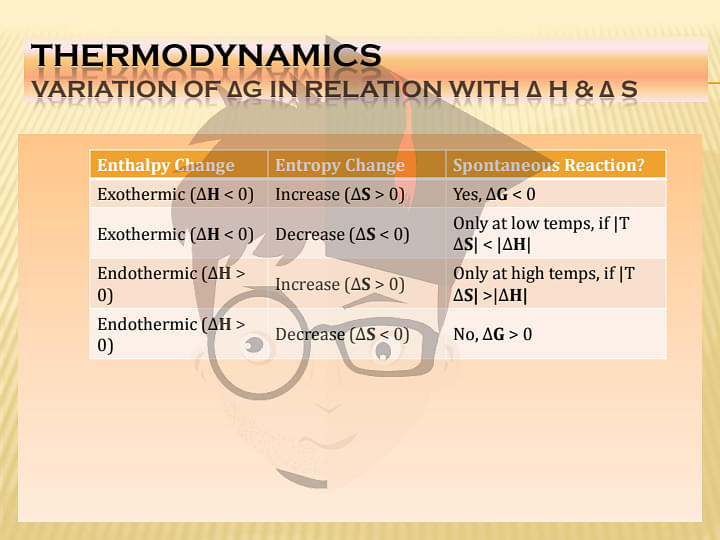
ΔG = ΔH - TΔS
Read More: Hess’s Law of Constant Heat Summation
Things to Remember
- Enthalpy is the measure of energy of a system
- Entropy is the measure of degree of randomness of a system
- Enthalpy is calculated using the formula E = U + PV
- Entropy is calculated using the formula ΔS = Q/T
- Enthalpy and entropy are related to each other using gibbs free energy. Formula for the same is ΔG = ΔH - TΔS
Sample Questions
Ques. What are Enthalpy and Enthalpy change? (2 marks)
Ans. Enthalpy is the product of pressure, the sum of internal energy, and the volume of a thermodynamic system. During a chemical reaction that is carried out in constant pressure, an amount of heat can be absorbed. This amount of heat is termed as Enthalpy change. ‘E’ is the symbol used to denote enthalpy. Joules, Calorie, BTU (British thermal unit) are the units used to express enthalpy. ΔH is the symbol used to denote enthalpy change and termed as ‘Delta H’.
Ques. What are exothermic and endothermic? (2 marks)
Ans. Endothermic means positive change in enthalpy and exothermic means a negative change in enthalpy. Enthalpy helps to determine whether a reaction was exothermic or endothermic.
Ques. What are enthalpy reactions and enthalpy formation? (2 marks)
Ans. In any chemical reaction, it is important to differentiate the product’s total enthalpy and reactant’s total enthalpy. This process of identifying the difference is known as the enthalpy reaction. ΔHRXN is used to denote the Enthalpy reaction. To produce a compound from a composition of elements a specific amount of energy is required. This required amount of energy is termed as enthalpy of formation. ΔHf is used to denote enthalpy of formation.
Ques. What are the properties of entropy? (2 marks)
Ans. In malleable solids, entropy is greater and in hard substances, entropy is lower. For instance, take water and dissolve a gas you can notice entropy decreasing. Try dissolving solid or liquid in the water and you can observe entropy increasing. Entropy does not depend on the path of heat exchange; it relies on the thermodynamic system mass. Entropy is also known as extensive property.
Ques. What is the SI unit of Entropy? (2 marks)
Ans. Joules per kelvin is the SI Unit of Entropy and S is used to denote entropy. The best examples of entropy are a campfire, dissolving sugar or salt, melting ice, or boiling water. During a process, the entropy cannot be reversed, it either increases or remains constant.
Read More:



Comments