



Education Journalist | Study Abroad Lead
Union of sets is one of the fundamental operations through which various sets can be related and combined with each other. It results in the formation of a new set containing elements of all the sets on which the operation has been applied.
The topic Union of Sets falls under CBSE Class 11 Mathematics. The chapter covers some basic definitions, types, and operations of sets. Click here to read more about the types of sets. The whole unit, i.e. Unit 1 Sets and Functions of CBSE Class 11 Mathematics, carries around 23 marks in the examination. Check CBSE Class 12 Mathematics.
Union of Sets: What are Sets?
[Click Here for Sample Questions]
In mathematics, a set refers to a collection of fixed objects like geometrical shapes, points in space, alphabetical letters, numbers, symbols, etc. The objects belonging to a set are known as their elements. A set that contains no element is known as a null or an empty set, which is usually denoted by { }. The sets having the same elements are said to be equal. A set is usually represented as S = {a, b, c, d}.

Sets and Elements of a Set
Union of Sets: Types of Sets
[Click Here for Sample Questions]
Based on the characteristics, sets are classified into many types:
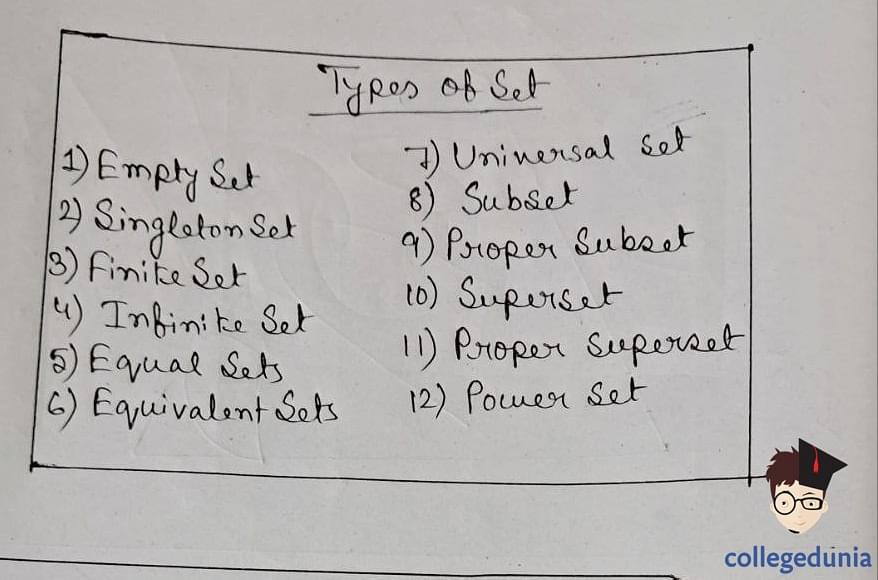
Types of Sets
In mathematics, certain operations are performed on two or more variables to get a new one such as addition, subtraction, etc. Similarly, in the set theory, specific operations are performed on two or more sets to get a new set, the elements of which depend on the operation performed.
The fundamental operations performed on sets are as follows :
- Union of sets
- Intersection of sets
- Difference of sets

Venn Diagram of Set Operations: Union, Intersection and Difference
In this article, we will discuss the union of sets in detail.
Union of Sets: Union of sets
[Click Here for Sample Questions]
The union of sets refers to a collection of all elements present in all the sets. By performing union operations, two or more sets can be combined. The union of sets can be denoted by ‘∪’.
Let us consider two sets X and Y, then Union of set X and set Y can be represented as:
X ∪ Y = {a: a ∈ X or a ∈ Y}
Example - Set A = {1,2,3} and set B = {1,4,5} then;
A ∪ B = {1,2,3,4,5}
Read Also: Class 11 Conic Sections
Union of Sets: Venn Diagram Representation of Union of Sets
[Click Here for Sample Questions]
Consider a universal set U such that set A and set B are subsets of this universal set 'U'. The union of sets A and B are the elements that lie in both sets A and B. The Venn diagram for the union of sets is shown below:

Venn Diagram of A ∪ B
The union of two sets A and B is given by the third set C, which means set C contains all those elements present in set A or set B.
| Relations and Functions | Types of Relations | Types of Functions |
| Binary Operations | Three-Dimensional Geometry | Plane |
Union of Sets: Properties of Union of sets
- A∪B = B∪A (Commutative law)
A∪B = {1,2,3,4,5,6}
B∪A = {1,2,3,4,5,6}
Therefore; A∪B = B∪A
- (A∪B)∪C = A∪(B∪C) (Associative law)
A∪B = {1,2,3,4,5,6}
(A∪B) ∪ C = {1,2,3,4,5,6} ∪ {6,7,8}
(A∪B) ∪ C = {1,2,3,4,5,6,7,8}
B ∪ C = {3,4,5,6} ∪ {6,7,8}
B ∪ C = {3,4,5,6,7,8}
A ∪ (B∪C) = {1,2,3,4} ∪ {3,4,5,6,7,8}
A ∪ (B∪C) = {1,2,3,4,5,6,7,8}
Therefore; (A∪B) ∪ C = A ∪ (B∪C)
- A∪Φ = A (The law of identity element; Φ is the identity of ∪)
Here two sets are given set A and set Φ,
Φ = empty set i.e. it has no elements and only set A contains the element, then the union will be only set A.
A ∪ Φ = {1,2,3} ∪ {}
A ∪ Φ = {1,2,3} = A
Therefore; A ∪ Φ = A
- A∪A = A (Idempotent law)
A ∪ A = {1,2,3} ∪ {1,2,3}
A ∪ A = {1,2,3} = A
- U∪A = U (Law of U)
Union will have all the elements of Universal set and set A.
Hence, union will be the universal set
U ∪ A = {1,2,3,4,5,6,7,8,9,10} ∪ {1,2,3,4}
= {1,2,3,4,5,6,7,8,9,10}
Therefore; U ∪ A = A

Properties of Union of sets
Check Important Link for Class 11 Horizontal and Vertical Lines
Union of Sets: Sample Questions
Ques. If A = {X: X is a natural number and a factor of 16} and B = {X: X is a natural number less than 6} then find A ∪ B? (1 marks)
Ans. Given: A = {1,2,4,8,16} and B = {1,2,3,4,5}
Then A ∪ B = {1,2,4,8,16} ∪ {1,2,3,4,5}
A ∪ B = {1,2,3,4,5,8,16}
Ques. If P = {3,6,9,12} and Q = {6,12,18,24,30}. Find P ∪ Q? (1 marks)
Ans. Given: P = {3,6,9,12} and Q = {6,12,18,24,30}
P ∪ Q = {3,6,9,12,18,24,30}
Ques. If A = {1,2,3,4,5}, B = {5,6,7,8}, and C = {6,8,11}. Find A ∪ B ∪ C? (1 marks)
Ans. Given: A = {1,2,3,4,5}, B = {5,6,7,8}, and C = {6,8,11}
A ∪ B ∪ C = {1,2,3,4,5,6,7,8,11}
Ques. If X = {1,2,6,7} and Y = {1,3,4,5,8}. Find X ∪ Y and also draw Venn diagram to represent it. (2 marks)
Ans. Given: X = {1,2,6,7}, and Y = {1,3,4,5,8}
Then X ∪ Y = {1,2,3,4,5,6,7,8}

Ques. Can any set element be negative? (1 marks)
Ans. No, the elements of any set cannot be negative. They can be natural numbers, rational numbers, whole numbers, imaginary numbers, or complex numbers.
Also Read:



Comments