



Education Journalist | Study Abroad Lead
Water is considered to be one of the most essential and vital elements required for the survival of all life forms on earth. Humans are extensively dependent on water for all its need. Hence, the study of water is of utmost importance. Multiple experiments have been conducted on it and a large amount of data has been recorded. Water is a chemical substance and has the formula H2O and is composed of two elements, namely, Hydrogen and Oxygen in the ratio 2:1. One molecule of water has two hydrogen atoms covalently bonded to a single oxygen atom. Water is so essential that we require it for every purpose be it domestic or industrial. 65 % of the human body is composed of water and it is vital for the survival of life on earth. Water is distributed unevenly on the earth’s surface. Water is a colourless, tasteless and odourless liquid as it is a polar inorganic compound.
| Table of Contents |
Key Terms: Water, Hydrogen, Oxygen, Polar Covalent Bond, Amphoteric Reaction, Redox Reaction, Liquid, Humans, H2O, Earth, Atom, Molecules
Water and Its Composition
[Click Here for Sample Questions]
Water is made up of 2 atoms of Hydrogen and 1 atom of Oxygen that are bound together by a covalent bond. It is a polar inorganic compound that is odourless, colourless and tasteless. It is the most studied chemical compound and is also widely known as the universal solvent. Water has a polar covalent chemical bond which means that the electrons are shared unequally among the 3 atoms.
The formation of a water molecule goes as follows: H2 + O2 = H2O

Water
Also Read: Importance of Water
Chemical Properties of Water
[Click Here for Sample Questions]
Water is highly reactive and thus reacts with a lot of substances and forms multiple compounds. Some of the important chemical properties of water are as follows:
Amphoteric Nature
This property of water is distinguishing and is one of the most important properties. It means that water has the ability to react as an acid as well as a base. Although, in its natural state, water is neither acidic nor basic. The prime reason behind this property is its tendency to gain as well as to lose protons in any chemical reaction.
Example:
- Acidic Behaviour: H2O (l) + NH3 (aq) → NH+4 (aq) + OH- (aq)
- Basic Behaviour: H2O (l) + H2S (aq) → H30+ (aq) + HS- (aq)
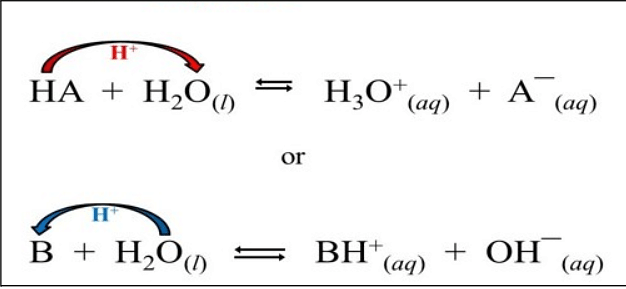
Amphoteric Nature of Water
Also Read: Acids, Bases and Salts
Redox Reactions
Water can be oxidised as well as reduced. Hence, it can undergo redox reactions easily. Electropositive elements have the ability to reduce water to hydrogen while electronegative elements have the ability to oxidise water to oxygen.
2H2O (l) + 2Na (s) à 2NaOH (aq) + H2 (g)
Hydrolysis Reaction
The hydrating tendency of water is very strong because it has a high dielectric constant. Thus, it also possesses the ability to dissolve numerous ionic compounds.
Solvency of Water
Being the universal solvent and high dielectric constant, it is regarded as the most solvent substance. Since positive charges in water are present due to hydrogen and negative charges are present due to oxygen, it attracts different molecules of multiple compounds, disrupts its molecular forces and makes it dissolve into it.

Water- The Universal Solvent
Check More:
Key Points About Water
[Click Here for Sample Questions]
Some of the important points about water are tabulated below:
| Chemical Formula | H2O |
| Molar Mass | 18.01528(33) g/mol |
| Boiling Point | 99.98 °C (211.96 °F; 373.13 K) |
| Melting Point | 0.00 °C (32.00 °F; 273.15 K |
| Acidity (pKa) | 13.995 |
| Vapour Pressure | 3.1690 kilopascals or 0.031276 atm |
| Basicity (pKb) | 13.995 |
| Refractive Index | 1.3330 (20°C) |
| Thermal Conductivity | 0.6065 W/m·K |
| Viscosity | 0.890 cP |
| Crystal Structure | Hexagonal |
| Molecular Shape | Bent |
Things to Remember
- Water is a chemical substance and has the formula H2O and is composed of two elements, namely, Hydrogen and Oxygen in the ratio 2:1.
- Water is a polar covalent compound. Water is also known as the universal solvent.
- The formation of a water molecule is H2 + O2 = H2O.
- Water is amphoteric in nature.
- It has a high value of the dielectric constant.
- About 85% of the human brain comprises water.
- Water is a colourless, tasteless and odourless liquid.
- Water has the ability to react as an acid as well as a base.
- Water can be oxidised as well as reduced.
- Water possesses the ability to dissolve numerous ionic compounds
Sample Questions
Ques. What is the dielectric constant and what is its value for water? (3 Marks)
Ans. Dielectric constant can be defined as a measure of the ease with which any substance can be polarized under the influence of an electric field. Thus, it is also a measure of the polarity of any substance. It can also be defined as the ability of a substance to insulate its charges.
The dielectric constant of water is very high and is recorded to be 78.6. Such high value helps it to be a great solvent for multiple substances, thus making it the universal solvent.
Ques. Explain the structure of water. (3 Marks)
Ans. One molecule of water comprises 2 hydrogen atoms, each of which is linked to a single oxygen atom by a covalent bond. The hydrogen atoms in H2O have 1 proton in each of their nuclei.
The oxygen atom has 6 electrons in its outer shell. Thus, by combining with the electrons of the 2 hydrogen atoms, the oxygen fills it by having 8 electrons. Due to the higher electronegativity of the oxygen atom, the electrons slightly move towards it, making the bond polar covalent in nature.
Ques. Explain the redox reaction of water. (3 Marks)
Ans. Redox reactions are oxidation-reduction reactions in which 1 element gets oxidized while the other one gets reduced. This is achieved by gaining or losing the electrons involved in the chemical reactions. Thus, it can be said that it is attained by the transfer of electrons among the species.
Water undergoes redox reaction in the format:
2H2O (l) + 2Na (s) à 2NaOH (aq) + H2 (g)
Ques. What is the amphoteric nature of water? Give some examples. (3 Marks)
Ans. The amphoteric nature means that water has the ability to act as an acid as well as a base in multiple chemical reactions. This gives a suggestion that water can be a proton donor as well as a proton acceptor depending on other chemical species involved in the reaction. Some examples of reactions that highlight the amphoteric nature of water are:
- Acidic Behaviour: H2O (l) + NH3 (aq) → NH+4 (aq) + OH- (aq)
- Basic Behaviour: H2O (l) + H2S (aq) → H30+ (aq) + HS- (aq)
Ques. What is the self-ionization property of water? (3 Marks)
Ans. Water undergoes self-ionization wherein its molecule, H2O, deprotonates itself i.e., loses its electron in order to form the hydroxide ion (OH-). The hydrogen nucleus (H+) then protonates itself i.e., accepts a proton from another water molecule to form the hydronium ion (H30+).
The reaction: H2O + H2O → H3O+ + OH−
This is also called auto-protolysis and it exemplifies the amphoteric nature of water.
Ques. What is the temporary and permanent hardness of water? (3 Marks)
Ans. Temporary hardness of water happens because of the presence of Magnesium bicarbonate and Calcium bicarbonate. Such hardness can be removed from water by boiling it. The reason behind this is that boiling promotes the formation of carbonate precipitate which can easily be separated from the water.
Permanent hardness of water happens because of the presence of calcium and as well as magnesium chlorides, nitrates and sulphates. This cannot be removed through the boiling process but can be removed by treating water with washing soda (Na2CO3)
Ques. Explain electrolysis of water. (3 Marks)
Ans. During the electrolysis of water, it can be split into its constituent elements, hydrogen and oxygen with the help of electric current passing through it.
The half-reaction on the cathode is: 2 H+ + 2 e- à H2
The half-reaction on the anode is: 2 H2O à O2 + 4 H+ + 4 e-
The potential required for the electrolysis of pure water is 1.23 V at a temperature of 25 °C.
Check More:



Comments