



Content Curator
Electropositivity is the tendency of an atom to donate electrons and form positively charged cations. Chemical reactions occur either by losing or gaining electrons to form chemical compounds. The term electronegativity and electropositivity come from the repulsion or attraction of charged electrons to the chemical elements. Electropositivity deals with the ability of a chemical element to lose its electrons to form a positively charged cation whereas electronegativity is the ability to gain electrons to form negatively charged electrons. Electropositivity is the opposite of electronegativity. Alkali metals mostly show electropositive characters to attain the nearest electronic configuration.
| Table of Content |
What Is Electropositivity?
[Click Here for Sample Questions]
The term Electropositive is generally defined as the tendency of an atom to release its electron to another atom to form a positively charged cation. The ability of an atom to form a cation is mostly shown by the metallic elements of the periodic table i.e. Alkali metals or alkaline metals.
Electropositivity is opposite to the term of electronegativity in which an element accepts an electron from another element to form a negatively charged anion. The higher the electronegativity character of an element, the lower the electropositive elements and vice versa. The electropositive elements lose electrons to electronegative elements to form an ionic compound. For example, Magnesium (Atomic Number :12) which has two electron in its outermost orbit lose its electron to form a positively charged cations in order to achieve the nearest noble gas electronic configuration whereas Chlorine (Atomic Number :17) a highly negative elements accepts the two electron to form a positively charged anion in order to complete its stable octet.
Therefore from the above mentioned example we can say, the electropositive element Magnesium and the electronegative element Chlorine combined to form an ionic salt named Magnesium Chloride or MgCl2. Magnesium Chloride is useful to treat and prevent the low amount of magnesium in the blood.
Difference between the Electropositive and Electronegative
[Click Here for Sample Questions]
Below we have given a comparison between the electropositive and electronegative of elements to help in understanding it better.
| Electropositive | Electronegative |
|---|---|
| It refers to the ability of an element to lose electrons in a chemical reaction | It is ability of an element to gain or accepts electrons |
| It repel electrons | It has the ability to attract electrons towards itself |
| It forms positively charged cations by removing one or more electrons | It forms negatively charged anions by accepting one or more electrons |
| Shown by mostly metals such as alkali and alkaline earth metals | Non metallic in nature |
| Most electropositive elements are Francium or Cesium | Most electronegative element are Fluorine or Chlorine |
Periodic Trends in the Electropositive Element
[Click Here for Sample Questions]
The periodic trends of the electropositive elements can vary depending upon various factors such as the ionisation energy of an element, the metallic character of the element, distance between the outermost electron and the nucleus of an element and the effective nuclear charge on the valence electrons. Since, electronegativity is opposite of electropositivity, we can say that the periodic trends of an electropositive element is always opposite to the periodic trends of an electronegative element.
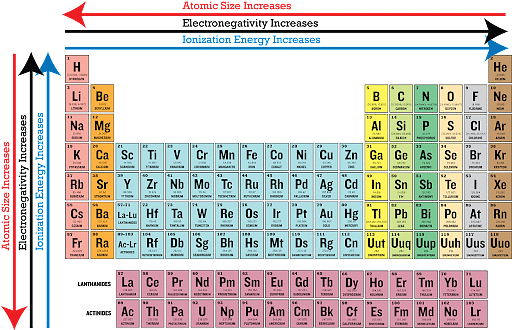
If an element goes from left to right in a period of the periodic table its electropositive character decreases whereas the electronegativity of an element increases across the period. And if an element goes from top to bottom in a group of periodic tables, the electronegativity decreases whereas the electropositivity of an element increases down the group. That's why the element at the top right of the periodic table is the least electropositive and the elements at the bottom left are more electropositive.
Almost all the alkali metals are considered as the most electropositive elements in the periodic table because the electropositivity of an element depends upon the metallic character of an element. Francium and Cesium are regarded as the highest electropositive elements and fluorine chlorine and oxygen are the most electronegative elements of the periodic table.
This image shows the periodic trends in the electropositive element:
Electropositive Character of An Element
[Click Here for Sample Questions]
The ability of an element to release an electron from its outermost electron shell to form a positively charged cation is known as the electropositive character. The elements having low ionisation energy have the highest tendency to release its electron to other elements. The nature of an electronegativity is effectively described by various factors: the more the element is inclined to lose electrons, the more they push electrons to another element.
Below we have given the periodicity of the element
- Going top to bottom down the group, the electronegativity decreases because the atomic number of an element increases down the group and thus the distance between the outermost electrons and the nucleus increases and the atomic radius.
- Going from left to right in the periodic table the electropositivity decreases. If the outermost shell of an element is less half full then it requires less energy to accept an electron than to lose whereas if it is more than the half electron it is easier to lose.
- The electropositivity and the metallic character of the electron also increases from top to bottom in a group.
Things To Remember
- The elements in the periodic table are divided into two parts: alkali metal and alkaline earth metals. Some metals and some are non metals.
- Both metals and nonmetals are classified as electropositive and electronegative.
- The electropositive element or group releases its electrons i.e. metals and acidic hydrogen.
- The electrode potential of an electropositive element has higher positivity than the standard hydrogen electrode which has a value of zero.
- Some monovalent alkali metals are Li+, Na+, K+ etc and divalent alkaline earth metals are Be2+, Mg2+, Ca2+ etc.
Important Questions
Ques 1. Give the chemical formulae of the following compounds: (3 marks)
(i) Magnesium chloride
(ii) Calcium oxide
(iii) Copper nitrate
(iv) Aluminium chloride
(v) Calcium carbonate.
Ans. The chemical formula of the compounds are given below
(i) Magnesium chloride
Symbol -Mg Cl
Charge - +2 -1
Formula - MgCl2
(ii) Calcium oxide
Symbol - Ca O
Charge - +2 -2
Formula - CaO
(iii) Copper nitrate
Symbol - Cu NO
Charge +2 -1
Formula -4 CU(N03)2
(iv) Aluminium chloride
Symbol - Al Cl
Charge - +3 -1
Formula - AlCl3
(v) Calcium carbonate
Symbol - Ca CO3
Charge - +2 -2
Formula - CaC03
Ques 2. What do you mean by polyatomic ions? Give examples. ( 2 marks)
Ans. The ions which have more than one atom either same or different and behave as a single unit of charge are known as polyatomic ions. Example: OH–, SO4²-, CO3²-.
Ques 3. Which element has the highest Electropositivity? ( 2 marks)
Ans. Caesium 'Cs' has the highest electropositive character in the periodic table. It is located in the first group and sixth period of the table. It has one electron in its outermost orbit so that it can easily donate its electron to attain the nearest noble gas electronic configuration.
Ques 4. Why is sodium metal less reactive than potassium metal? ( 2 marks)
Ans. As we know, the ionization enthalpy ?Hi of a potassium metal is 419 kJ mol -1 whereas the ionization enthalpy of sodium element is 496 KJ mol. Hence, we can say that the Ionization enthalpy of potassium is less than that of sodium, so potassium is more reactive than sodium.
Ques 5. Why are potassium metal and caesium metals used in photoelectric cells rather than lithium elements? (2 marks)
Ans. Potassium and Caesium have the lowest ionisation enthalpy than lithium element. So these metals can easily emit electrons on exposure to light. That's why potassium and caesium are used in photoelectric cells.
Ques 6. Why are lithium salts more commonly hydrated than any other alkali metal? (1 mark)
Ans. Lithium Li+ ions are relatively smaller in size which can polarize water molecules more easily than any other alkali metal ions.
Ques 7. Consider the following species:
F–, Na+, Mg2+, N3-, O2-, Al3+
What is common in all of them and arrange them in order of increasing ionic radii? ( 2 marks)
Ans. All the given species are isoelectronic in nature and have 10 electrons. As we know that in isoelectronic species, the greater the nuclear charge, the lesser will be the atomic or ionic radius so the arrangement is
Al3+ < Mg2+ < Na+ < F– < O2- < N3-
Ques 8. Why does electropositivity increase in the group? ( 2 marks)
Ans. As we go from top to bottom down the group, the electronegativity decreases because the atomic number of an element increases down the group and thus the distance between the outermost electrons and the nucleus increases and the atomic radius.



Comments