



Education Content Expert
Hydrogen is the most abundant chemical element that accounts for 90% of all the atoms.
- It is the smallest and lightest element, with an atomic weight of 1.008u and atomic number 1.
- The most common form of hydrogen is a gas, which is colourless and odourless but combustible.
- Hydrogen is a unique element since it resembles both halogens and alkali metals.
- Since it is a particularly reactive element, various hydrides and other compounds can be created.
- Hydrogen is found in both plant and animal tissues.
Preparation of Hydorgen is possible in laboratories as well as commercially through various methods. It is used for the synthesis of a variety of elements and other compounds.
| Table of Content |
Key Terms: Hydrogen, Halogens, Electronic Configuration, Ion, Covalent Compounds, Atomic Number, Element
What is Hydrogen ?
[Click Here for Sample Questions]
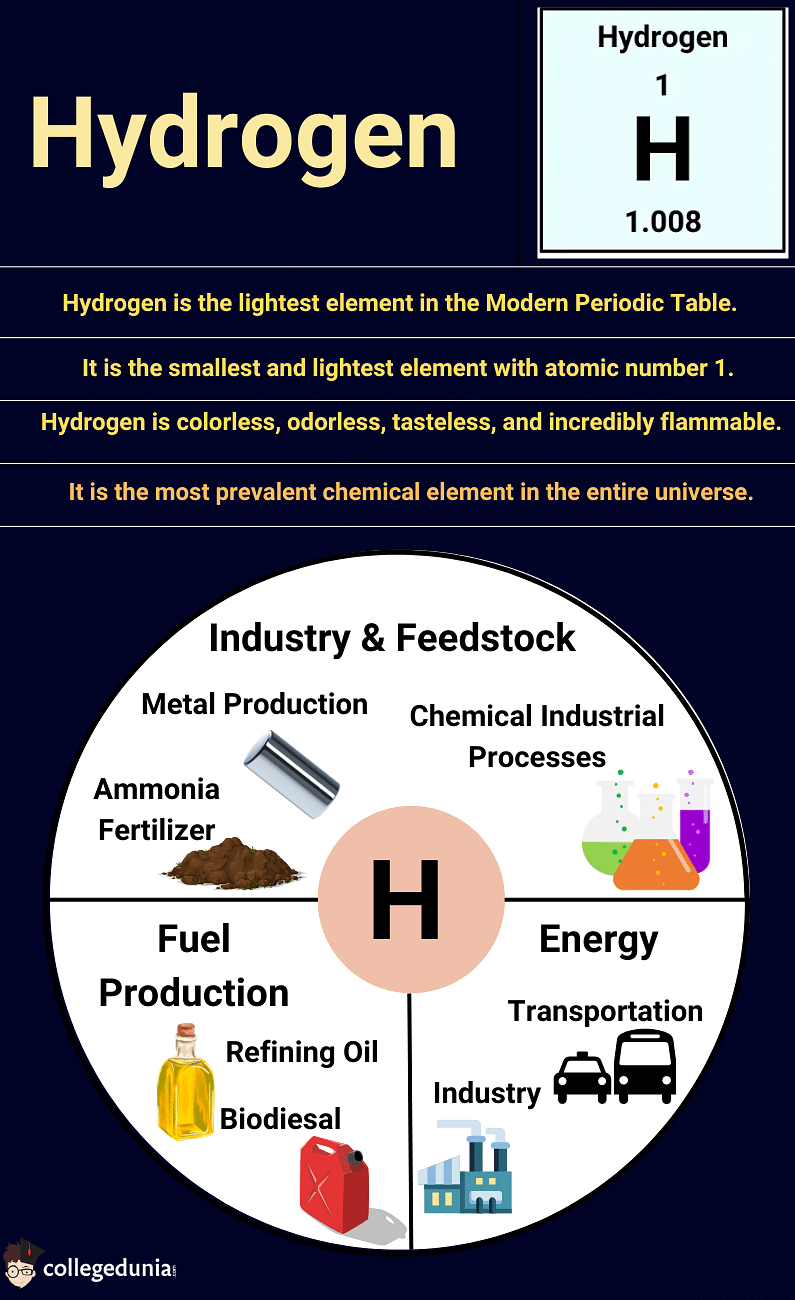
Hydrogen is the lightest element in the Modern Periodic Table. It has the symbol H and the atomic number 1. Under normal conditions, hydrogen is a gas composed of diatomic molecules with the formula H2.
- Hydrogen is colorless, odorless, and tasteless, non-toxic, and incredibly flammable.
- It is the most prevalent chemical element in the universe, accounting for approximately 75% of all normal matter.
- Sun and other stars are mostly made up of hydrogen in the plasma state.

Hydrogen
Properties of Hydrogen
[Click Here for Previous Year Questions]
Hydrogen is a unique element as it resembles both halogens and alkali metals. The electronic configuration of hydrogen is 1s1. It is a reactive element that produces several hydrides and other products. It can be found in significant amounts in plant and animal tissues.
Properties of Hydrogen Similar to Alkali Metals
The important properties of hydrogen which resembles alkali metals include:
- The electronic configuration of hydrogen (1s1) is similar to the alkali metals.
- Like alkali metals hydrogen also loses one electron to form a unipositive ion.
- One more similarity with alkali metals is that like alkali metals hydrogen also forms halides, oxides, and sulfides.
Properties of Hydrogen Similar to Halogens
The important properties of hydrogen which resembles halogens include:
- Like halogens, hydrogen is short by one electron from its corresponding noble gas.
- Like halogens, it gains one electron to form a uni negative ion.
- It also forms diatomic molecules and combines with elements to form hydrides and a large number of covalent compounds.
Read More:
| Relevant Concepts | ||
|---|---|---|
| Hydrogen Fuel | Isotopes of Hydrogen | Hydrogen Bonding |
| Position of Hydrogen in the Periodic Table | Hydrogen Bomb | Hydrogen Chloride |
Isotopes of Hydrogen
[Click Here for Sample Questions]
Isotopes are the one or two forms of the same element, which differ in the mass number of the atom but having the same atomic number.
- Hydrogen has the three most stable, naturally occurring isotopes namely Protium 1H1, Deuterium 1H2, Tritium 1H3, or T.
- They all differ from each other in a number of neutrons.
- Ordinary hydrogen or protium has no neutrons, deuterium has one neutron, and tritium has two neutrons.
Preparation of Hydrogen
[Click Here for Previous Year Questions]
Hydrogen is produced when powdered zinc and diluted hydrochloric acid are combined. TAdditionally, we can create hydrogen by combining zinc and aqueous alkali.
- Hydrogen is created through the electrolysis of acidified water using platinum electrodes.
- Warm aqueous barium hydroxide solution can be electrolyzed between nickel electrodes to produce hydrogen that is highly pure.
- Hydrogen is created when a stream combines with hydrocarbons at extremely high temperatures while using a catalyst.
- For instance, at 1270 K in the presence of nickel, methane interacts with water to produce carbon monoxide and water.
Preparation of Hydrogen can be done through the following methods:
- Preparation of Hydrogen by Laboratory Method
- Preparation of Hydrogen by Commercial Method
- Industrial Preparation of Hydrogen
Preparation of Hydrogen in Laboratory
Hydrogen is prepared in laboratory though the following methods:
(I) When granulated Zinc is added to dilute hydrochloric acid, the hydrogen gas is formed.
Zn + HCL → ZnCl2 + H2
(II) When aqueous alkali is treated with zinc, hydrogen is produced.
Zn + 2NaOH → Na2ZnO2 + H2
Preparation of Hydrogen by Commercial Method
There are several commercially available methods for preparing hydrogen, and this is one of them. The following are some examples of generalized approaches.
(I) Electrolysis of acidified water produces hydrogen in the presence of platinum electrodes.
2 H2O (l) → 2 H2 (g) + O2 (g)
(II) Electrolyzing warm aqueous barium hydroxide solution in presence of nickel electrode will give high purity hydrogen.
(III) Electrolysis of brine solution gives sodium hydroxide and chlorine; hydrogen is obtained as a byproduct.
2 Na+ (aq) + 2 Cl- (aq) + 2 H2O (l) → Cl2(g) + H2(g) + 2Na+ (aq)+ 2 OH- (aq)
(IV) Hydrogen is obtained by the reaction of steam and coke at high temperature and presence of a catalyst.
C nH2n+2 + nH2O → nCO + (2n+1) H2
CH4 (g) + H2O (g) → CO (g) + 3H2 (g)
Industrial Preparation of Hydrogen
The catalytic steam-hydrocarbon process is an important industrial method for producing hydrogen. At 650°-950° C, the gaseous or vaporized hydrocarbons are treated with high pressure steam over a nickel catalyst to generate carbon oxides and hydrogen.
CnH2n+2 + nH2O → nCO + (2n+1) H2
CnH2n+2 + 2nH2O → nCO + (3n+1) H2
The major reaction products are then treated in various ways depending on the application of the hydrogen. Another important method of producing hydrogen is the noncatalytic partial oxidation of hydrocarbons at high pressures.
CnH2n+2 + n/2O2 → nCO + (n+1) H2
A feed system is required for correct oxygen and fuel rates. Individual design burners is required for rapid reactant mixing. And a cooling system is required to recover heat from effluent gasses.
What is Syngas?
[Click Here for Sample Questions]
Syngas is a mixture of carbon monoxide and water. It is commonly referred to as water gas.
- It is called so because it is used in the synthesis of methanol and numerous hydrocarbons.
- It can be made made from sewage, sawdust, scrap wood, and other wastes.
- Syngas can also be generated from coal, a process known as coal gasification.
Hydrogen gas generation can be boosted by reacting syngas carbon monoxide with a stream in the presence of iron chromate as a catalyst and at a temperature of 673K.
CO2(g) + H2O(g) = CO(g) + H2O(g)
The reaction described above is known as the water gas shift reaction.
Uses of Hydrogen
[Click Here for Previous Year Questions]
Some important uses of Hydrogen include:
- Hydrogen is used in the synthesis of various inorganic compounds such as ammonia, nitric acid, and nitrogenous fertilizers.
- It is used in the synthesis of vegetable oils from vanaspati fats.
- It is used in the preparation of a highly useful chemical, hydrogen chloride.
- Many metal hydrides are manufactured using hydrogen.
- Hydrogen in its liquid form is used as rocket fuel.
- It is used for generating electrical energy in various fuel cells as it does not produce any pollution.
- Scientists are visualizing hydrogen as a future source of energy.
- Atomic hydrogen produced by the dissociation of hydrogen is used in cutting and welding purposes.
Check More:
| Related Topics | ||
|---|---|---|
| Bohr Model of the Hydrogen Atom | Laboratory Preparation of Hydrogen Gas | Hydrogen Peroxide |
| Periodic Classification of Elements | Difference Between Element and Compound | Hydrogen Spectrum |
Things to Remember
- Hydrogen is the first element in the periodic table denoted by the symbol ‘H’.
- The properties of hydrogen resembles bioth alkali metals and halogens.
- Hydrogen is typically created when powdered zinc reacts with diluted hydrochloric acid.
- It can also be prepared through various commercial and industrial methods.
- The most significant use of hydrogen is synthesis of Ammonia.
- Hydrogen serves as rocket fuel in space research.
Previous Years’ Questions
- Hydrogen can be prepared by the action of dil… (AIIMS - 2007)
- Hydrogen gas is prepared in the laboratory by reacting…
- Which of the following statement about hydrogen is… (NEET - 2016)
- Hydrogen bond is strongest in… (AIPMT - 1992)
- Oxidation state of hydrogen is +1 in… (AIIMS - 2018)
- Hydrogen peroxide is prepared in the laboratory by…
- Which one of the following can produce hydrogen when… (Rajasthan PMT - 2006)
- Hydrogen gas will not reduce… (JEE Advanced - 1985)
- The property of hydrogen which distinguishes it from alkali metal…
- When a hydrogen atom is raised from the ground state to an…
Sample Questions
Ques. List five uses of Hydrogen. (3 Marks)
Ans. The following are five important uses of Hydrogen:
- The combination of hydrogen and oxygen produces an oxy-hydrogen flame, which is useful for cutting and welding.
- Fuel is made from hydrogen gas.
- Hydrogen is employed in vegetable oil hydrogenation.
- Hydrogen gas is widely employed in the production of ammonia gas, which is used to make fertilizers.
- With hydrogen fuel cells, hydrogen fuel is being tested in the automotive industry.
Ques. How is Syngas produced? (2 Marks)
Ans. Syngas can be produced by steam reforming or partial oxidation of natural gas, liquid hydrocarbons, or coal gasification. Methane steam reforming is an endothermic reaction that requires 206 kJ/mol of methane:
CH4 + H2O → CO + 3H2
Ques. Give the properties of hydrogen which resembles halogen. (2 Marks)
Ans. The following are some similarities between Hydrogen and Halogens:
- Hydrogen and halogens each require one electron to achieve a stable electrical state.
- When it comes to metals, they are both non-metallic.
- When compared to metals, both have a high electronegativity.
- Both hydrogen and halogens behave as negative ions when combined with metals.
- In nature, both hydrogen and halogen elements exist as diatomic species, such as hydrogen gas (H2) and halogens (F2, Cl2, Br2, I2).
Ques. What properties of hydrogen make it unique? (2 Marks)
Ans. Hydrogen is a non-toxic, odorless, tasteless, colorless, and highly combustible gas. It is diatomic in nature. These properties of Hydrogen make it unique in nature.
Ques. Molecular Hydrogen does not react with all the elements while atomic hydrogen combines with all the elements. Why? (2 Marks)
Ans. The bond dissociation energy of molecular hydrogen is very high hence molecular hydrogen is inert in nature. On the other hand, atomic hydrogen is highly unstable and hence very reactive.
Ques. Give a reason why hydrogen resembles alkali metals? (2 Marks)
Ans. The reason why hydrogen resembles alkali metals is that hydrogen also has one valence electron in its outermost shell, like alkali metals, and has an ability to lose one electron like alkali metals. Hydrogen shows a +1 oxidation state like alkali metals.
Ques. Hydrogen generally forms covalent compounds why? (2 Marks)
Ans. Covalent compounds are formed by the sharing of electrons and hydrogen has only one electron in its outermost shell to attain noble gas configuration hydrogen can lose an electron or share the electron to form a covalent compound, hence instead of losing one electron hydrogen only shares the electron to form a covalent compound.
Ques. Why is the Ionisation enthalpy of hydrogen is higher than that of sodium? (2 Marks)
Ans. Ionisation enthalpy is the energy required by the atom to lose electrons from its ground state. Hydrogen has only one electron in its K- shell while sodium has one electron in its M-shell. It is difficult to remove electrons from K-shell instead of M-shell. Hence Ionisation energy of hydrogen is higher than that of Sodium.
Ques. Explain one method for the preparation of hydrogen in the laboratory. (2 Marks)
Ans. Dihydrogen gas is created in the laboratory by placing zinc grains in a 500 ml flask. A thistle funnel is used to add dilute HCl or dilute sulphuric acid to this. Because hydrogen gas is lighter than water, the gas is collected by the downward displacement of water.
Zn + 2HCl→ ZnCl2+ + H2
Zn + 2H2SO4→ ZnSO4+ + H2
Ques. Explain one method for the commercial production of hydrogen. (1 Mark)
Ans. Electrolysis of water carried out in an acidic medium using platinum electrodes is the commercial method for producing hydrogen.
Check-Out:



Comments