



Content Curator
Inorganic chemical potassium hydrogen phosphate (the chemical formula is K2HPO4) is a member of the potassium phosphate family. It's also known as potassium phosphate dibasic or dipotassium phosphate. Dipotassium phosphate is a water-soluble salt that is commonly used as a fertilizer, food ingredient, and buffer. It is a popular compound of phosphorus and potassium supplier. It is made by partially neutralizingphosphoric acid with the help ofpotassium hydroxide. It's an inorganic phosphate and a potassium salt. It has a fertilizing function. As an addition, dipotassium phosphate is included in dry powder liquids, imitation dairy creamersmultivitamins, and starter cultures.
Read More: Method of Preparation of Diazonium Salts
| Table of Contents |
Key Terms: Potassium hydrogen phosphate, K2HPO4, formula, chemical, salt, soluble, atom, phosphoric acid.
Potassium Hydrogen Phosphate Formula
[Click Here for Sample Questions]
The potassium phosphate salt, potassium hydrogen phosphate commonly referred to as dipotassium phosphate is a highly water-soluble potassium phosphate salt. To manufacture it, potassium hydroxide is needed to partially neutralize phosphoric acid. It's a white, odourless crystalline material.
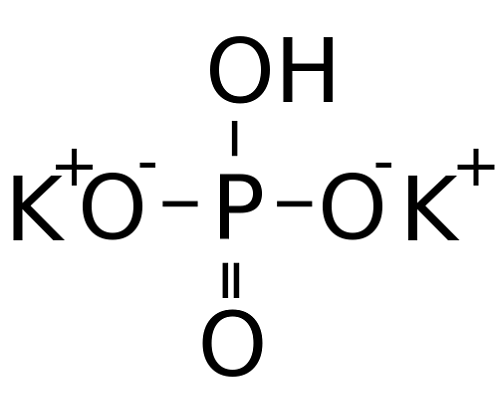
Potassium Hydrogen Phosphate
Properties of Potassium Hydrogen Phosphate
[Click Here for Sample Questions]
| Name | Potassium hydrogen phosphate |
| Alternative Names | Potassium phosphate dibasic or Dipotassium phosphate. |
| Molecular Formula | K2HPO4 or HK2O4P |
| Colour | White colour |
| Nature | Corrosive, Irritant |
| Density | 2.44 g/cm³ |
| Molar Mass | 174.2 g/mol |
| Melting Point | > 465 °C |
| Molecular Weight | 174.176 |
| Solubility | Very Soluble in Water |
Physical Properties
Potassium hydrogen phosphate is a crystalline solid that is odourless and colourless. It has a 2.44 g/ml density and breaks down at temperatures higher than 465 °C. It's a solid that deliquesces i.e.,a solid which absorbs enough water to turn itselfinto a solution.
Chemical Properties
Potassium hydrogen phosphate is strongly water soluble and slightly soluble in alcohols. It's a variable nature and highly viscous chemical that reacts with water to produce a mildly basic solution. It is a stable substance, but when subjected to heat, it decomposes.
Also Read: Types of Alcohol
Structure of Potassium Hydrogen Phosphate Formula
[Click Here for Sample Questions]
K2HPO4 is the chemical formula for potassium hydrogen phosphate.
It's phosphoric acid's dipotassium salt (H3PO4), which has 3 acidic protons. It is made up of one phosphate anion (HPO42-)and two potassium cations (K+), with one hydroxyl group, two single-bonded oxygen atoms, and one double-bonded oxygen atomcoupled to the phosphorous atom.

Structure of Potassium Hydrogen Phosphate
Manufacturing of Potassium Hydrogen Phosphate Formula
[Click Here for Sample Questions]
The partial reaction of phosphoric acid (H3PO4) with potassium carbonate or potassium hydroxide (KOH) potassium hydrogen phosphate (K2CO3).
2 KOH + H3PO4 → K2HPO4 + 2 H2O
Uses of Potassium Hydrogen Phosphate Formula
[Click Here for Sample Questions]
It is used in minor amounts in paper processing, also as a fertilizer, as a buffering agent for coffee creamers, as yeast nutrient, as chemical reagents in Pharmaceuticals.
- The principal applications of potassium hydrogen phosphate are as a fertiliser, corrosion inhibitor, and buffering agent.
- It's also used in food, vitamins, non-dairy creamers, and medications.
- It possesses radioprotective properties and is utilized as an electrolyte source.
- Paper processing, yeast feed, agar for culture microorganisms, and chemical reagent are among the other uses.
- In an occupational or industrial context, cleaning or safety products are employed,Agricultural pesticides (non-pesticidal),Anti-corrosion and anti-scaling chemicals,Fluids with functional properties (closed systems),Chemicals used in laboratories,Lubricants, and additives to lubricants.
Also Read: Werner’s Theory of Coordination Compounds
Health Hazards of Potassium Hydrogen Phosphate Formula
[Click Here for Sample Questions]
Potassium hydrogen phosphate may cause skin irritation, can cause harm tothe eyes, and respiratory system when ingested or inhaled.
It is non-toxic and considered a safe food additive. Excess potassium salt consumptioncan cause electrolyte imbalances, which can cause symptoms including nausea, sickness, diarrhea, stomach discomfort, and nutrient absorption problems.
Read More: Order of Reaction
Things to Remember
- The potassium salt potassium hydrogen phosphate is the dipotassium salt of phosphoric acid.
- It functions as a buffer. It's an inorganic phosphate and a potassium salt.
- Potassium hydrogenphosphate (K2HPO4) is asalt i.e. highly soluble in water.
- It is commonly used as a phosphorus and potassium source anda buffering agent in fertilizers and food additives.
- Potassium hydrogenphosphate is used to generate buffer solutions, as well as trypticase soy agar, used to produce agar plates for bacteria growing.
- Higher doses of potassium hydrogen phosphate should be kept at room temperature.
Also Read: Lewis acids
Sample Questions
Ques. What is Potassium Hydrogen phosphate formula? (3 marks)
Ans. The ionic compound potassium hydrogen phosphate is made up of potassium and hydrogen phosphate.
The potassium ion is referred to as a cation. K+
Hydrogen phosphate is an anion: HPO42 is an electrically neutral chemical. The simplest collection of ions with a complete charge of zero should be reflected in the formula for an ionic compound.
The potassium dihydrogen phosphate formula is K2HPO4.
Ques. What is the pH of potassium hydrogen phosphate? Is it an acid or a base? (2 marks)
Ans. Potassium hydrogen phosphate is extremely soluble in water and just slightly so in alcohols. It's a deliquescent and hygroscopic chemical that dissolves in water to produce a mildly basic solution.
The pH of potassium hydrogen phosphate is 6.5
Ques. What are the components of K2HPO4? (1 mark)
Ans. Potassium hydrogen phosphate (K2HPO4) is a highly soluble salt that is commonly used as a phosphorus and potassium source as well as a buffering agent in fertilisers and food additives.
Ques. Is K2HPO4 an ionic or a covalent compound? (1 mark)
Ans. The ionic substance dipotassium phosphate is used for electrolyte replacement and complete parenteral nutrition (TPN) treatment.
Ques. When comparing KH2PO4 with K2HPO4, what's the difference? (3 marks)
Ans. When used as fertiliser, the major difference in KH2PO4 and K2HPO4 is:
KH2PO4 is monobasic and can only release a little quantity of potassium, whereas K2HPO4 is dibasic and can release a large amount of potassium. The amount of potassium cations attached to the phosphate molecule is referred to as monobasic or dibasic.
Ques. You have 2.00 mol of potassium hydrogen phosphate,In the 2.0 mol, how many k+ ions are there? (2 marks)
Ans. Water will dissociate potassium ions. There will be twice as many K-ions as the compound since there are two K-ions for each and every mole of K2HPO4. So, it will be 2 x 2.00 mole or 4.00 mole.
Ques. You have 4.00 mol of potassium hydrogen phosphate, K2HPO4. In the 4.0 mol, what is the no.ofoxygen atoms are there? (3 marks)
Ans. K2HPO4 has four atoms in each molecule.
1 mol K2HPO4 = 4 mol O atoms = 4 x 6.022 × 1023 O atoms
4 mol K2HPO4 = 4 x 4 mol O atoms = 4 x 4 x 6.022 × 1023.
= 9.64 x 1024 O atoms
Ques. You have 8.45 mol of potassium hydrogen phosphate. In the 8.35 mol, what is the no. ofpotassium ions are there? (3 marks)
Ans. One mole of the molecule includes two moles of K+ ions, as shown by the chemical formula K2HPO4.
In addition, 1 mole of ions = 6.022 × 10²³ ions.
The number of K+ ions in 8.45 mol K2HPO4.
= 8.45 mol × 2 mol K+ ions / 1 mol K2HPO4 × 6.022 × 1023 K+ ions/1 mol K+ ions
= 1.02 × 1025 K+ ions.
Ques. Discuss the method of disposal, storage, and the permissible tolerance limit. (5 marks)
Ans. Methods of Disposal:
Guidelines for land treatment or burying (sanitary landfill) dumping procedures are undergoing considerable adjustment at the time of assessment. Communicate with environmental regulatory bodies for advice on appropriate disposal procedures before implementing land disposal and recycling residue (including landfill leachate).
Conditions of Storage:
The injection of potassium phosphates should be kept at room temperature.
Permissible Tolerances:
When used as a buffering agent in line with good agricultural practice as inert (or sometimes active) chemicals in pesticide formulations sprayed to growing crops exclusively, dipotassium hydrogen phosphate is subject to the requirement of a tolerance.
Ques. Write down the FDA Regulations which need to be followed while working with potassium hydrogen phosphate. (5 marks)
Ans. The following are the FDA Regulations:
- When used in conformity with good manufacturing practice, dipotassium phosphate using it as a sequestrant in human food is widely accepted as safe.
- When used in line with acceptable manufacturing or feeding practice, dipotassium phosphate utilized as a sequestrant in animal medications, feeds, and similar items are widely acknowledged as safe.
- Potassium phosphates are a type of indirect food additive that is only used in adhesives.
Read Also:



Comments