



Education Journalist | Study Abroad Lead
Chickens are the most widely domesticated animals used for their meat and eggs, notwithstanding the age-old issue of who came first, the chicken or the egg. Chicken belongs to the Phasianidae family, Aves class, and Galliformes order. Chickens can be found all over the world, with the exception of Antarctica. A chicken can grow up to 70 cm in height, weigh roughly 2.6 kg, and have a 30-centimetre tail. All domestic chickens are descended from the Red Jungle Fowl, and the domestic chicken is known as Gallus Domesticus. A male chicken is referred to as a rooster, whereas a female chicken is referred to as a hen. According to some estimates, there are around 25 billion chickens on the planet, making them the most numerous bird species. Chicks are baby chickens born from eggs that take 21 days to hatch. Hens or female chickens will sit on their eggs to keep them warm so the chicks can hatch healthy.
Table of Contents
| Table of Content |
Key Terms: Chicken, Hen, Rooster, Chick, Gallus Domesticus, Egg, Pullet, Pecking Order, Embryo, Life Cycle, Gallus Domesticus, Chicks
Overview of Chicken Life Cycle
[Click Here for Sample Questions]
The chicken life cycle is divided into four stages. The four stages can be described as follows:
- Stage 1 (Embryo): When the egg is deposited, the embryo phase begins. This stage of life takes 21 days to complete.
- Stage 2 (Chick): When the chick hatches on day 21, the chick phase begins. The length of time this phase takes varies according to the chicken breed.
- Stage 3 (Pullet): When it comes to chicken development, the pullet stage is sometimes overlooked. Chickens, it turns out, are similar to humans in that they must go through adolescence before becoming adults.
- Stage 4 (Adult): The life cycle of an adult chicken can take up to seven years. An adult chicken's lifespan is determined by both breed and husbandry.
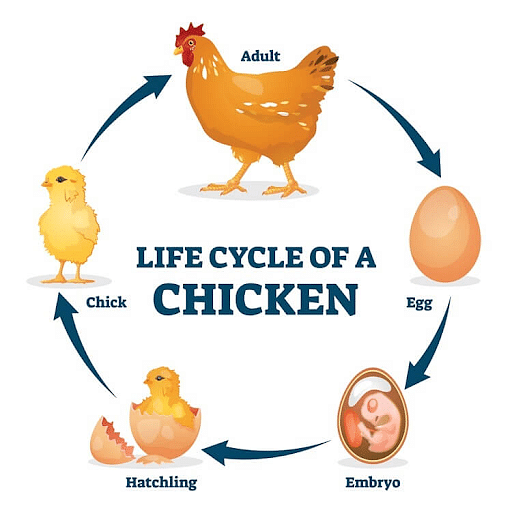
Life Cycle of a Chicken
Also Read: Cockroach Life Cycle
Chicken Life Cycle: As an Embryo
[Click Here for Sample Questions]
The process of egg-laying in chickens takes place during the lengthy summer months. After ovulation, it takes a female hen about 23 to 26 hours to lay her eggs. One hour after the first set of eggs are laid, hens have another ovulation. Female hens can lay up to 300 eggs every year thanks to their frequent ovulation cycle. The hen continues to lay eggs until she has a suitable number of eggs in her nest. Infertile and fertile eggs can be laid by female chickens. Only viable eggs will hatch and give birth to newborn chicks. It takes roughly 21 days for the small chicks to emerge after a female chicken lays a clutch of fertilised eggs. The action starts as soon as the egg is placed in the nest.
- 1st Day: Tissue begins to grow and develop.
- 2nd Day: The heart is formed and begins to beat.
- 3rd Day: The circulatory system begins to form and the chick's tail bud forms.
- 4th Day: The young chick's limbs, including wing and leg buds, begin to grow. The brain and eyes begin to develop as well.
- 5th Day: The chick undergoes the development of knee and elbow buds.
- 6th Day: The chick's toes and claws develop individual digits. The beak begins to form as well.
- 7th Day: The beak develops more and the egg tooth emerges (what the chick uses to break out of the egg). The comb begins to grow at the same time.
- 8th Day: The tiny chick begins to develop feathers.
- 9th Day: The mouth begins to open.
- 10th Day: The claws of the chick begin to form.
- 11th Day: Tail feathers start to emerge.
- 12th Day: Scales begin to form on the feet and legs.
- 13th Day: The lady develops eyelashes.
- 14th Day: The chick's body rotates such that the head is at the egg's bigger end.
- 15th Day: The gut of the chick is pulled inwards towards the abdominal area.
- 16th Day: The chick's entire body is covered in feathers.
- 17th Day: The chick's head is drawn down between her thighs.
- 18th Day: The chick's body has entirely filled the egg's internal area.
- 19th Day: The yolk sac is nearly completely digested.
- 20th Day: The chick begins pipping (breaking through the eggshell) from the inside with the egg tooth.
- 21st Day: The chick continues to develop and eventually hatches from the egg.
Chicken Life Cycle: As a Chick
[Click Here for Sample Questions]
Without a question, the chick stage of the chicken life cycle is the cutest. Chicks are adorably fluffy spherical puffs of fluff. Like little fluffy robots, they make peeping noises and follow their mother around.
Mothers impact their baby chicks. They will imprint on the first moving object they perceive in the absence of a mother hen (such as when chicks are incubator-hatched). Newborn chicks are fully reliant on their mothers for assistance in navigating their new environment. They must be taught how to eat and drink properly.
Young chicks are delicate and shaky. As their muscles mature, it will take a week or so for their legs to get stronger. Tiny chicks develop at a breakneck pace. In the first month of life, they might double in size. The young chicks have entered the adolescent stage of life at the age of six to eight weeks, depending on the breed (about 60 days for most).
The chicks begin to grow larger and develop adequate feathers by week 3 or 4. By week 8, the chicks have grown to the point where they can walk outside and change their diet. They can peck on mealworms and other insects in addition to grains.

Chicks
Chicken Life Cycle: As a Pullet
[Click Here for Sample Questions]
A chicken that is no longer a chick but not quite an adult is referred to as a "pullet."
In the chicken life cycle, the pullet stage is the most uncomfortable. Pullets have patchy feathers and awkward bodies, making them appear to be all wings and legs.
It's crucial to keep an eye on pullets when they're near-adult hens. Pullets aren't quite as big or powerful as adults. A pullet is two-thirds the size of an adult chicken and can be bullied in a flock with a pecking order. After 18 weeks, an adolescent female chicken can lay eggs, and the eggs she lays are smaller than adult eggs. The pullet stage, like the chick stage, varies depending on the breed of chicken. The pullet period lasts until the hens are roughly 20 weeks (five months) old for most breeds.

Pullet
Also Read:
Chicken Life Cycle: As an Adult
[Click Here for Sample Questions]
During the pullet stage of chicken life cycle, female chickens (hens) may begin laying their first eggs. You may notice that the eggs appear unnaturally little if this occurs. Adult hens will produce normal, full-size eggs once they reach adulthood, thus these are only "practise" eggs.
Male chickens become roosters during the adult stage of the chicken life cycle. Around "their" hens, roosters can be quite raucous and possessive. Around the age of 18 weeks, roosters begin crowing (4.5 months).
Adult hens should lay one egg each day on average, though skipping a day here and that’s usual. For the first one to two years of their lives, adult chickens will lay virtually every day. Hens typically lay for roughly 10 months before taking a break. During this time off, they will moult their feathers and regrow new ones.
Egg-laying may become irregular after the first year or two of adulthood. When chickens are sick or don't get enough light, they will sometimes stop laying eggs. Under ideal husbandry conditions, adult hens can live for seven years or longer.

Adult Chicken
Also Read: Fungus Life Cycle
Things to Remember
- Chickens that are members of the free-flocking bird family can live for up to 8 years in ideal conditions.
- Poultry chickens can live for up to 30 years. Before their owner slaughters them for their meat, they can act as egg warmers for roughly 2 to 3 years.
- Chickens can be found all over the world, with the exception of Antarctica. According to some estimates, there are around 25 billion chickens on the planet, making them the most numerous bird species.
- Chicken life cycle consists of four stages namely- Embryo, Chick, Pullet and Adult.
- Chickens begin their lives as precocial chicks, meaning they are almost self-sufficient when they are first hatched. They typically spend the majority of their days and time resting in the sun and thereby enjoying their retirement phase.
Sample Questions
Ques. What is the average lifespan of a chicken and how long do they lay eggs? (3 Marks)
Ans. Chickens can live for 8 to 15 years if they are properly cared for, and they can continue to lay into their teens. If the hens are from one of the hybrid egg-producing breeds, they are rarely kept for more than a year, despite the fact that they are capable of laying eggs for many years.
Ques. Is it true that chickens sleep? (3 Marks)
Ans. Chickens have a REM phase of sleep, which is characterised by rapid eye movement and is associated with dreaming. This explains why hens sleep with one eye open and the other closed, an evolutionary adaptation that allows them to keep an eye out for predators while they sleep.
Ques. What do chickens eat exactly? (3 Marks)
Ans. Chickens eat a wide variety of foods. They are omnivores by nature, meaning they will consume almost anything they can get their hands on. On their own, they'll find a plethora of protein- and vitamin-rich foods, such as insects and grubs, foliage, and seeds.
Ques. Chickens lay eggs on a regular basis, but how frequently do they do so? (5 Marks)
Ans. There are three important aspects to consider:
- Chicken breed- Some chickens are developed for meat production and lay few eggs; others are intended for egg production and can lay as frequently as once a day; and yet others are bred as "dual-purpose" chickens, who are good for both egg-laying and meat production, albeit not optimal for either.
- Age of the hen- Hens begin to lay eggs at the age of 4-6 months and lay best throughout their first year. After that, their output drops year after year.
- Season- Egg production drops dramatically in the winter (because of fewer daylight hours). Summer is the peak laying season.
Ques. Why do hens lay eggs of various colours? (5 Marks)
Ans. Different breeds produce eggs of various colours. Eggs come in a variety of colours, including light brown, dark chocolate brown, white, off-white, pinkish, green, and even blue. Some lay speckled eggs as well.
Here are a few essential details:
- The hue of an individual bird's eggs will almost always be the same.
- Individuals within a breed may differ in the hue of their eggs, but not in the basic colour (brown, white, blue etc.).
- Looking at a chicken's earlobe can help you figure out what colour egg she'll lay. White earlobed hens always lay white eggs, whereas red earlobed hens can lay brown, blue, or green eggs.
Ques. Is there a "pecking order"? (5 Marks)
Ans. Yes. This is a genuine occurrence. Pecking order is well-defined in all chicken flocks. It's their way of avoiding chaos.
Everyone gets pushed around by the lucky chicken at the head of the pecking order. She gets first dibs on food, water, and ideal roosting locations, among other things. She has full pecking rights if she doesn't like what anyone else is doing. She has the authority to tell any other chicken to leave. The poor chicken at the bottom of the pecking order has the exact opposite situation: she can be pecked by anyone in the flock, and she has first dibs on food and other resources. The rest of a flock's chickens are somewhere in between these two extremes. Only the #1 chicken can bully the #2 chicken, who can then bully everyone else, and so on.
The pecking order is set at a young age and usually does not change until life comes to an end finally.
Ques. Why is the egg touted as being nutrient-dense? (2 Marks)
Ans. The egg is only 75 calories, but it provides 7 grammes of protein and 1.5 grammes of saturated fat. and 5 g of fat Vitamins A, D, B12, phosphorus, choline, carotenoids, riboflavin, cholesterol, and pantothenic acid are all found in it.
Ques. Is it possible for chickens to fly? How often does chicken consume food? (3 Marks)
Ans. In chickens, the capacity to fly is limited and varies by species. Chickens of larger species have difficulty flying, but smaller species may fly up to 25 feet.
In a single day, a fully grown adult chicken consumes 120 grammes of pellets. In order to generate eggs and sperm for reproduction, they must eat continuously throughout the day.



Comments