



Content Writer-SME
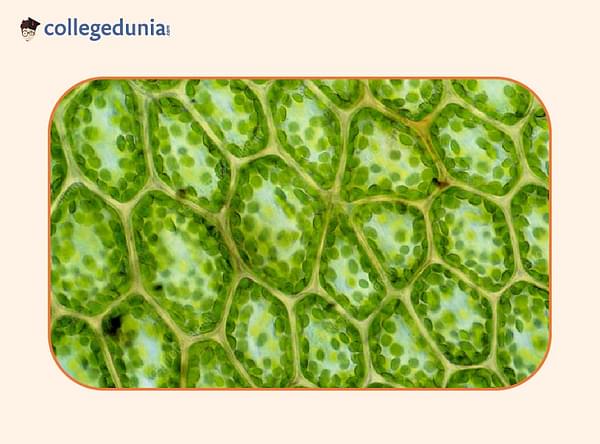
Chlorophyll is a green organic pigment present in the thylakoid membrane of chloroplast. The presence of chlorophyll and chloroplasts are distinctive features of plant cells, algae and cyanobacteria (blue-green algae).
- Green plants synthesize their own food in the presence of sunlight and chlorophyll by the process of photosynthesis.
- However, chlorophyll plays a major role during photosynthesis by converting light energy into chemical energy.
- The plants involved in the process of photosynthesis are called autotrophs.
Apart from chlorophyll, anthocyanins, carotenoids and xanthophylls are also present in green plants which play an important role in the photosynthesis process. In this article, we will discuss the complex structure, formula, types and functions of chlorophyll in more detail.
What is Chlorophyll?
[Click Here for Sample Questions]
The word "chlorophyll" is derived from two Greek words: chloros, meaning "light green," and phylon, meaning "leaves." Thus, chlorophyll can be defined as:
| "The green pigment present in the leaves of plants, algae and cyanobacteria that plays an important role in photosynthesis is called chlorophyll." |
It is essential for photosynthesis, which is the process of converting light energy into a chemical form so that living organisms can use it. Chlorophyll absorbs energy from sunlight, which is then utilized to convert carbon dioxide into carbohydrates and gives oxygen as the byproduct.
- These pigments are found in all green sections of plants and are organized in the chloroplasts of each cell.
- The chlorophyll structure is similar to that of hemoglobin present in the red blood cells of mammals and other animals.
- They absorb light from the sun, specifically red and blue light, and transform it into chemical energy.
Structure of Chlorophyll
[Click Here for Sample Questions]
The chlorophyll molecule consists of a magnesium atom placed at the center, encircled by a nitrogen-containing structure known as a porphyrin ring. Since, it is an organic compound, it is represented by a formula. The chlorophyll formula is written as C55H72O5N4Mg. The complex structure of chlorophyll is made up of three constituent elements:
- Magnesium Atom: The magnesium atom is present in the center of the chlorophyll structure. It plays a major role in the absorption of sunlight during the process of photosynthesis.
- Porphyrin Ring: A ring structure composed of nitrogen and four pyrrole rings together form a porphyrin ring. It is involved in the process of energy conversion.
- Phytol Chain: The last component of chlorophyll that is attached to the porphyrin ring is called the phytol chain. It contains long carbon chains that play a major role during chlorophyll degradation or leaf senescence.
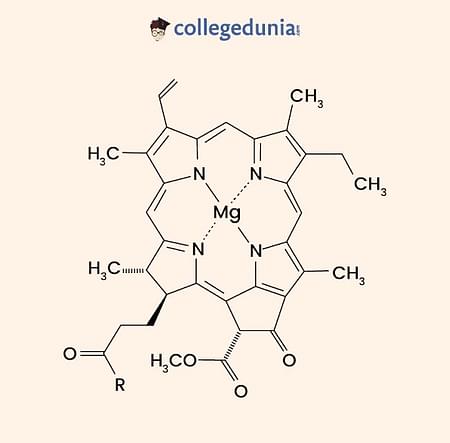
Chlorophyll Structure
Location of Chlorophyll
[Click Here for Sample Questions]
Chlorophyll has a fixed location in green plants and algae and it is a small pancake-like structure present in the chloroplast called the thylakoid membrane. Grana are a structure found in chloroplasts made up of stacks of flattened discs known as thylakoids. These thylakoids contain the photosystem, which contains photosynthetic pigments. It is also present in the stroma of chloroplast.
Role of Chlorophyll
[Click Here for Sample Questions]
The main function of chlorophyll is in photosynthesis, in which plants receive light energy and transform it into chemical energy.
- Carbohydrates are synthesized using sunlight, carbon dioxide, and water.
- Almost all green plants and certain organisms, such as cyanobacteria and algae, have chlorophyll.
- In the photosynthesis process, chlorophyll absorbs sunlight of various wavelengths.
- It synthesizes carbohydrates with the help of carbon dioxide and water.
- In chlorophyll, a magnesium ion is abundant, forming a large ring-like structure called chlorine.
- A unique characteristic of chlorine rings is that they are heterocyclic compounds formed from pyrrole.
Types of Chlorophyll
[Click Here for Sample Questions]
There are two types of chlorophyll in green plants: chlorophyll a and chlorophyll b. Each kind of chlorophyll absorbs light at slightly different wavelengths. Chlorophyll c is present in some marine algae. Chlorophyll d is found in certain cyanobacteria species. Chlorophyll e is very uncommon, appearing exclusively in certain golden algae. The different types of chlorophyll are:
Chlorophyll A
Chlorophyll A is mainly found in higher plants and green algae. It is the primary light-harvesting pigment found in all photosynthetic organisms.
- This pigment absorbs the majority of the wavelength contained in the blue-violet and orange-red sections of the light and reflects the yellow-green light, giving such parts a green color.
- The molecular formula of Chlorophyll A is C55H72O5N4Mg.
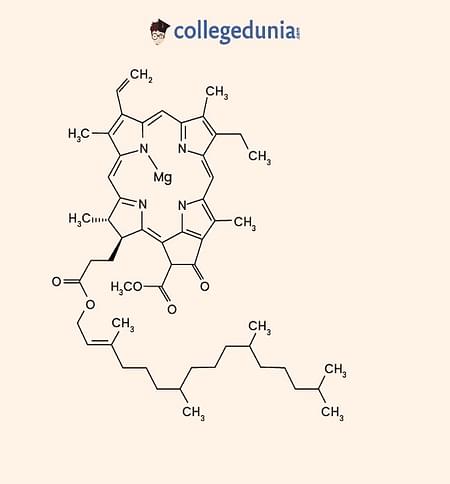
Structure of Chlorophyll A
Chlorophyll B
Chlorophyll B is also found in higher plants and green algae. It acts as a light-harvesting pigment, transmitting light excitation to chlorophyll A.
- In oxygenic photosynthetic organisms, chlorophyll b is the second most prevalent chlorophyll.
- This pigment absorbs the majority of the wavelength contained in the blue section of the light.
- The concentration of chlorophyll b may grow as organisms adapt, and as chlorophyll b concentration increases, so does the spectrum of wavelengths absorbed by the organisms.
- The molecular formula of Chlorophyll B is C55H70O6N4Mg.
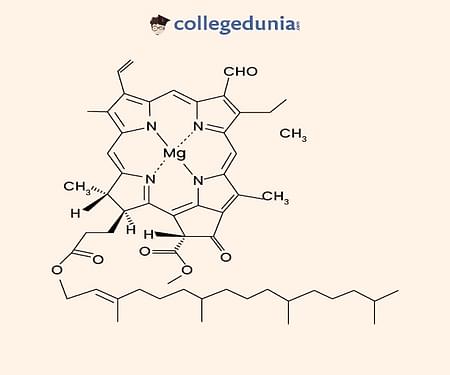
Structure of Chlorophyll B
Chlorophyll C
Chlorophyll C is found in brown algae, diatoms, and dinoflagellates. It is a secondary pigment present in certain marine algae and is less abundant than chlorophyll a and b.
- It absorbs light in the 447-520 nm wavelength range and thus creates a blue-green hue.
- Chlorophyll pigments in chlorophyll c are further classified as chlorophyll c1, chlorophyll c2, and chlorophyll c3.
- The molecular formula of Chlorophyll C is C35H28O5N4Mg.

Structure of Chlorophyll C
Chlorophyll D
Chlorophyll D is found in cyanobacteria and red algae. Chlorophyll D is one of the rare kinds of chlorophyll.
- It is primarily found in marine algae and photosynthetic organisms living in deep water where light does not penetrate very well.
- It absorbs far-red wavelengths beyond the optical spectrum as well as some blue-green wavelengths.
- The molecular formula of Chlorophyll D is C54H70O6N4Mg.

Structure of Chlorophyll D
Chlorophyll E
Chlorophyll E is found in some golden algae such as Vaucheria hamata, and Tribonema bombycid.
- Chlorophyll E is one of the rare kinds of chlorophyll and serves as an accessory pigment in a variety of photosynthetic species.
- It was discovered recently, hence the structure and the molecular formula are not defined yet.
Chlorophyll F
Chlorophyll F is found in cyanobacteria. Chlorophyll F is found in aquatic creatures and allows for the absorption of infrared light present in the red region.
- The precise role of chlorophyll f in photosynthesis is unknown, although evidence of it serving as an accessory pigment has been discovered.
- The molecular formula of Chlorophyll F is C55H70O6N4Mg.
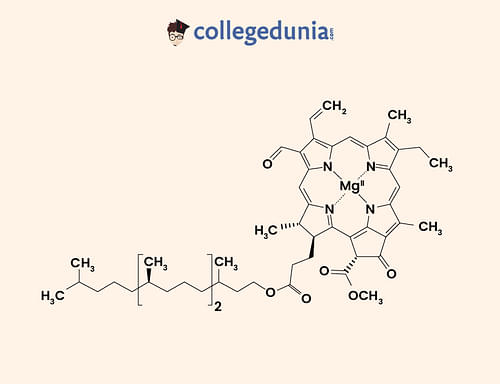
Structure of Chlorophyll F
Functions of Chlorophyll
[Click Here for Sample Questions]
The following are some important functions of Chlorophyll:
Biosynthesis of the Sugar
Plants use Chlorophyll A and B to absorb the energy from the sun. Chlorophyll is present in the thylakoid membranes of chloroplasts. The process of photosynthesis takes place in chloroplasts.
- Thylakoids are tiny membrane sacs that are piled on top of one another.
- There are many other proteins embedded in these membranes, which are responsible for transferring energy through chlorophyll to ATP.
- The proteins not only transfer the energy but also channel the energy into the synthesis of sugars, this process is called a photosystem.
- This whole process is termed 'Photosynthesis'. Photosynthesis takes place in plants, algae, and many other living organisms.
- These organisms use carbon dioxide (CO2), water (H2O), and sunshine to generate glucose.
- They can either use this glucose in the process of cellular respiration to generate ATP, or they can mix it with other molecules to be stored.
Production of Oxygen
The process of photosynthesis gives out oxygen as the byproduct. Plants can utilize this oxygen for cellular respiration, but they also expel surplus oxygen into the atmosphere.
- The oxygen is generated during the first stage of the light cycle of the photosynthesis process.
- Water molecules are divided by plants to create electrons, hydrogen ions, and diatomic oxygen.
- The electrons power the electron transport chain, which in turn powers ATP synthesis.
- The oxygen is dispersed into the atmosphere. All of the oxygen we breathe is created in this manner.

Production Of Oxygen
Difference Between Chlorophyll and Chloroplast
[Click Here for Sample Questions]
The following are the differences between Chlorophyll and Chloroplast
| Chlorophyll | Chloroplast |
|---|---|
| They provide a green color to plants. | It is an organelle found in plant cells and photosynthetic sites. |
| They are of six types i.e. a, b, c, d, e, and f. | There are no further subtypes of Chloroplast. |
| In chlorophyll, carotenoids have yellow and red pigments and green pigments. | They have no pigments. |
| They are present in chloroplast. | They are present in plant cells. |
| The pigment that carries out photosynthesis | Organelle carrying out photosynthesis |
| They are found inside chloroplasts, in thylakoid membranes. | They are found throughout the plant cell, especially in the leaves. |
| They do not have their own DNA. | They have their own DNA organelle known as cpDNA. |
Benefits of Chlorophyll
[Click Here for Sample Questions]
Chlorophyll is not only important for plants, and photosynthetic organisms but also for the survival of life on the earth. The benefits of chlorophyll are mentioned as follows:
- Chlorophyll produces sugar using the ATP mechanism, which is powered by chlorophyll.
- Plants are the primary producers and supply the foundation of the food chain.
- All other creatures in the food chain rely on the sugars produced by plants to survive.
- Chlorophyll is responsible for the production of oxygen.
- While chlorophyll does not directly create oxygen.
- Chlorophyll along with other complex proteins is linked to the transfer of electrons to molecules like ATP and NADPH, which may hold energy in bonds.
- The necessity for electrons to drive this process leads water molecules to split, resulting in the formation of oxygen.
- This oxygen is discharged into the atmosphere, which is used by all living organisms for breathing.
Things to Remember
- Chlorophyll is a pigment that is found in all green plants as well as a few other species.
- It is essential for photosynthesis, which is the process of converting light energy into a chemical form.
- A long carbon-hydrogen side chain is attached to the ring, which is called a phytol chain.
- Chlorophyll A is mainly found in higher plants and green algae.
- It is the primary light-harvesting pigment found in all photosynthetic organisms.
- The molecular formula of Chlorophyll A is C55H72O5N4Mg.
- Chlorophyll B is also found in higher plants and green algae.
- It acts as a light-harvesting pigment, transmitting light excitation to chlorophyll A.
- In oxygenic photosynthetic organisms, chlorophyll b is the second most prevalent chlorophyll.
- Chlorophyll produces sugar using the ATP mechanism, which is powered by chlorophyll.
- Plants are the primary producers and supply the foundation of the food chain.
- All other creatures in the food chain rely on the sugars produced by plants to survive.
Sample Questions
Ques. What is the chemical formula of chlorophyll? (1 Mark)
Ans. The chemical formula of chlorophyll is C55H72O5N4Mg.
Ques. What is photosynthesis? (2 Marks)
Ans. Photosynthesis is a photochemical process in which green plants produce their own food. The chlorophyll absorbs sunlight, which, combined with water and CO2, is converted into energy molecules (glucose). Oxygen is a byproduct of photosynthesis.
Ques. Do cyanobacteria have chlorophyll? (2 Marks)
Ans. Cyanobacteria are photoautotrophic organisms. They include different types of chlorophyll pigments. They also capture sunlight to perform photosynthesis. They contain a variety of chlorophyll pigments, including chlorophyll a and b, as well as carotenoids.
Ques. Do the plants with non-green leaves have chlorophyll? If not, how photosynthesis occurs in such plants? (2 Marks)
Ans. Yes, the plants with non-green leaves have chlorophyll, but in lesser quantities. Photosynthesis happens in such plants as well. The other pigments present in the leaves mask the green color of the Chlorophyll so that the leaves do not appear green but perform photosynthesis.
Ques. What is a photosystem? Explain briefly. (1 Mark)
Ans. A photosystem is a group of proteins and pigments that convert energy to coenzymes like NADPH and ATP, which supply energy for several cellular processes.
Ques. Does the type of pigment affect the process of photosynthesis? Explain. (3 Marks)
Ans. Plants have many different kinds of pigments. These pigments are chemical substances that absorb light at various wavelengths. Algae, cyanobacteria, and plants all have various chlorophyll pigments. Chlorophyll is the primary pigment for photosynthesis in higher plants, and it serves as the reaction center of photosystems. Accessory pigments produce light-harvesting complexes that improve photosynthetic efficiency by absorbing diverse wavelengths.
Ques. Do the leaves with darker colors contain more chlorophyll? (1 Mark)
Ans. Plants that grow in shady areas possess chlorophyll b, which absorbs low-intensity light. The leaves of these plants are darker than the leaves of plants that grow in high-intensity light.
Ques. Is Photosynthesis an endothermic reaction? Explain briefly. (2 Marks)
Ans. Photosynthesis is an endothermic reaction because energy from the sun or sunlight is absorbed throughout the photosynthesis process. Endothermic reactions are any chemical processes that absorb heat energy from their environment to produce products. Hence, photosynthesis is an endothermic reaction.
Ques. Do plants undergo the process of Photosynthesis at night? (5 Marks)
Ans. No, plants do not photosynthesis at night. Plants can only undertake photosynthesis at night if they are exposed to artificial light of the appropriate wavelengths.
Photosynthesis happens in two stages:
- The light reaction- It is also known as the photochemical phase. The light reaction includes light absorption, photolysis of water to liberate oxygen, production of high energy, and also intermediates ATP and NADPH.
- The dark reaction- It is also known as the biosynthetic phase. In the dark reaction, the Calvin cycle is used to synthesize sugar. ATP and NADPH, which are generated during the light reaction, are used in the production of sugar during the dark reaction, Hence, the dark reaction, indirectly dependent on light.
Ques. Mention some of the important factors that affect the process of photosynthesis. (2 Marks)
Ans. The rate of photosynthesis is influenced by a number of factors. The primary variables influencing photosynthetic rate include light intensity, water, soil pH, carbon dioxide concentration, temperature, and other climatic conditions.
Ques. Explain the Calvin cycle and its significance in plants. (2 Marks)
Ans. The Calvin cycle is the light-independent reaction. The Calvin cycle occurs in the stroma of the chloroplasts. It includes light absorption, photolysis of water to liberate oxygen, production of high energy, and also intermediates ATP and NADPH.
Ques. What are the benefits of chlorophyll? (5 Marks)
Ans. Chlorophyll is not only important for plants, and photosynthetic organisms but also for the survival of life on the earth. The benefits of chlorophyll are mentioned as follows:
- Chlorophyll produces sugar using the ATP mechanism, which is powered by chlorophyll.
- Plants are the primary producers and supply the foundation of the food chain.
- All other creatures in the food chain rely on the sugars produced by plants to survive.
- Chlorophyll is responsible for the production of oxygen. While chlorophyll does not directly create oxygen.
- Chlorophyll along with other complex proteins is linked to the transfer of electrons to molecules like ATP and NADPH, which may hold energy in bonds.
- The necessity for electrons to drive this process leads water molecules to split, resulting in the formation of oxygen.
- This oxygen is discharged into the atmosphere, which is used by all living organisms for breathing.



Comments