



Content Curator
Chloroplasts are a type of plastid i.e. a round, oval, or disk-shaped structure that synthesizes and stores food. Chloroplasts differ from other types of plastids by their green color, which is caused by the presence of two pigments: Chlorophyll a and Chlorophyll b.
- Chloroplasts are found within the cells of plants and green algae that are responsible for photosynthesis.
- Photosynthesis is the process by which light energy is transformed into chemical energy.
- It results in the production of oxygen and energy-rich organic compounds.
- Photosynthetic cyanobacteria are free-living near relatives of chloroplasts.
- The endosymbiotic hypothesis holds that chloroplasts and mitochondria (energy-producing organelles in eukaryotic cells) are descended from these organisms.
| Table of Content |
Key Terms: Chloroplast, Plastid, Organic compound, Mitochondria, Photosynthesis, Chlorophyll, Algae, Chloroplast membrane, Plant cell, Grana, Stroma
What is Chloroplast?
[Click Here for Sample Questions]
The Chloroplast definition is given as
| “A chloroplast is an organelle that contains the photosynthetic pigment chlorophyll, which absorbs sunlight and transforms it into usable energy, releasing oxygen from water”. |
Chloroplasts are present in all green plants and algae. They are the food manufacturers of plants. These are present in the mesophyll cells of plants' leaves.
- They have a high concentration of chlorophyll, which absorbs sunlight.
- This cell organelle is not seen in animal cells.
- Chloroplasts, like mitochondria, have their own extranuclear DNA, making them semiautonomous.
- They also create the proteins and lipids essential for the chloroplast membrane.
Diagram of Chloroplast
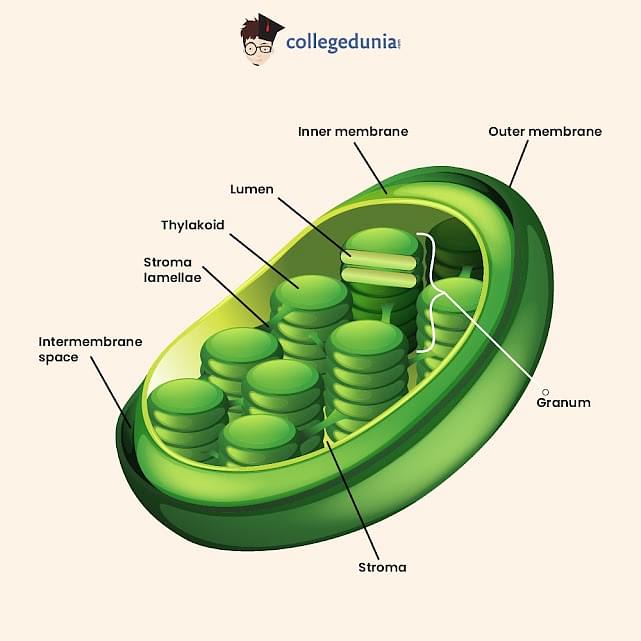
The chloroplast diagram below shows the chloroplast structure and illustrates the various parts of the chloroplast. The parts of a chloroplast such as the inner membrane, outer membrane, intermembrane space, thylakoid membrane, stroma, and lamella can all be easily identified.
Also Read:
| Related Articles | ||
|---|---|---|
| Transportation in Plants | Heterotrophic Nutrition | Autotrophic Nutrition |
| Excretion in Plants | A Labelled Diagram of Mitochondria with Detailed Description | Carbon Cycle |
Structure of Chloroplast
[Click Here for Sample Questions]
Chloroplasts are present in all higher plants. It is oval or biconvex and is found in the mesophyll of the plant cell. The chloroplast typically measures 4-6 µm in diameter and 1-3 µm in thickness.
- They are double-membrane organelles that have outer, inner, and intermembrane spaces.
- There are two different regions present inside a chloroplast known as the grana and stroma.
- Grana consists of stacks of disc-shaped structures called thylakoids or lamellae.
- The functional units of chloroplasts are the grana, which is comprised of chlorophyll pigments.
- Stroma is the homogeneous matrix that contains grana and is similar to the cytoplasm of cells in which all the organelles are embedded.
- It comprises a variety of enzymes, DNA, ribosomes, and other components.
- Stroma lamellae connect stacks of thylakoid sacs or grana.
The chloroplast structure comprises the following parts:
Membrane Envelope
It has inner and outer lipid bilayer membranes. The inner membrane separates the stroma from the intermembrane space.
Intermembrane Space
It is the space between the inner and outer membranes.
Stroma
It is a colorless, alkaline, aqueous, protein-rich fluid found within the inner membrane of the chloroplast that surrounds the grana.
Thylakoid System (Lamellae)
The system is suspended inside the stroma. It is a cluster of membrane sacs known as thylakoids or lamellae.
- The thylakoid membranes contain green pigments called chlorophyll.
- It is the source of light-dependent processes in the photosynthesis process.
- The thylakoids are stacked in stacks known as grana, with each granum containing around 10-20 thylakoids.
Chlorophyll
It is a green photosynthetic pigment that plays an important role in photosynthesis.
Grana
Grana are stacked lamellae found in plastids. These are regions where light energy is converted into chemical energy.
Functions of Chloroplast
[Click Here for Sample Questions]
The following are the functions of chloroplast
- The main function of chloroplast is to synthesize food through photosynthesis.
- It absorbs light energy and converts it into chemical energy.
- The structure of chloroplast contains a part known as chlorophyll, which traps solar energy and is used in the production of food in all green plants.
- It produces NADPH and molecular oxygen (O2) through the photolysis of water.
- Photosynthesis produces ATP or adenosine triphosphate.
- During the Calvin Cycle, also known as the dark reaction of photosynthesis, carbon dioxide (CO2) from the atmosphere is used to produce carbon and sugar.
Things to Remember
- Chloroplasts are a type of plastid i.e. a round, oval, or disk-shaped structure that synthesizes and stores food.
- Photosynthesis is the process by which light energy is transformed into chemical energy.
- Chloroplasts, like mitochondria, have their own extranuclear DNA, making them semiautonomous.
- The chloroplast typically measures 4-6 µm in diameter and 1-3 µm in thickness.
- There are two different regions present inside a chloroplast known as the grana and stroma.
- Intermembrane space is the space between the inner and outer membranes.
Also Read:
Sample Questions
Ques. What is the most important function of chloroplast? (1 Mark)
Ans. The most important function of the chloroplast is to produce food through photosynthesis.
Ques. Why is the chloroplast green? (1 Mark)
Ans. Chloroplasts contain chlorophyll, a green pigment that gives them their color.
Ques. What is the basic definition of Chloroplast? (2 Marks)
Ans. The chloroplast is an organelle and is a unique element in plant cells. It even contains an important element that is important in the process of photosynthesis which is termed ‘Chlorophyll’. These contain carotenoids and pigments of chlorophyll and they even perform the process of photosynthesis. These types of plastids are green in color. They have green-colored pigments in the cells of plants and are termed chlorophyll.
Ques. How many types of plastids are there? (1 Mark)
Ans. There are three types of plastids: chloroplast, chromoplast, and leucoplast.
Ques. What are the basic functions of chloroplast? (5 Marks)
Ans. The basic functions of the chloroplast are-
- To synthesize food through the process of photosynthesis.
- They provide diverse metabolic activities.
- They serve as cellular sensors
- They produce Adenosine Triphosphate- ATP through the process of photosynthesis.
- They absorb the energy of light and convert it into chemical energy.
- They even produce Molecules of oxygen (O2) and NADPH by the water of photolysis.
- It helps to carry out photosynthesis.
Ques. What are the parts of chloroplast? (3 Marks)
Ans. Chloroplast has 6 parts those are called as-
- Envelope (Outer Membrane)
- Intermembrane Space
- Inner Membrane
- Stroma
- Thylakoid System
- Peripheral Reticulum
Ques. What are the parts of chloroplasts? (5 Marks)
Ans. The following are the parts of chloroplasts:
Envelope (Outer Membrane)- It is a membrane with semi-porous and is pervious to molecules that are small and ions that are diffused easily. The outer membrane of the chloroplast is not at all permeable to larger and huge proteins.
Intermembrane Space- It is an inter-membrane that is thin and has space of about 10-20 nanometres and it is available between the inner and outer membrane.
Inner Membrane- It forms a border to the stroma. The inner membrane regulates the passage of materials that go in and out. Fatty acids, carotenoids, and lipids are synthesized in the inner membrane of the chloroplast.
Stroma- It is an aqueous, alkaline fluid that is protein-rich and is present in the inner membrane of the chloroplast. Stroma is the space outside the thylakoid.
Thylakoid System- It is a system suspended in the stroma. It is a collection of sacs membranous which are termed thylakoids. Chlorophyll is found in thylakoids and is the area for the light reaction process of photosynthesis. Grana is the arrangement of stacks in which thylakoids are arranged.
Ques. What are the characteristic features of chloroplast? (3 Marks)
Ans: Chloroplasts are either round, oval, or disk-shaped bodies that are involved in the synthesis and storage of food and energy. Chloroplasts are divided into two types, chlorophyll a and chlorophyll b. One of the major functions of those pigments is to absorb light energy. In most plants, chloroplasts are present in all green tissues, though they are mostly concentrated in the parenchyma cells of the leaf mesophyll. They are roughly 1–2 μm (1 μm = 0.001 mm) in thickness and 5–7 μm in diameter.
Ques. What happens to plants that lack chloroplast? (5 Marks)
Ans. Chloroplasts are an important element for the health and survival of plants as well as photosynthetic algae. Chloroplasts are similar to Solar Panels, which take light energy and convert it into use that powers multiple functions. There is one such exception- Rafflesia, which is a parasitic plant that possesses nutrients from other plants, specifically, Tetrastigma vines. As Rafflesia gets all of its energy from parasitizing the other plant, therefore it does not need its chloroplast. This is the reason why the plant has gotten so used to this mechanism, and that it has lost the genes that code the development of the chloroplast. It is considered to be the only genus belonging to plants on land that lack chloroplasts.
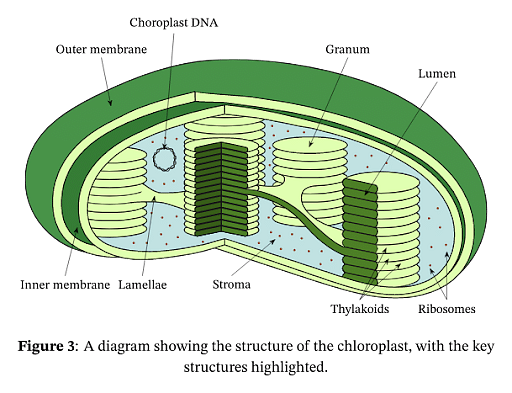
Ques. Draw a labeled diagram of the chloroplast. (3 Marks)
Ans.
For Latest Updates on Upcoming Board Exams, Click Here: https://t.me/class_10_12_board_updates
Check-Out:



Comments