



Education Journalist | Study Abroad Lead
Triangles are constructed based on their congruency requirements. A triangle is a polygon made up of three straight lines. As a result, there are three sides and three angles in a triangle. The triangle can be built using geometrical instruments such as a protractor, compass, ruler, and scale. However, before constructing triangles, we must first understand their characteristics. A triangle is a closed curve or polygon formed by three-line segments. In geometry, any three non-collinear points form a unique triangle and, separately, a unique plane (known as two-dimensional Euclidean space). The sides, angles, and vertices of a triangle are its primary components.
| Table of Content |
Key Terms: Triangles, Isosceles Triangle, Equilateral Triangle, Scalene Triangle, Obtuse-Angled Triangle, Acute-Angled Triangle, Right-Angled Triangle, Angle-Side-Angle Triangle Construction
Triangle and Its Types
[Click Here for Sample Questions]
In Geometry, triangles are polygons having three sides and three vertices. There are three straight sides to this two-dimensional shape. A triangle is a three-sided polygon. The sum total of all the three angles of a triangle is 180°. The triangle is enclosed by a single plane. Triangles are classified into six different categories based on their sides and angles.

Triangle
Read More: Angle Between a Line and a Plane
Types of Triangles Based on Sides
[Click Here for Sample Questions]
On the basis of sides, the triangle can be classified into given types:
- Isosceles Triangle: An isosceles triangle is defined as a triangle that has two equal sides.
- Equilateral Triangle: A triangle with three equal sides and three angles is called an equilateral triangle.
- Scalene Triangle: A scalene triangle has unequal sides.
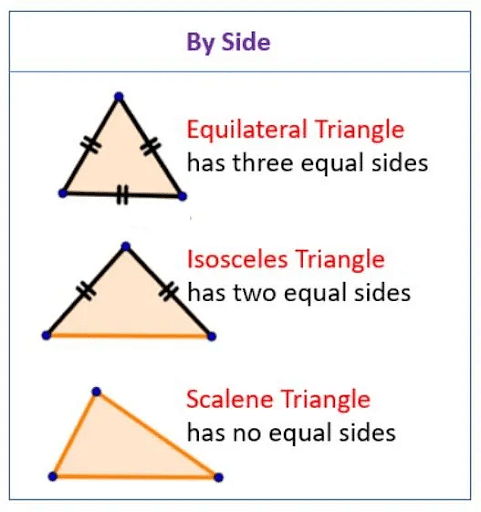
Types of Triangle Based on Sides
Types of Triangles Based on Angles
[Click Here for Sample Questions]
A triangle can be classified into the following types based on the angles:
- Obtuse-angled Triangle: An obtuse-angled triangle has one angle of more than 90 degrees.
- Right-angled Triangle: A right-angled triangle is a triangle with a 90-degree angle.
- Acute-angled Triangle: A triangle with all angles less than 90 degrees.

Types of Triangle Based on Angles
Read More: Right Angle Formula Properties Solved Examples
Properties of Triangles
[Click Here for Sample Questions]
Here are some important properties of a triangle:
- The side opposite the largest side of an angle is greater than a triangle.
- Any difference between two triangle sides is always less than the difference between the third and fourth sides.
- According to the angle sum condition, the sum of all angles in a triangle equals 180.
- The measure of the exterior angle of a triangle is the sum of its opposite interior angles.
- Any two sides of a triangle are always greater than the sum of the third side.
ASA Triangle Construction
[Click Here for Sample Questions]
To construct a triangle based on the ASA criterion, we require the measurements of two alternate angles and the length of a side between these two angles. If any alternative side is provided in place of the included side, the ASA triangle cannot be produced since it does not match the ASA requirements.
To construct an ASA triangle, we'll need a ruler to measure the length of the side and a protractor to measure the angles.
Make an ASA triangle with AB = 3cm, ∠CAB = 450, and ∠CBA = 600.
Step 1: Draw a 3 cm long line segment AB with the ruler.

Step 2: Using the protractor, draw a ray at point B that forms a 60-degree angle with line BA.
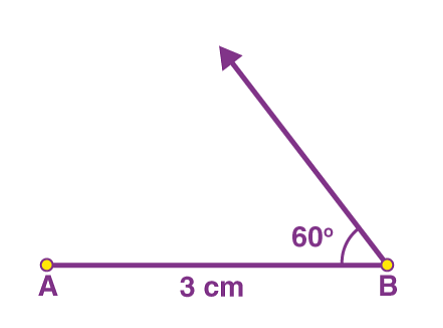
Step 3: With the protractor, draw a ray at point A that forms a 45-degree angle with line AB.

Step 4: Label the point where the two rays cross as C.

As a consequence, you have triangle ABC with the required dimensions.
The third angle of the triangle will be 75 due to the angle sum property of a triangle.
In other words, the sum of 60 + 45 +Third Angle equals 1800.
1800 - 1050 = 750 equals the third angle.
The third angle is 75 degrees.
Read More: Congruence Of Triangles- Conditions (SSS, SAS, ASA, RHS)
Things to Remember
- A triangle is a polygon made up of three straight lines and three angles.
- The total of the three interior angles of a triangle equals 180 degrees.
- The sum of the opposite internal angles equals the outward angle's measurement.
- The sum of the lengths of the first two sides of a triangle is always greater than the length of the third side.
- In a right-angled triangle, the square of the hypotenuse length (the side opposite the right angle) equals the sum of the squares of the other two sides.
- Triangles can be constructed on the basis of three criteria- SSS Criteria, SAS Criteria and ASA criteria.
- In order to construct a triangle based on ASA Criterion, we require the measurements of two alternate angles and the length of a side between these two angles.
Solved Questions
Ques. Make a triangle ABC in which BC is 6 cm, angle B is 350, and angle C is 1000. (3 Marks)
Ans. Here are the steps t construct the triangle:
- Step 1: Create a line segment with a length of BC = 6 cm.
- Step 2: Construct CBX so that it equals 35.
- Step 3: Draw BCY on the same side of BC as X. The value of BCY is 1000.
- Step 4: Make arrangements for BX and CY to meet at A.

ABC is the required triangle.
Ques. Create the triangle XYZ, where XY = 7 units, angle X = 400, and angle Y = 1050. (3 Marks)
Ans. The steps are as follows:
- Step 1: Using a scale and a pencil, draw a line segment XY = 7 units long.
- Step 2: Using the protractor, draw an angle X = 400 at point X.
- Step 3: Using the protractor, draw an angle Y = 1050 at point Y.
- Step 4: Label the crossing spots with the letter Z.
- Step 5: Connect the points XZ and YZ.
- Step 6: As a result, the triangle XYZ is required.

Ques. Make a triangle PQR with PQ equal to 5 units, QR equal to 6 units, and PR equal to 3.5 units. (3 Marks)
Ans. The steps are as follows:
- Step 1: Draw a 6-unit-long QR line segment.
- Step 2: At point Q, take a 5-unit compass reading and draw an arc.
- Step 3: Take a compass measurement of 3.5 units at point R and draw an arc crossing the preceding arc.
- Step 4: Connect the PQ and PR lines.

As a result, PQR is the required triangle.
Ques. Create a right-angled isosceles triangle with a base of 4 units. (3 Marks)
Ans. The steps are as follows:
- Step 1: Using a scale and a pencil, draw a line QR = 4 units.
- Step 2: Make a 90-degree angle at point Q using the protractor.
- Step 3: Using a compass, draw an arc of length QR = 4 units at point Q.
- Step 4: Join Public Relations. As a result, triangular PQR is necessary.

Ques. Create an equilateral triangle XYZ with 6-unit sides. (3 Marks)
Ans. The following are all of the construction steps:
- Step-1: Using a scale and a pencil, draw a length line YZ = 6 units.
- Step 2: Using a compass, place a compass point at point Y and draw an arc of length six units.
- Step 3: Using a compass, place a compass point at point Z and draw an arc of length 6 units.
- Step 4: Label the intersection with X and connect it to XY and XZ.

Ques. Draw an isosceles triangle with 6 units, 5 units and 6 units. (3 Marks)
Ans. The following are the measures to take:
- Step 1: Draw a line segment of BC = 5 units.
- Step 2: At point B, draw a six-unit-long arc.
- Step 3: Now, draw an arc with the same 6-unit length at point C.
- Step 4: Label the junction spots with A.
- Step 5: Connect AB and AC to produce an ABC isosceles triangle.

Ques. What are the applications of triangle construction? (2 Marks)
Ans. Triangles are used in the following ways:
- In the building of skyscrapers and bridges.
- In the use of the Pythagorean theorem.
Ques. What exactly is triangle construction? What are the criteria for constructing triangles? (3 Marks)
Ans. Triangle construction is the process of drawing a triangle with certain requirements while keeping the triangle's attributes in mind.
Triangles are constructed using the following criteria:
- SSS – When all three sides' dimensions are known.
- SAS – When the lengths of two sides and an angle are known.
- ASA – When two angles are measured, the side is known.
- RHS – When the base and hypotenuse measurements are known.



Comments