



Content Curator
Cpk or Process Capability Index is a process for measuring capability. This can be used for finding the measurable property of something at an exact point. It is also used for measuring the capabilities of the producer in order to produce the products based on the tolerance range of a customer. The Cpk formula is used for calculating the target or certainty of an average performance. It is given by the formula:
Cpk = min [(USL−mean)/3σ, (mean−LSL)/3σ]
| Table of Content |
Key Takeaways: Cpk Formula, Process Capability Index, Product Output, Tolerance Zone, Variations.
What is Cpk?
[Click Here for Sample Questions]
Cpk or Process Capability Index is used to calculate the output of a particular product. It is a calculation tool used by many to estimate the product output. This is usually used for measuring the extent of variations of any process that experiences relative to its limits of specifications. This also helps in comparing the different processes with respect to the optimal situations or if the process bears the required results.
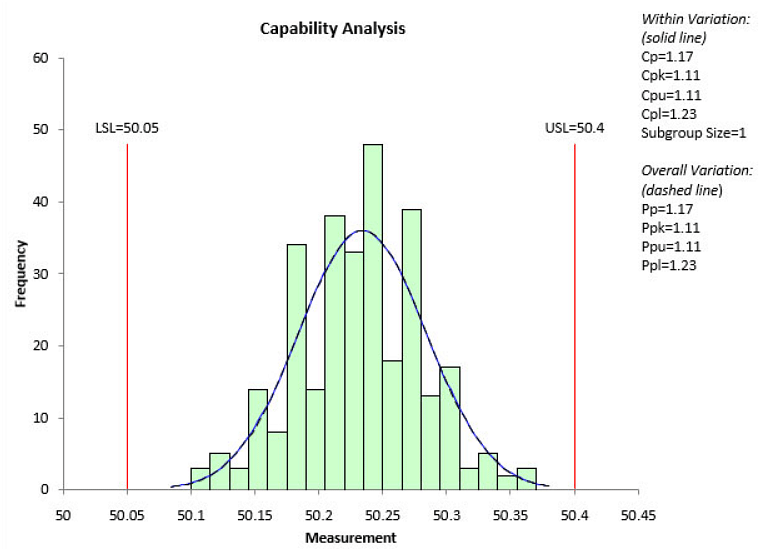
Cpk or Process Capability Index
The most common process capability index is provided by Cp, which is an estimation of the process mean-centered between the limits of the specifications by assuming that the output of the process is approximate. It says how many times the value of the tolerance zone is larger than the value of variations.
Read Also:
Calculation of Cpk (Process Capability Index)
[Click Here for Sample Questions]
Cpk is a measurement of process capability. Process capability index measures your process to see if it is capable of making an item within the given specifications. On the other hand, the process capability index lets you know where your process is in relation to the center of those specifications. The Cp for the upper limit is represented as the Cpu, while the Cp for the lower limit is represented as the Cpl. The Cpk equations for each are nearly identical.
Read Also: Theoretical Probability
Uses of Cpk Formula
[Click Here for Sample Questions]
The process capability index or Cpk Formula is mostly used for the measurements of any achieving process. The value of Cpk is used for depicting how closely a process will be able to produce the output of its overall specifications. For calculating the performance of an average, the development of any process, product or service has to follow a well structured process. The formula of Cpk is used in confirming the successful outcomes of any process.
Also Read:
| Independent Events in Probability | Multiplication Theory on Probability | Conditional Probability Formula |
Cpk Formula
[Click Here for Sample Questions]
This is an important statistical tool. It refers to an arithmetical study of the natural process of the variability of the given responsibilities under consideration. The process capability index or Cpk is used for the calculation of the ability of the process. The Cpk formula is mainly given by
Cpk = min [(USL−mean)/3σ, (mean−LSL)/3σ]
where,
Cpk → Process capability index
Mean → Mean value
USL → Upper specifications limits
LSL → Lower specifications limits
Also Read:
Things to Remember
[Click Here for Sample Questions]
- Cpk stands for "Process Capability Index".It is a measurable process used to measure the capability for producing the desired output based on the tolerance range of the customer.
- Cp stands for Process Capability. It is similar to the Cpk measurable process.
- Here the formula of Cpk i. e. (Process Capability Index) is represented by,
Cpk = min [(USL−mean)/3σ, (mean−LSL)/3σ]
- There is a slight difference between Cp and Cpk.
- The difference between Cpk and Cp is given here. The Cp is used to measure the ability of the process to meet the specification of the particular product. Whereas Cpk deals with the production of the products within the tolerance rate of the customers.
Sample Questions
Ques. What is the formula of Cpk? (2 marks)
Ans. The mathematical formula for the calculations of Cpk is written as Cpk = = min(USL - μ, μ - LSL) / (3σ), in which the LSL is known as the lower specifications limits and the USL is called upper specifications limits. The process whose Cpk is equal to 2.0 is considered as excellent whereas a Cpk of 1.33 is considered as adequate.
Ques. What is the Process Capability Index? (2 marks)
Ans. A process capability index or Cpk is the measurement of a process capability. It shows how close a process is going to give the needed output in comparison to the overall specifications. This also decides about the consistency of the percentage average.
Ques. The temperatures of a room are kept between 17 degree Celsius and 25 degrees Celsius. The process for maintaining the temp. has a standard deviation of 2°C. If the temp. mean is equal to 22 degrees Celsius then find the PCI using cpk formula. (2 marks)
Ans. To find the Cpk of the given process
USL or Upper Specification Limit = 25ºC
LSL or Lower Specification Limit = 17ºC
and the mean = 22ºC, Standard Deviation = 2ºC
Cpk = minimum (mean - LSL / (3σ), USL - mean) /(3σ)
= min ( 22-17/3×2, 25-22/3×2)
= min ( 5/6 , 3/6 )
= 3/6
= 0.5
Hence the capability index of the process i.e. Cpk is equal to 0.5.
Ques. What do you mean by Cpk with examples? (2 marks)
Ans. The Cpk or process capability index is a type of standard index that is used for the calculation of the capability of any process. The higher the value of Cpk, the better the capability process is. For example, Machine A has a capability index of 1.7 and Machine B has a Cpk of 1.1. Then from the Cpk value we can say that Machine A is better than Machine B.
Ques. What does min mean in the Cpk formula? (2 marks)
Ans. Based on the equation of Cpk that is [minimum (mean - LSL, USL - mean)] / (0.5*NT). Here, LSL stands for lower specifications limits and the USL is known as upper specifications limits. Since we describe the Cpk as the process of Capability for achieving whether or not the mean is centered between the limits of specifications.
Ques. The food at any restaurant, when given to a customer, should be served between the temperature of 23ºC and 45ºC. The standard deviation of the process that is mainly used for keeping the food at the correct temperature is of 2ºC and the mean value for these temperatures is of 35ºC. Calculate the process capability index of the process? (2 marks)
Ans. To find the Cpk of the given process
USL or Upper Specification Limit = 45ºC
LSL or Lower Specification Limit = 23ºC
and the mean = 35ºC, Standard Deviation = 2ºC
Cpk = minimum (mean - LSL / (3σ), USL - mean) /(3σ)
= min ( 35 – 23 / 3 × 2, 45 – 35 / 3 × 2)
= min ( 12/6 , 10/6 )
= 10/6
= 1.66
Hence the capability index of the process i.e. Cpk is equal to 1.66.
Ques. What does a Cpk of 1.67 mean? (2 marks)
Ans. The result of a Process Capability study is a single measurement, which gives a sign of the capacity of an interaction to reliably output which is within required specifications. If CPK <1.00 then it is Poor or unfit and if 1.00< CPK <1.67 (Fair) CPK >1.67 (Excellent, Capable).
Ques. What is the formula for CP and Cpk? (2 marks)
Ans. A perfectly focused cycle will have Cp = Cpk. Both Cpk and Ppk relate the standard deviation and focusing of the cycle about the midpoint to the allowable tolerance specifications. An estimate for Cpk = Cp(1-k) and since the most extreme value for k is 1.0, then, at that point, the value for Cpk is equivalent all of the time to or not exactly Cp.
Ques. The food at any restaurant, when given to a customer, should be served between the temperature of 30ºC and 50ºC. The standard deviation of the process that is mainly used for keeping the food at the correct temperature is of 2ºC and the mean value for these temperatures is of 41ºC. Calculate the process capability index of the process? (2 marks)
Ans. To find the Cpk of the given process
USL or Upper Specification Limit = 50ºC
LSL or Lower Specification Limit = 30ºC
and the mean = 41ºC, Standard Deviation = 2ºC
Cpk = minimum (mean - LSL / (3σ), USL - mean) /(3σ)
= min ( 41-30/3×2, 50-41/3×2)
= min ( 11/6 , 9/6 )
= 9/6
= 1.5
Hence the capability index of the process i.e. Cpk is equal to 1.5.
Ques. The temperature of any room during the training period must be kept between 19 degrees Celsius and 27 degrees Celsius. The process for maintaining the temp. has a standard deviation of 2°C. If the temp. mean is equal to 22 degrees Celsius then find the PCI using cpk formula. (2 marks)
Ans. To find the Cpk of the given process
USL or Upper Specification Limit = 27ºC
LSL or Lower Specification Limit = 19ºC
and the mean = 22ºC, Standard Deviation = 2ºC
Cpk = minimum (mean - LSL / (3σ), USL - mean) /(3σ)
= min ( 22-19/3×2, 27-19/3×2)
= min ( 3/6 , 8/6 )
= 3/6
= 0.5
Hence the capability index of the process i.e. Cpk is equal to 0.5.
Read Also:



Comments