



Content Curator
Theoretical probability is based on our reasoning when we do no experiment but depend on our reasoning to understand the likelihood of an event. In our everyday lives, we often encounter a situation where we have to take a chance or we have to choose an option depending on the situation. But can we predict if a particular event is going to happen or not? Yes, we can! And this study of the likelihood of occurrences of a particular event is what we call probability.
| Table of Content |
What is Probability?
Probability is the branch of Mathematics that is primarily concerned with the mathematical description of how likely an event is to occur. The value of probability falls in the range of 0 to 1. If the probability of an event is 0 it is called an ‘impossible’ event. It means it's an event that cannot happen.
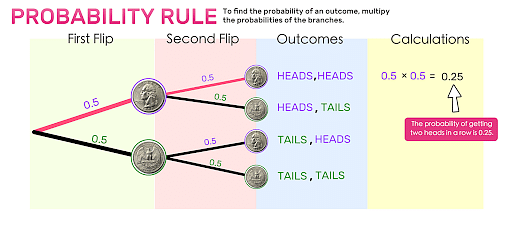
Probability
For example, if a coin is flipped, getting both Heads and tails simultaneously will be an impossible event. On the other hand, a certain event is an event which will surely happen. For instance, if the same coin is flipped, the chance of getting a head or a tail is a certain event.
Theoretical Probability: Definition
Theoretical probability can be defined as the situation when we are predicting the probability of an event based on what we can expect to happen in an experiment considering all the possibilities that are theoretically possible. So theoretical probability is not based on any data from an experiment repeated multiple times. It is based on our reasoning.
\(\text{Theoretical Probability} = \frac{\text{Number of favorable (desired) outcomes}}{\text{Total number of possible outcomes}}\)
Theoretical probability can be mathematically expressed as the ratio of the total number of favourable outcomes and all the possible outcomes.
Also Read: Probability — A Theoretical Approach
P(E)= No. of favourable outcomes/ total no. of all possible outcomes
= N(E)/ N(S)
[P(E)= Theoretical probability
N(E)= All the favourable outcomes
N(S)= All possible outcomes of the event P(E), also known as Sample Space.]
For example: let us find out the probability of getting a”3” when a fair die is rolled.
A die has 6 sides and when we roll it, we will be facing any one of the six sides. So, the possible outcomes will be 1,2,3,4,5,6.
So here, the sample space is {1,2,3,4,5,6} and the total number of possible outcomes is 6.
No. of favourable outcomes= no. of times the die is rolled to get 3 at one throw=1
So, the probability of getting a 3 when a fair die is rolled is
P (getting a 3) = No. of favourable outcomes/ total no. of all possible outcomes = 1/6
Let us take another example, what is the probability that the die rolls up to an even number.
Here, the sample space is {1,2,3,4,5,6} and the total number of all possible outcomes is 6.
No. of favorable outcomes (even number) = {2,4,6} =3
So, P(getting an even number)= No. of favorable outcomes/ total no. of all possible outcomes
= \(\frac{3}{6}\)
= \(\frac{1}{2}\)
One thing that has to be mentioned here, that no experiment has been conducted nor any experimental data has been taken into consideration. Here, the probability of an event is determined by our own reasoning.
Also Read:
Events in ProbabilityExperimental Probability
In case of experimental probability, the probability is determined on the basis of the result obtained in an experiment repeated several times. It is also known as empirical probability.
Experimental probability is mathematically expressed by the ratio of no. of times an event occurs and total number of trials.
P(E) = No. of times an event occurs/ Total no. of trials
So, for instance, if we are to find the probability of getting heads after flipping a coin ten times, the experimental probability would be the number of times we get heads after flipping a coin for 10 times. Assume that we have got heads 7 times out of 10 throws, then the experimental probability of getting a head becomes 7/10.
Here the probability determination is done from the actual experimental data and NOT by calculating theoretically possible or desirable outcomes.
Also Read:
Probability DistributionTheoretical vs. Experimental Probability
We have already mentioned that probability is the ratio of all the favourable outcomes and all the possible outcomes. So if we find that 0
P(E)+ P(E)’=1
Now if we perform the experiment plenty of times, we will see the experimental probability is getting closer to the value of theoretical probability.
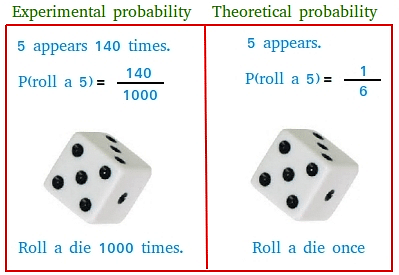
For instance, you may not get 50% for heads and tails in the first 10 throws of the fair coin but if you throw it 50 times or even 100 times, you will find the value of the experimental probability is getting closer to the theoretical probability value.
Theoretical probability is calculated to have a fair idea of the outcomes and likelihood of an event so necessary steps can be taken to avoid undesirable circumstances. For example, for a successful launch of a satellite the theoretical probability is calculated, not the experimental one.
Also Read:
Multiplication Rule of ProbabilityThings To Remember
- Probability is primarily concerned with the mathematical description of how likely an event is to occur. The value of probability falls in the range of 0 to 1.
- If the probability of an event is 0 it is called an ‘impossible’ event.
- A certain event is an event which will surely happen. The probability of a certain event is always 1.
- Theoretical is when we are predicting the probability of an event based on what we can expect to happen in an experiment considering all the possibilities that are theoretically possible. There is no experiment conducted here.
- In the case of experimental probability, the probability is determined on the basis of the result obtained in an experiment repeated several times
- If an experiment is done plenty of times, the experimental probability will get closer to the value of theoretical probability.
Sample Questions
Ques. What will be the Sample Space of Outcomes when Two fair Coins are Tossed? (2 marks)
Ans: When two fair coins are tossed the sample space of all the possible outcomes is
S={ HH, TH, HT, TT}.
Ques. What is an impossible event? (2 marks)
Ans: When the probability of an event is 0 it is called an ‘impossible’ event. It means it’s an event that cannot happen. It is also known as ‘zero’ probability.
Ques. What is a certain event? (2 marks)
Ans: A certain event is an event which will surely happen. For instance, if the same coin is flipped, the chance of getting a head or a tail is a certain event.
Ques. What is the Rule of Complements in Probability? (3 marks)
Ans: If P(E) represents the probability of an event to happen and P(E)’ represents chances of non-occurrence of the same event, we can mathematically express it as-
P(E)+P(E)’=1
So, P(E)’ is the complement of P(E).
Ques. Two coins are flipped 20 times. determine the theoretical probability of both coins landing on heads. (2 marks)
Ans: If two coins are flipped there can be 4 possible outcomes- {(H,H), (H, T), (T,H), (T, T)}. Therefore, 1 out of the 4 possible outcomes has both coins land on heads.
So, the theoretical probability will be \(\frac{1}{4}\) or 25%.



Comments