



Content Curator
Cube root table from 1 to 100 is applied to solve mathematical problems. The cube root of a number can be defined as a value, which when multiplied by itself three times, yields the original number. The cube root is denoted by the “∛ “ symbol.
Cube numbers are the results of multiplying a number by itself three times. A number is a perfect cube if each factor appears three times in the prime factorization of any Number. The prime factorization method can be used to find the value of the cube root.
Key Terms: Cube root, Perfect cube, Integer, Multiplication of Integers, Prime Factorization, Integer
What is Cube Root?
[Click Here for Sample Questions]
The cube root of a number can be defined as a value, which when multiplied by itself three times, yields the original number.
- Finding the cube root is the inverse operation of finding the cube.
- For example, We know that 3√8 = 2 or 8 = 23. The cube root symbol is denoted by “∛”.
- The cube root of “a” is represented as: a = 3√b.
- The cube root formula can be represented by “y”, where it is the cube root of x. Thus, 3√x= y.
![Cube Root Example]()
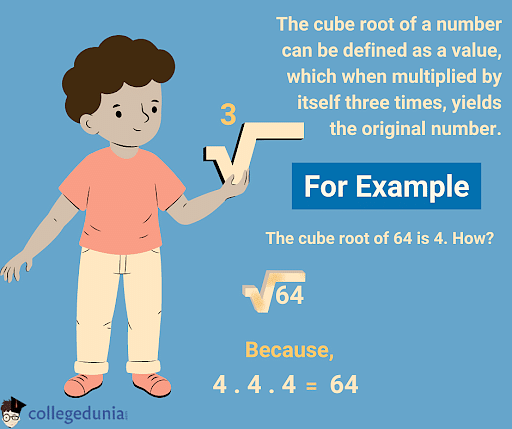
Cube Root Example
Read more: Cubes and Cube Roots MCQs
What is Perfect Cube?
[Click Here for Sample Questions]
The final outcome of multiplying the same integer by three is a perfect cube.
- A number that is expressed as three times the product of another number is referred to as a perfect cube.
- There are only ten perfect cubes from 1 to 1000. A perfect has a cube root that is a whole number. Whether the number is an integer or a fraction, we can always find its cube.
- For example, the cube of 4, for instance, is: 4 x 4 x 4 = 64.
Read More:
Cube Root 1 to 100
[Click Here for Sample Questions]
The following are the cube roots from 1 to 100
| Number | Cube root (3√) |
|---|---|
| 1 | 1 |
| 2 | 1.25992105 |
| 3 | 1.44224957 |
| 4 | 1.587401052 |
| 5 | 1.709975947 |
| 6 | 1.817120593 |
| 7 | 1.912931183 |
| 8 | 2 |
| 9 | 2.080083823 |
| 10 | 2.15443469 |
| 11 | 2.223980091 |
| 12 | 2.289428485 |
| 13 | 2.351334688 |
| 14 | 2.410142264 |
| 15 | 2.466212074 |
| 16 | 2.5198421 |
| 17 | 2.571281591 |
| 18 | 2.620741394 |
| 19 | 2.668401649 |
| 20 | 2.714417617 |
| 21 | 2.758924176 |
| 22 | 2.802039331 |
| 23 | 2.84386698 |
| 24 | 2.884499141 |
| 25 | 2.924017738 |
| 26 | 2.962496068 |
| 27 | 3 |
| 28 | 3.036588972 |
| 29 | 3.072316826 |
| 30 | 3.107232506 |
| 31 | 3.141380652 |
| 32 | 3.174802104 |
| 33 | 3.20753433 |
| 34 | 3.239611801 |
| 35 | 3.27106631 |
| 36 | 3.301927249 |
| 37 | 3.332221852 |
| 38 | 3.361975407 |
| 39 | 3.391211443 |
| 40 | 3.419951893 |
| 41 | 3.44821724 |
| 42 | 3.476026645 |
| 43 | 3.50339806 |
| 44 | 3.530348335 |
| 45 | 3.556893304 |
| 46 | 3.583047871 |
| 47 | 3.60882608 |
| 48 | 3.634241186 |
| 49 | 3.65930571 |
| 50 | 3.684031499 |
| 51 | 3.708429769 |
| 52 | 3.732511157 |
| 53 | 3.756285754 |
| 54 | 3.77976315 |
| 55 | 3.802952461 |
| 56 | 3.825862366 |
| 57 | 3.848501131 |
| 58 | 3.870876641 |
| 59 | 3.892996416 |
| 60 | 3.914867641 |
| 61 | 3.936497183 |
| 62 | 3.95789161 |
| 63 | 3.979057208 |
| 64 | 4 |
| 65 | 4.020725759 |
| 66 | 4.041240021 |
| 67 | 4.0615481 |
| 68 | 4.081655102 |
| 69 | 4.10156593 |
| 70 | 4.1212853 |
| 71 | 4.140817749 |
| 72 | 4.160167646 |
| 73 | 4.179339196 |
| 74 | 4.198336454 |
| 75 | 4.217163327 |
| 76 | 4.235823584 |
| 77 | 4.254320865 |
| 78 | 4.272658682 |
| 79 | 4.290840427 |
| 80 | 4.30886938 |
| 81 | 4.326748711 |
| 82 | 4.344481486 |
| 83 | 4.362070671 |
| 84 | 4.37951914 |
| 85 | 4.396829672 |
| 86 | 4.414004962 |
| 87 | 4.431047622 |
| 88 | 4.447960181 |
| 89 | 4.464745096 |
| 90 | 4.481404747 |
| 91 | 4.497941445 |
| 92 | 4.514357435 |
| 93 | 4.530654896 |
| 94 | 4.546835944 |
| 95 | 4.562902635 |
| 96 | 4.57885697 |
| 97 | 4.594700892 |
| 98 | 4.610436292 |
| 99 | 4.626065009 |
| 100 | 4.641588834 |
Read more: Number System
Perfect Cubes from 1 to 50
[Click Here for Sample Questions]
The following are the Perfect cubes from 1 to 50
| Number | Cube of the Number |
|---|---|
| 1 | 1 |
| 2 | 8 |
| 3 | 27 |
| 4 | 64 |
| 5 | 125 |
| 6 | 216 |
| 7 | 343 |
| 8 | 512 |
| 9 | 729 |
| 10 | 1000 |
| 11 | 1331 |
| 12 | 1728 |
| 13 | 2197 |
| 14 | 2744 |
| 15 | 3375 |
| 16 | 4096 |
| 17 | 4913 |
| 18 | 5832 |
| 19 | 6859 |
| 20 | 8000 |
| 21 | 9261 |
| 22 | 10648 |
| 23 | 12167 |
| 24 | 13824 |
| 25 | 15625 |
| 26 | 17576 |
| 27 | 19683 |
| 28 | 21952 |
| 29 | 24389 |
| 30 | 27000 |
| 31 | 29791 |
| 32 | 32768 |
| 33 | 35937 |
| 34 | 39304 |
| 35 | 42875 |
| 36 | 46656 |
| 37 | 50653 |
| 38 | 54872 |
| 39 | 59319 |
| 40 | 64000 |
| 41 | 68921 |
| 42 | 74088 |
| 43 | 79507 |
| 44 | 85184 |
| 45 | 91125 |
| 46 | 97336 |
| 47 | 103823 |
| 48 | 110592 |
| 49 | 117649 |
| 50 | 125000 |
Read more: Prime numbers
Things to Remember
- The result of multiplying a number by itself three times is known as the perfect cube of that number.
- From 1 to 1000, there are only 10 perfect cubes.
- A negative number's cube is always a negative number.
- The symbol 3 represents the cube root of a number.
- When a prime factor is not possible to divide into groups of three then the number is not a perfect square.
Read More:
Sample Questions
Ques: Find the cube root of 8000. (1 mark)
Ans: Prime factorisation of 8000 is
2 × 2 × 2 × 2 × 2 × 2 × 5 × 5 × 5
So, 3√8000 = 2 × 2 × 5 = 20
Ques: Determine the sides of a cubical box with a volume of 64 cm3. (1 mark)
Ans: Give Volume = 64cm3
Consider the edge of the dice to be a cm, then the volume = a3
a3 = 64cm3
a3 = 4 cm
Ques: Is the number 9000 a perfect cube? (1 mark)
Ans: The prime factorization method can be used to calculate the cube root of a number.
In factorization, 3 is multiplied only twice.
As a result, 9000 is not a perfect cube.
Ques: Determine the cube root of 216. (2 marks)
Ans: We know this through prime factorisation, we get;
216 = 2×2×2×3×3×3
216 = 23 x 33
216 = (2×3)3 = 63
3√216 = 6
Ques. Find 3√343. (2 marks)
Ans: By prime factorisation
343 = 7x7x7
343 = 73
3√343 = 7
Ques: Determine the value of 3√1728. (2 marks)
Ans: Using the prime factorisation method,
1728 = 2×2×2×2×2×2×3×3×3
1728 = 23 ×23 x33
1728 = (2×2×3)3
1728 = 123
3√1728 = 12
Ques: Determine the volume of a cube whose surface area is 96cm². (2 marks)
Ans: The surface area of a cube is equal to 6 x Side².
The surface area of the cube is given as 96cm².
6 x Side² = 96
Side² = 96 / 6
Side² = 16;
Side = 4
The cube's volume = Side3 = (4)3 = 64cm3
Ques: What is 1331's cube root? (1 mark)
Solution: Using the prime factorisation method,
we obtain; 1331 = 11×11×11 = 1131
1331 = 113
3√1331 = 11
Ques: Determine the cube root of 64. (2 marks)
Ans: The prime factorisation method must be used to find the cube root of 64.
64 = 2×2×2×2×2×2
64 = 4 × 4 × 4
64 = 43
Considering the cube roots from both side we get;
3√64 = 3√(43)
3√64 = 4
Ques: Find the smallest number that must be multiplied by 243 to get a perfect cube. (3 marks)
Ans: We have 243 = 3 × 3 × 3 × 3 × 3

The prime factor 3 does not belong to a group of three.
∴ The number 243 is not a perfect cube.
Now, [243] × 3 = [3 × 3 × 3 × 3 × 3] × 3
or 729 =3 × 3 × 3 × 3 × 3 × 3
729 is now a perfect cube.
As a result, the smallest number required to multiply 243 to form a perfect cube is 3.
Read Also:



Comments