



Content Curator
Number lines are straight lines with numbers fixed at regular intervals or segments along its length. They are normally represented horizontally. One main feature of the number line is that it can be extended infinitely in any direction. The number on a number line decreases when it moves from right to left and increases as it moves from left to right.
| Table of Contents |
Keyterms: Straight lines, Number lines, Intervals, Real number, Whole number, Arithmetic operations
Also Read: Fractions on Number Line
What is a Number Line?
[Click Here for Sample Questions]
Number line can be determined as the pictorial representation of numbers on a straight line. It is used as a reference for ordering and comparing numbers. Any real number can be represented on a number line that includes the natural number and every whole number. Creating number lines is a simple way of comparing numbers. A blank number line can be a visual representation of a number line with no markers or numbers. It is crucial for solving word problems. It was originally conceived as a visual diagram for solving addition and subtraction.

Number Line
Also Read: Rational Numbers on Number Line
Numbers on Number Line
[Click Here for Sample Questions]
Numbers are learned better with the help of number lines. Similarly, arithmetic operations can be defined better on a number line. Identifying or locating numbers on a number line is the best practice in order to use the number line. In an ideal number line, zero will be there in the middle of the line. Considering zero as a point, negative numbers are placed on the left side of the line. Positive real numbers are placed on the right side of the number line. The value of the number decreases as we move from 0 to left.
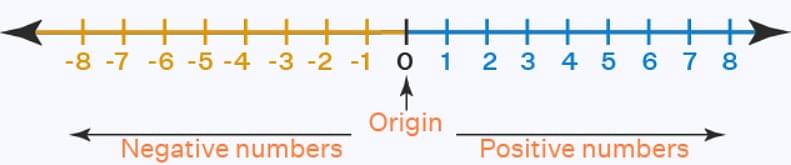
Positive and negative numbers
Number Lines - Addition
[Click Here for Sample Questions]
The addition of two positive numbers will lead to the generation of another positive number. In other words, the result will always be positive when two positive numbers are added. Hence, the movement of numbers will be towards the right side. Adding 1 and 5 (1+5) will give the number 6.
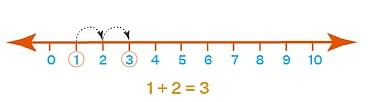
Addition on Number line
The addition of negative numbers is also done in a number line. The result will always be a negative number when we add two negative numbers. Hence, the movement in adding negative numbers is always towards the left. Consider the number -2 and -3 (Both are negative). Now identify -2 on the number line, and move 3 places to the left and the result is -5. The result is a negative number and it is being positioned on the left side.
Also Read: Descending Order
Number Lines - Subtraction
[Click Here for Sample Questions]
The subtraction of any number on the number line will result in a movement towards the left. When the subtraction of two positive numbers takes place, the resulting number moves to the left as far as the value of the second number. Assume subtracting the number 5 from the number 2. Find number 2 on the line, then move 5 places to the left, the result is -3.
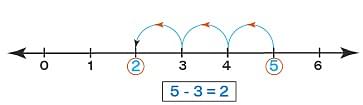
Subtraction on Number Line
The subtraction of two negative numbers is done on the number line. The result or movement will be to the right of the number line as far as the value of the second number. Consider subtracting -4 from -2 (Both are negative numbers). Locate the number -2 on the line, then move 4 places to the right, and the result is 2 (Positive number).
Things to Remember
- Number line is the visual representation of numbers on a straight line.
- Number lines are used for ordering numbers or comparing numbers.
- Number 0 will be the middle point of any number line.
- All positive or natural numbers occupy the right side of the line beginning with zero.
- Negative numbers occupy the left side of the number line.
Also Read:
Sample Question
Ques: Which is the biggest number on the number line? (2 marks)
Ans: The direction or movement of numbers on the number line are important. The more movement towards the right side means greater value. The value starts decreasing when the movement happens towards the left. Both left and right continue to be infinite with negative and positive numbers starting from the center.
Ques: What do the dots represent on a number line? (2 marks)
Ans: The dots or points considered as coordinated, where number 0 is the center point or origin. The movement from center to the right side is increasing in order. Movement from center to the left is decreasing order.
Ques: Define number line? (2 marks)
Ans: A number line is the pictorial representation of numbers. It is a horizontal straight line that expresses integers on it at regular intervals.
Ques: What is the use of number lines? (2 marks)
Ans: Number line is a visual representation of numbers on a straight line. It is used for the ordering and comparison of numbers. The arithmetic operations such as addition, subtraction, etc can be performed using number lines.
Ques: What does it mean when we arrange integers on the left side of the number line? (2 marks)
Ans: When the integers are arranged on the left side of a number line, it means those numbers are smaller than those on the right side. Number 6 is placed on the left side of 7 as 6 is less than 7.
Ques: Give a brief definition for the tangent of a circle? (2 marks)
Ans: The tangent to a circle is determined as a line which intersects the circle at only one particular point. The common point between the circle and the tangent is called the point of contact.
Ques: What are natural numbers? (2 marks)
Ans: Natural numbers are real numbers and are part of the number system. All the positive integers from 1 to infinity are natural numbers. They are also used for counting purposes. Natural numbers do not include zero, negative numbers, fractions and decimals.
Ques: What is the main difference between whole numbers and natural numbers? (2 marks)
Ans: Natural numbers are real numbers and they only include positive integers starting with number one and going upto infinity. Where, whole numbers are the combination of natural numbers and zero. Whole numbers start from 0 and continue to infinity.
For Latest Updates on Upcoming Board Exams, Click Here: https://t.me/class_10_12_board_updates
Also Check:



Comments