



Content Writer-SME
Deficiency diseases are group of diseases that are caused by the lack of essential macronutrients in the regular diet. A well-balanced diet on a daily basis is important for good health. But what type of deficiency diseases occurs if any of the essential nutrients are deficient in the diet?
A wide range of health issues, including digestive problems, skin disorders, stunted bone growth, and even dementia can be caused by mineral and vitamin deficiencies in humans. Thus, we should always eat a well-balanced diet that includes all of the essential nutrients our bodies require everyday. Here, in this article, we will be discussing deficiency diseases in depth along with some important questions.

Deficiency Diseases
What is Deficiency Disease?
[Click Here for Sample Questions]
Inadequate intake of essential nutrients can cause weakness and health problems, resulting in deficiency diseases. Nutritional disorders are another name for deficiency diseases. A well-balanced diet is critical for a person's health and well-being.
Consuming enough nutrients keeps us healthy and disease-free. Any nutrient imbalance in the diet can result in an excess or deficiency of certain nutrients and this becomes a problem in long-term. We can get all the forms of nutrients through two sources:
- Plant-based food sources- Examples of plant based food sources include carrot, green-leafy vegetables etc.
- Animal-based food sources- Eggs, meat, and fish are some of the examples of animal based food sources.
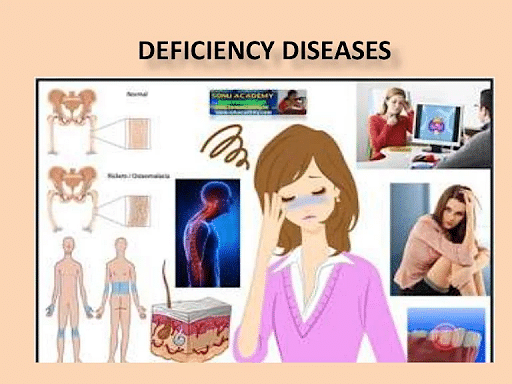
Anemia, scurvy, night blindness, and rickets are some of the common deficiency diseases that can be experienced by person of any age. These diseases are generally classified according to the type of nutrient that is deficient.
Types of Deficiency Diseases
[Click Here for Sample Questions]
A lack of protein, vitamins, and minerals leads to a variety of deficiency diseases. Several types of diseases includes:
Protein Energy Deficiency (PEM):
Protein and energy deficiency go hand in hand, so these deficiencies are referred to as protein energy malnutrition (PEM) or protein-calorie malnutrition (PCM). PEM affects people of all ages, but it is more common in children.

Vitamin Deficiency:
It is a long-term lack of vital amines in our bodies. If there is a lack of vitamin intake, the condition is referred to as primary deficiency; if the cause of the deficiency is malabsorption of vitamins due to a disorder, the condition is referred to as a secondary deficiency. Vitamin deficiencies can lead to diseases like beriberi and pellagra.
Mineral Deficiency:
Minerals are nutrients required by the human body to function properly. When the body does not obtain or absorb the required amount of a mineral, it is said to have a mineral deficiency. It can happen gradually over time for a variety of reasons.
- These can include an increased mineral requirement in the body, a lack of minerals in the diet, and so on.
- The deficiency of minerals can lead to several health problems.
- For example, deficiency of iron can result in anaemia.
Protein Deficiency Diseases
[Click Here for Sample Questions]
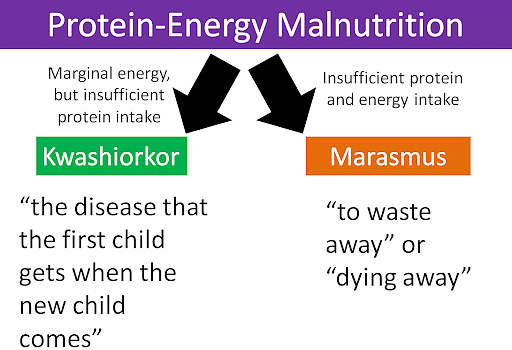
The excess or deficiency of proteins are both associated with diseases in humans which is commonly called protein energy malnutrition. Kwashiorkor and marasmus are the two examples of protein energy malnutrition.
Kwashiorkor
A severe protein deficiency causes Kwashiorkor. Kwashiorkor usually appears in children between the ages of 13 and 15, when their daily protein intake is less than 1g/kg of body weight.
Symptoms include:
- Slowed growth and bulging eyes.
- Due to water retention, the abdomen (stomach) swells (retention of water by the cells is called oedema).
- Legs become thinner and more curved (matchstick legs)
- The skin becomes scaly and peels.
- Before the age of five, the hair turns reddish.
- It has an impact on brain development.
Marasmus
Marasmus is a disease that occurs when energy is primarily insufficient. Thus, marasmus is caused by insufficient food intake or starvation, resulting in a calorie and energy deficiency. It is common in infants under the age of one year.
Symptoms:
- The child's body is made up of only skin and bones; ribs are visible, and the child has a shrivelled appearance.
- The skin is thin and wrinkled, with loose folds visible.
- The fat layer beneath the skin vanishes completely.
- The face appears to be larger than the rest of the body.
- Digestion has been hampered.
- Slowed physical and mental development.
- The body becomes more vulnerable to infections.
Kwashiorkor and Marasmus Disease Prevention and Control:
- A protein-rich diet can be used to treat the disease.
- A blend of wheat, gramme, soya bean, peanuts, and jaggery (gur).
- A diet rich in animal protein, such as meat and fish.
Vitamin Deficiency Diseases
[Click Here for Sample Questions]
A lack of vitamins in the diet for an extended period of time causes hypovitaminosis (vitamin deficiency) or avitaminosis (vitamin deficiency) (lack of vitamins). There are several types of essential vitamins, including vitamin A, vitamin B, vitamin C, and vitamin D.
- Vitamins are classified into two types: water-soluble vitamins and fat-soluble vitamins.
- Fat-soluble vitamins include vitamins A, D, E, and K.
- Water-soluble vitamins include vitamins B and C.
Below we have mentioned the names of deficiency diseases and their food sources in tabular form:
| Vitamin Deficiency | Deficiency Diseases | Food sources to overcome deficiency |
|---|---|---|
| Vitamin A | Night blindness, dryness of skin and hair, retardation of growth. | Fish liver oil, carrots, buttermilk, sweet potatoes and tomatoes. |
| Vitamin B1 (Thiamine) | Beriberi (loss of appetite, retarded growth) | Rice, milk, green vegetables, wheat and meat. |
| Vitamin B2 (Riboflavin) | Inflammation of tongue, drying of cheilosis (retarding the growth and digestion) | Egg yolk, liver, yeast |
| Vitamin B5 (Nicotinamide) | Pellagra-pigmentation of skin, mental confusion, degeneration of the spinal cord. | Barley, liver, maise, wheat, rice |
| Vitamin B6 | Convulsions, mental changes, failure to gain weight. | Yeast, milk, fish, cereals, maise |
| Vitamin B12 | Anaemia, degradation of the spinal cord. | Egg, fish, curd, liver of pig and sheep |
| Vitamin C | Scurvy (bleeding, spongy, swollen gums) | Citrus fruits, onion, cabbage, amla, green leafy vegetables, tomatoes |
| Vitamin D | Rickets (bone deformities in children) and osteomalacia | Exposure to sunlight |
| Vitamin E | Muscular weakness, abnormal growth. | Vegetable oils like wheat germ oil, cottonseed oil, soya bean oil, etc. |
| Vitamin K | Increased blood clotting time. | Green leafy vegetables, fish meat, etc. |
| Vitamin P | Haemorrhage, decrease in capillary resistance. | Orange and grapes |
Mineral Deficiency Diseases
[Click Here for Sample Questions]
Mineral deficiency diseases are caused by a lack of minerals such as iron, calcium, and iodine, among others. The following are a few mineral deficiency diseases caused by a lack of minerals:
| Mineral Deficiency | Deficiency Disease | Prevention |
|---|---|---|
| Iron | Anaemia: A person suffering from anaemia will not have enough energy to engage in daily activities. The daily iron requirement is 18mg. | Green leafy vegetables, dals, wheat, rice, apple, banana, guava, eggs, meat, and liver are all part of a healthy diet. Iron is better absorbed by the body when it is combined with vitamin C/protein. Many green leafy vegetables are high in vitamin C, and dals, liver, and meat are high in protein. As a result, these aid in iron absorption. |
| Iodine | Goiter: It is an enlargement of the thyroid gland, which is located in the neck. Iodine is required for the thyroid gland to produce the hormone thyroxine. Thyroxine regulates the rate at which the body consumes oxygen. The gland enlarges if the body does not get enough iodine. | Iodine is abundant in seafood, leafy vegetables, water, and iodized salt. These foods should be included in the diet. As effective cures for goitre, the ICMR has developed intramuscular injections of iodised oil (mostly poppy seed oil) and oral sodium iodate tablets. |
| Calcium | Calcium Deficiency: A lack of calcium in the diet weakens and brittles the bones. It can also result in tooth decay. | Milk, eggs, dairy products, and leafy vegetables should all be included in your diet. Beans, figs, broccoli, tofu, soy milk, fortified cereals, nuts and seeds, including almonds and sesame seeds, are high in calcium. |
| Phosphorous | Phosphorus deficiency: A lack of phosphorus in the diet weakens and brittles the bones. Inadequate heart and muscle function. Our body's genetic material is not properly formed. | Milk, green vegetables, and cereals should be included in the diet. |
Things to Remember
- Deficiency diseases are illnesses caused by a chronic lack of certain essential nutrients, particularly vitamins and minerals, in one's diet."
- Deficiency diseases are caused by deficiency of either vitamin like Vitamin A, B6, B12, B3, C, D, K or minerals like Iron, Iodine, Phosphorous, Calcium, Zinc and Magnesium.
- Consuming simple, wholesome foods such as groundnuts, soybeans, pulses, and so on.
- Food that has been cooked for an extended period of time or that has been undercooked loses its nutritional value. Keeping cut vegetables and fruits for an extended period of time destroys their nutritional value. By avoiding this, you can avoid deficiency diseases.
- Fermentation and sprouting both preserve and enhance the nutritional value of food.
Sample Questions
Ques: What exactly are deficiency diseases? Name any five. (2 marks)
Ans: Consuming enough nutrients keeps us healthy and disease-free. Any nutrient imbalance in the diet can result in an excess or deficiency of certain nutrients. Inadequate intake of a specific nutrient can result in a deficiency disease. Deficiency diseases include anaemia, goitre, rickets, beriberi, scurvy, pellagra, and others.
Ques: Which disease is caused by a vitamin A,B,C,D deficiency? (2 marks)
Ans: Vitamin A causes night blindness, dry skin and hair, and growth retardation.
Vitamin B causes Beriberi, pellagra
Vitamin C causes Scurvy
Vitamin D causes Rickets
Ques: How Can Deficiency Diseases Be Prevented? (3 marks)
Ans: Vitamin and mineral deficiency diseases are easily avoidable if we eat a well-balanced diet and live a healthy lifestyle. This is simple to accomplish if we follow a few simple steps:
- Incorporate vitamin and mineral-rich foods into your diet.
- Consume simple and nutritious foods such as soybeans and pulses.
- Vitamins in food denature when cooked for an extended period of time, so avoid cooking for an extended period of time.
- Incorporate mineral and vitamin supplements into your diet.
- Food fortification, the process of adding micronutrients to food, is a health policy practised in countries where a large portion of the population is malnourished. It is carried out on a large scale in these areas to prevent deficiency diseases.
- Genetically modified foods are also used to prevent deficiency diseases.
Ques: Name the Diseases Caused by Vitamin C Deficiency. (2 marks)
Ans: Scurvy is a rare disease caused by a lack of vitamin C. The symptoms include anaemia, exhaustion, and spontaneous bleeding, as well as debility, limb pain, and swelling in certain areas of the body. Scurvy develops when the plasma concentration drops below 0.2 mg/dL. Vitamin C supplements, either orally or intravenously, can be used to treat it. Gum disease and connective tissue problems are two other diseases caused by vitamin C deficiency.
Ques: What are the symptoms and prevention of Iodine Deficiency? (2 marks)
Ans: Hyperthyroidism is caused by Iodine deficiency. Hyperthyroidism is characterised by an enlargement of the thyroid gland. The individual is tired and sluggish. Childhood deficiency causes physical and mental retardation. This is referred to as cretinism. Iodine-rich foods include seafood, leafy vegetables, water, and iodized salt. These foods should be included in the diet. As effective cures for goitre, the ICMR has developed intramuscular injections of iodised oil (mostly poppy seed oil) and oral sodium iodate tablets.
Ques: What are the signs and symptoms of a vitamin B6 deficiency? And name some food containing vitamin B12. (2 marks)
Ans: A few symptoms of vitamin B6 deficiency include skin rashes, mood swings, cracked and sore lips, tiredness and a lack of energy, among others. Fruits high in vitamin B12 include nuts, asparagus, bananas, oranges, and peaches, among others.
Ques: Why does the human body require nutrient-dense food? (2 marks)
Ans: The human body requires food and the nutrients found in it for growth and development. This food eventually provides us with the energy we need to go about our daily lives. A well-balanced diet also helps to strengthen our immune system, allowing us to develop resistance to a variety of diseases. The food we eat provides us with essential nutrients for the human body such as fats, proteins, carbohydrates, vitamins, fibre, minerals, and water. We require adequate nutrients in our bodies to live a healthy life because each nutrient performs a specific function and works together to maintain the processes of our human body.



Comments