



Content Curator
A mountain, according to geologists, is any landform that rises above the surrounding landscape by at least 300 metres. They are usually found in ranges and are generated when tectonic plates meet and the ground rises up. The himalayas, karakoram mountain ranges, hindu kush mountains, alps and andes are some examples of mountain ranges.
| Table of Content |
Key Takeaways: Mountains, Mountain animals, Mountain Plant, Snow leopard, Marmot, Himalayan Bear
What are Mountains?
[Click Here for Sample Questions]
A mountain is a raised section of the Earth’s crust with steep sides and exposed bedrock. A mountain is larger than a hill and has a smaller summit area than a plateau, rising at least 300 metres (1000 feet) above the surrounding plain. Only a few mountains have isolated summits, while the majority are part of larger mountain ranges.
Mountains are produced by tectonic processes, erosion, or volcanism, all of which operate on time spans of millions of years or longer. Mountain ranges are gradually flattered by weathering, slumping, and other forms of mass wasting, as well as erosion by rivers and glaciers, once mountain growth ceases.
High mountain peaks produce colder temperatures than sea level at similar latitudes. Because plants and animals differ at different elevations, these cooler climates have a substantial impact on mountain ecosystems. Because of the less favourable terrain and climate, mountains are used less for agriculture and more for resource extraction like mining and logging, as well as recreation like mountain climbing and skiing.
With an elevation of 8850 metres (29,035 feet) above mean sea level, Mount Everest in Asia’s Himalaya is the world’s tallest peak. The highest known peak on any planet in the Solar System is Mars Olympus Mons, which stands at 21,171 metres (69,459 ft).

Mars Olympus Mons
The Ecosystem of the Mountains
[Click Here for Sample Questions]
The climate in the mountains differs from that found on the plains due to the high height and relief. Furthermore, weather can vary depending on differences in height, location, solar exposure, latitude, and other factors. Mountain ranges in temperate climates have more seasons than their tropical counterparts.
The climate conditions at the tops of mountains, on the other hand, are frequently similar. The following are some of the mountain features :
- Oxygen density is lower.
- There is less air pressure.
- Reduce the temperature.
Climate variation in mountain environments is responsible for some of the world's most diverse species. At high altitudes, when the weather is harsh, there are few mountain creatures and flora.
The few that have been discovered have developed special adaptations to cope with the climate. Mountain animals have thick body fur that protects them from the cold. Their hooves and legs have evolved to aid them in navigating slick rocks.
Mountain Plant Adaptation
[Click Here for Sample Questions]
The trees at the mountains are often conical in shape. The leaves are needle shaped and thin. It assists them in conserving water. Plants in mountainous places have another remarkable adaptation : their seeds are connected to the surface of their scales in a cone-like shape.
Coniferous trees, such as pines and spruces are typical mountain vegetation. Vegetation such as temperate woodland, scrubland and tundra can be found on the foothills of mountains, where the temperature is moderate. Animals that live in mountain habitats include black bear, wolves, mountain goats, and elk.
Mountains Animals
[Click Here for Sample Questions]
A few facts regarding the Montane ecology are included below.
The majority of mountain creatures are definitely on the run. Mountain animal size is quite essential. This is primarily owing to the fact that smaller animals lose heat and cool down more quickly due to their larger surface area. As a result, the mountain animals are quite huge. Some of the large mountain animals migrate to other locations. Bighorn sheep, for example, which eat on alpine tundra flora in the summer, migrate downward in the fall to avoid deep snow.
Mountain animals have thick coats and wools to shield them from the cold, as well as quick hooves to assist them ascend the hillsides. Chamois , ibex, snow leopard, tahr and giant horn sheep are some of the animals found in the area.
Yaks have huge hearts and lungs, which help them adjust for the lack of oxygen at high elevations. Golden eagles, for example, have adapted to this habitat and use it as a breeding and foraging ground.
The following is a list of some of the most common mountain animals -
-
The Himalayan Bear
One of the most common cold mountain creatures is bears. The Himalayan brown bear (Ursus arctos isabellinus) and the Himalayan black bear are the two varieties of bear found in the Himalayan Mountain.
A glossy black brownish coat with a whitish mark on the breast distinguishes black bears.it has a mane made up of long neck and shoulder hairs. Brown bears are sandy or reddish- brown in colour. The asiatic bear is an omnivore that spends its summer in mountain forests at elevations of 11,800 feet. During the winter, these animals migrate to lower areas.

Himalayan Bear
-
Snow Leopard
They can be found in high mountain ranges such as the Himalayas and the Siberian Mountains. They have powerful legs that allow them to jump vast distances with ease. They have thick hair and a long tail that they use to balance their bodies. They are shy animals that are only seen once in a while.

Snow Leopard
-
Mountain Ibex
Wild mountain goats can be found throughout North Africa, and Europe. They spend the summer in the snowy mountain ranges and the winter in the lower regions. The males have curving horns and beards, and the females have grey to brownish fur. Ibex come in a variety of shapes and sizes, including Siberian, Asiatic and Nubian.
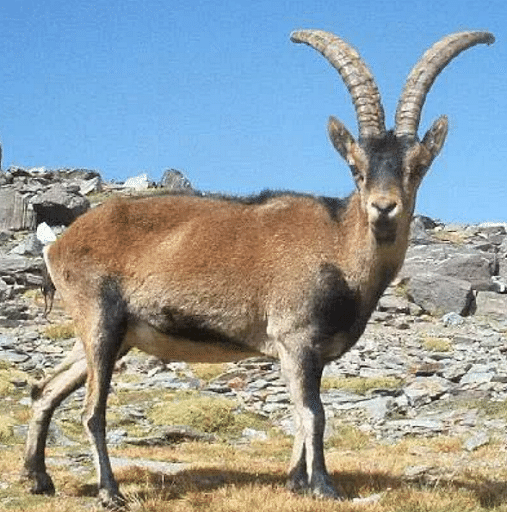
Mountain Ibex
-
Marmot
These enormous squirrels can be found in North America and Eurasia's highlands. They have thick fur all over, small legs, and powerful claws to aid in digging.
Marmots are vegetarians who eat tundra flora and other plants native to the mountains. During the summer, they store food and hibernate during winter.

Marmot
-
Himalayan Red Panda
They are little mountain cats the size of a domestic cat. They have reddish brown fur, a long shaggy tail, and thickly haired short legs. Red pandas eat bamboo, but they are also known to eat eggs, birds and insects and they prefer to hunt alone. These creatures can be found in the Himalayan temperate forest.

Himalayan Red Panda
Also Read:
Things to Remember
[Click Here for Sample Questions]
- A mountain is a raised section of the Earth’s crust with steep sides and exposed bedrock.
- A mountain is larger than a hill and has a smaller summit area than a plateau, rising at least 300 metres (1000 feet) above the surrounding plain.
- Mountain animals are quite huge.Some of the large mountain animals migrate to other locations.
- Mountain animals have thick coats and wools to shield them from the cold, as well as quick hooves to assist them ascend the hillsides. Chamois , ibex, snow leopard, tahr and giant horn sheep are some of the animals found in the area.
- The climate in the mountains differs from that found on the plains due to the high height and relief based on height, location, solar exposure, latitude, and other factors.
Sample Questions
Ques. What is the significance of mountains? (2 marks)
Ans. Mountains are crucial because they provide one of the important sources of freshwater. They also serve as a protective barrier against inclement weather. Mountains maintain the water cycle. It provides resources to human and tourist centres also. Mountains have a heavy influence on climate.
Ques. What are some of the most common mountain plants? (2 marks)
Ans. The trees at the mountains are often conical in shape. The leaves are needle shaped and thin. It assists them in conserving water. Plants in mountainous places have another remarkable adaptation. Cedars, pines and spruces are some of the vegetation that grow in the mountains. These plants usually have distinguishing traits that set them apart from plants found in other parts of the world.
Ques. Which animals can withstand extreme cold? (1 mark)
Ans. The gigantic musk ox can withstand extremely cold temperatures. It has fur all over its body, which aids in its ability to survive extremely cold conditions.
Ques. Which creatures are capable of surviving at the highest elevation? (1 mark)
Ans. Yak, Ibex, Tibetan gazelle of the Himalayas, and vicunas Llamas of the Andes are examples of animals that can thrive at extremely high altitude.
Ques. What are the endangered mountain animals? (2 marks)
Ans. An endangered animal is one that is highly likely to go extinct in the near future, either globally or within a certain political jurisdiction. Habitat loss, poaching, and invasive species are all potential threats to endangered species.
Mountain gorillas, Javan rhinoceros, snow leopards, tiger, orangutans, leatherback sea turtles, and Irrawaddy dolphins are just a few of the endangered mountain creatures
Ques. What are the features of mountains? (2 marks)
Ans. They typically have steep, sloping sides with sharp or rounded ridges, as well as a high point known as a peak or summit. A mountain, according to most geologists, is a landform that rises at least 1,000 feet (300 metres) above its surrounding. A mountain range is a grouping of mountains that are near in proximity to one another.
Ques. What are the types of mountains? (5 marks)
Ans. Volcanic, fold, plateau, fault-block, and dome are the five basic forms of mountains.
Volcanic Mountains - Volcanoes form along plate boundaries as tectonic plates move, erupting and forming mountains. A volcanic arc system is a group of volcanoes that form near a subduction zone, where a sinking oceanic plate’s crust melts and drags water down with it.
Fold Mountains - Plates buckle and fold when they clash or undergo subduction (that is when they ride over one another), generating mountains. Most major continental mountain ranges are formed by thrusting and folding, often known as orogenesis. The balkan mountains, the Jura mountains, and the Zagros mountains are all examples.
Block Mountains - Block mountains can form when a fault block is lifted or slanted. Higher blocks are referred to as horsts, whereas troughs are referred to as garbens. There is a presence of tensional forces when the surface spreads apart. When tensional forces are powerful enough to divide a plate, it gets divided in such a manner that the central block becomes lower in comparison to the flanking blocks.



Comments