



Education Journalist | Study Abroad Lead
Kidneys are the part of the human excretory system which also consists of one pair of ureters, a urinary bladder, and a urethra. Kidneys help in filtering the blood and removing the impurities from our body through urine. These also help in balancing electrolyte levels in the body. Kidneys are reddish-brown, bean-shaped structures situated in between the last thoracic and third lumbar vertebra. They are close to the dorsal wall of the abdominal cavity. There are some differences between the left kidney and right kidney but the function of both kidneys are the same. In these articles, we will explore the differences between the left and right kidneys.
| Table of Content |
Key Takeaways: Kidney, Nephrons, Excretory System, stomach, medulla, pancreas, circulatory system
What is a kidney?
[Click Here for Sample Questions]
Kidneys are one of the vital organs in the excretory system. Each kidney of a human body has a size ranging from 10 cm to 12 cm, 5 to 6 cm in width, and 2 to 3 cm in thickness. They have an average weight of around 120 - 170g. The inner concave side of the kidney is a notch which is also called the hilum through which the nerves and the ureters enter. To the inner side of the hilum, there is a broad funnel-shaped space, which is called the renal pelvis. The outer layer of the kidney is a tough membrane. In the kidney there are two zones, one is called the outer cortex and the other is the inner medulla. The medulla is partitioned into some conical masses.
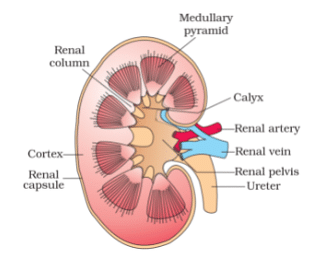
Kidney
Structure of kidneys
[Click Here for Sample Questions]
Each kidney consists of approximately one million complex tubular structures which are called nephrons. It has divided into two parts - the glomerulus and the renal tubule. The glomerulus is a tuft of capillaries that are formed from the afferent arteriole.
The renal tubule begins with a structure similar to the cup which is called the bowman’s capsule which covers the glomerulus. Glomerulus together with the bowman’s capsule is called the Malpighian body. The tubules form a highly coiled network called a proximal convoluted tube.
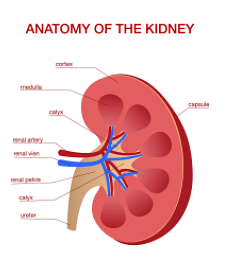
Left kidney
[Click Here for Sample Questions]
Left Kidney is situated on the left side of the body. The left kidney is a little longer than the right kidney. There is a difference of about 1.5 cm. Its anterior surface is attached to the stomach, spleen, pancreas, where the posterior part is connected with rib 11 and rib 12.
Read: Stomach Ulcer
Right kidney
[Click Here for Sample Questions]
Rght kidney is located on the right side of the body. The anterior surface of the right kidney is associated with the liver, right suprarenal gland, the descending part of the duodenum, the large and small intestine. The posterior part of the kidney is associated with the diaphragm, rib-12, psoas major, quadratus lumborum, tendons of the transverse abdominal muscle, and transverse process of vertebrae L1.

Left and right kidney
Also read: Renal Failure
Difference between left and right kidney
[Click Here for Sample Questions]
Though the kidneys perform the same function, there are slight differences between them. The left kidney is slightly longer than the right kidney by 1.5 cm. The left kidney is found to be situated slightly higher than the right kidney due to the asymmetry caused by the liver in the abdominal cavity. Another key difference between the left and right kidney is that the left renal artery provides blood to the left kidney and the right renal artery gives blood to the right kidney. The anterior and posterior surface of the right and left kidney is connected to different structures in the body.
| Left kidney | Right kidney |
|---|---|
| It is situated in the left of the body, between rib11 and rib12 | It is situated in the right of the body, under rib12 only. |
| The left renal artery is connected it | The right renal artery is connected to it |
| Left kidney is slightly larger | Right kidney is smaller than the left one |
| Left kidney is located a little higher. | It is slightly lower than the left one due to asymmetry of the liver. |
| The renal volume is around 146cm3 | The renal volume is around 134cm3 |
Also read Blood Circulatory System
Things to remember
[Click Here for Sample Questions]
- Kidneys help in filtering the blood and removing the impurities from our body through urine.
- Kidneys are reddish-brown, bean-shaped structures.
- Kidney size ranges from 10cm to 12cm, 5 to 6 cm in width, and 2 to 3 cm in thickness.
- Kidneys have an average weight of around 120-170g.
- The renal tubule begins with a structure similar to the cup which is called the bowman’s capsule.
- The left kidney is slightly longer than the right kidney by 1.5 cm.
- The inner concave side of the kidney is called the hilum through which the nerves, the ureters enter.
Also read:
Sample Questions
Ques. What is the structure of the kidney? (3 marks)
Ans. Kidneys are bean-shaped structures and are reddish-brown in color. The length of the kidney is 10-12cm in length, 5-7cm in width, and 2-3cm in thickness. They have a weight of around 120-170 g depending on the individual. The outer layer of the kidney is a tough membrane and inside it has 2 parts – one is the outer cortex and the inner medulla.
Ques. What is ultrafiltration? (3 marks)
Ans. Bowman’s capsule has epithelial cells which are called podocytes. They are arranged in an intricate way leaving some small spaces called filtration slits. The filtration of blood through these membranes is so efficient that almost all the constituents of the plasma except the proteins pass onto the lumen of the Bowman’s capsule. It is called ultrafiltration.
Ques. What is the glomerular filtration rate? (3 marks)
Ans. The amount of the filtrate formed by the kidneys in a minute is called glomerular filtration rate (GFR). For a healthy individual GFR is approximately 125ml/min or 180L per day. Our kidneys have built-in mechanisms to regulate of glomerular filtration rate.
Ques. What is the function of the collecting duct? (3 marks)
Ans. This long duct extends from the cortex of the kidney to the inner parts of the medulla. The excess water passing through the duct can be reabsorbed here to make the urine concentrated. This duct allows the passage of small amounts of urea to the medullary interstitium to keep up the osmolarity. It also plays a role in the maintenance of pH and ionic balance of blood by the selective secretion of H+ and K+ ions.
Ques. How the size of the kidneys is affected by aging? (3 marks)
Ans. Firstly, both the kidneys differ in shape and size but perform the same functions in the body. The kidney is small at a young age and it grows simultaneously with the individual until it achieves its average size which is around 10-12 cm. After this size is achieved then they remain in this size and stop growing at all.
Ques. How urine formation takes place in the kidneys? (5 marks)
Ans. There are mainly three processes that are associated with urine formation.
They are glomerular filtration, reabsorption, and filtration. All these processes take place in different parts of the nephron. The first step for urine formation is filtration of blood which is carried out by glomerulus called glomerulus filtration. The kidneys filter about 1000-1200ml of blood per minute. This is roughly one-fifth of the total blood pumped out by each ventricle of the heart in a minute. About 180 L of filtrate is formed by kidneys but urine released is only 1.5L per day which means 99% of the filtrate is absorbed by renal tubules. This is called reabsorption. The tubular cells secrete substances like H+ , K+, and ammonia into the filtrate during urine formation.
Ques. Write five differences between left and right kidneys. (5 marks)
Ans. The main difference between the left and right kidneys are:
| Left kidney | Right kidney |
|---|---|
| It is situated in the left of the body, between rib11 and rib12 | It is situated in the right of the body, under rib12 only. |
| The left renal artery is connected to it | The right renal artery is connected to it. |
| Left kidney is slightly larger | Right kidney is smaller than the left one |
| The left kidney is located a little higher. | It is slightly lower than the left one due to asymmetry of the liver. |
| The renal volume is around 146cm3 | The renal volume is around 134cm3 |
Also read Kidney Function Test: Components, Types, and Functional Unit



Comments