



Education Journalist | Study Abroad Lead
A cropping system can be defined as a combination of different factors like crops grown, sequences of crops, and practices followed for growing them on a particular agricultural land over several years. The cropping system to be employed in a field depends on the crop choice, environmental conditions of the particular area, and the availability of other essential resources. Cropping pattern is another term that is used interchangeably with the cropping system. However, cropping pattern simply refers to the sequence of crops cultivated on a particular piece of land and their arrangement on the field. There are four cropping patterns: Monocropping, Mixed Cropping, Intercropping, and Crop Rotation. Let us discuss Mixed Cropping, Intercropping, and the difference between the two here.
Read More:- Manures and Fertilizers
| Table of Contents |
Keyterms: Cropping system, Crop, Monocropping, Mixed Cropping, Intercropping, Crop Rotation, Cropping pattern, Crop yield, Agricultural land
What is Intercropping?
Intercropping can be defined as the cultivation of two or more crops simultaneously on a particular agricultural land in specific row patterns to increase productivity. The main purpose of intercropping is to increase the crop yield from a particular piece of land by utilizing all the resources optimally, which are otherwise not used completely when a single crop is grown. This cropping technique is primarily used by small farmers who majorly depend on rainfall for crop yield. The crops commonly cultivated with intercropping are soybean and maize, finger millet and cowpea, etc.
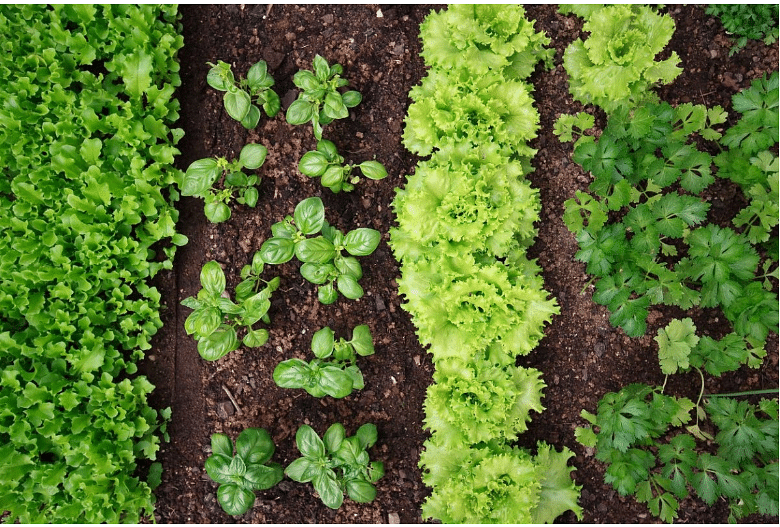
Interplanting or Companion Planting
There are three types of intercropping methods based on the spatial and temporal overlap of the different crops:
- Mixed Intercropping is a basic cropping method where two or more crops are completely mixed and sown in the available field.
- Row cropping is a cropping method where two or more crops are sown in alternate rows. Alley cropping and strip cropping are variations of row cropping.
- Temporal intercropping is a cropping method where a fast-growing crop is sown with a slow-growing crop so that one crop is harvested before the other one matures. This is also known as relay cropping.
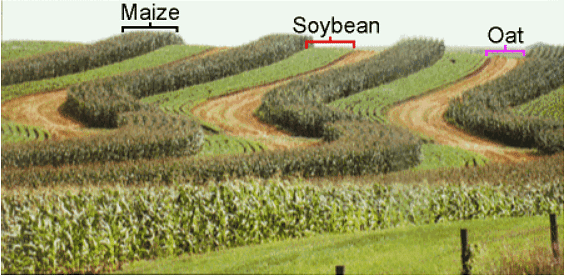
Strip Intercropping
Read More:- Difference Between Compost and Vermicompost
Benefits of Intercropping
Some of the benefits of Intercropping are mentioned below:
-
Resource Allocation
Different strategies have to be implemented to grow different crops on a single piece of land as the resource requirements of each crop vary from one another. Factors like soil and climate also play a key role in deciding the crops to be cultivated.
-
Mutualism
Cultivation of multiple crops in a field can be quite beneficial for increasing plant growth and yield. Plants that are slender and cannot withstand strong rain or wind may get structural support from bigger trees.
For example, in a tropical multi-tier system, a coconut tree is grown in the upper tier, a banana tree is grown in the middle tier followed by pineapple, ginger, and medicinal plants in the lower tier. Intercropping of mutually compatible crops results in the biodiversity of insects and microorganisms that enhance the plant yield.
-
Pest Control
Increasing the diversity of crops results in better pest management as it controls the outbreak of crop pests by increasing the diversity of predators. The different ways in which intercropping can help in pest management are as follows:
- Trap cropping involves the planting of an attractive crop near the main crop to draw the pests away from the main crop thus saving the main crop.
- Repellant intercrops are the crops that provide a repellent smell to mask the actual smell of the main plant to keep the pests away.
- Push-pull cropping is a combination of trap cropping and repellant cropping techniques wherein an attractive crop draws the pest towards it and a repellant crop keeps the pests away.
What is Mixed Cropping?
Mixed Cropping can be defined as the cultivation of multiple crops simultaneously on a particular piece of land. In this cropping pattern, the seeds of two or more crops are sown randomly. The choice of the crops to be cultivated in a particular field must be made taking different factors like the duration, environmental conditions, growth, water requirements, nutrient requirement, root pattern, etc. into consideration.
This cropping technique helps the farmer to reduce the risk of crop failure due to unfavorable climatic conditions thus reducing the loss incurred. Examples of crops commonly grown in mixed cropping are wheat and gram, groundnut and sunflower, etc.
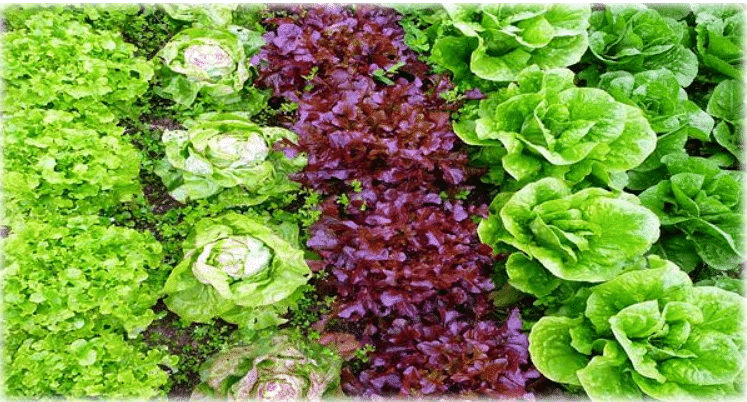
Mixed Intercropping
Read More:-
Benefits of Mixed Cropping
Some of the benefits of mixed cropping are listed below:
- The overall risk of crop failure due to uncertain rainfall is reduced.
- The risk of pest infestation to the crops is greatly minimized.
- The fertility of the soil is known to have improved after this cropping technique is employed in a field.
- The crop yield is also found to have increased over time after implementing this technique.
- Mixed cropping ensures that the soil is utilized well.
- This method also allows for the harvesting and sale of multiple crops at a time.
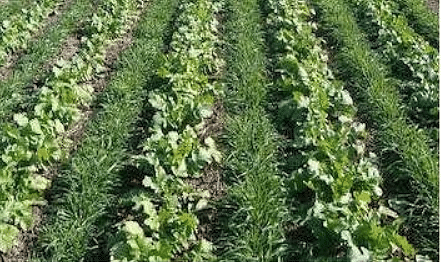
Benefits of Mixed Cropping
Difference Between Mixed Cropping and Intercropping
| Mixed Cropping | Intercropping |
|---|---|
| Mixed cropping aims at avoiding crop failure even in unfavorable climatic conditions. | Intercropping aims at optimum utilization of the space available for the cultivation of multiple crops to increase crop productivity. |
| No particular pattern is followed. | Seeds are planted in a specific row pattern. |
| Seeds of two or more plants are mixed and sowed. | Seeds of the plants are not mixed and they are sowed separately in a certain pattern. |
| Fertilizers and Pesticides used for the crops are the same. | Pesticides and Fertilizers are used separately for each crop based on their specific requirements. |
| The duration, maturity, and lifecycle of each crop sown vary considerably. | The duration, maturity, and lifecycle of each crop sown are similar to each other. |
| The crop yield obtained can be harvested and sold together. | The yield of each crop is harvested and sold separately at different times. |

Mixed Cropping vs Intercropping
We can conclude that intercropping is a refined version of mixed cropping. So, it is possible to use intercropping even for crop combinations where mixed cropping is usually practiced.
Things to Remember
- Mixed cropping is a cropping technique wherein two or more crops are planted at the same time in the same piece of land.
- Intercropping is a cropping technique wherein two or more crops are planted at the same time in the same piece of land in a definite pattern.
- The main objective of mixed cropping is to reduce crop failure even in climatic conditions like low rainfall.
- The main objective of intercropping is the optimal use of a specific land for increased productivity.
- Some of the combinations of crops used in mixed cropping are groundnut and sunflower, wheat and gram, etc.
- Some of the combinations of crops used in intercropping are soybean and maize, finger millet and cowpea, etc.
- Mixed intercropping, row cropping, and temporal intercropping (relay cropping) are the three types of commonly used intercropping techniques.
Sample Questions
Ques. What are the various types of cropping? (3 marks)
Ans. The four types of cropping that are commonly practiced are as follows:
- Monocropping
- Mixed cropping
- Intercropping
- Crop Rotation
Ques. What is monocropping? (1 mark)
Ans. Monocropping can be defined as a cropping system wherein a single crop is grown at a time every year on a particular piece of land.
Ques. What are the main benefits of mixed cropping? (3 marks)
Ans. Mixed cropping results in the creation of a rich, biodiverse environment for insects and land organisms like earthworms which increase soil fertility.
- It helps in preventing crop failure and is known to produce a higher crop yield compared to monocropping.
- Infestation of pests is less in mixed cropping.
Ques. What are the limitations of intercropping? (3 marks)
Ans. Some of the limitations of intercropping are mentioned below:
- The resource requirements of each crop planted on the same land will be different. So, it is very important to understand the needs of each crop and provide them efficiently which is a strenuous task.
- Not all trap crops are found to be successful in keeping pests on a commercial scale. So, it is necessary to choose them carefully.
- Managing the different intercropping systems is another challenging task.
Ques. Describe the Pest Management techniques used in intercropping? (3 marks)
Ans. The three pest management techniques used in intercropping are mentioned below:
- Trap cropping involves planting a more attractive crop close to the main crop which draws the pests towards it.
- Repellent intercrop involves the planting of crops with a repelling smell close to the main crop so that they mask the smell of the main crop and push the pests away.
- Push-pull cropping involves the planting of both attractive crops and repelling crops that perform the same function as a trap crop and a repellent crop.
Ques. What is the other name of Intercropping? Mention its types (2 mark)
Ans. The other name of Intercropping is Companion cropping.
The different types of intercropping are mixed intercropping, row cropping, and temporal or relay cropping.
Ques. What are the main benefits of intercropping? (3 marks)
Ans. The main benefits of intercropping are as follows:
- The resources are utilized in an optimum manner to acquire better yield and productivity.
- The growth of mutually compatible crops in a field results in better biodiversity of insects. This further leads to improved soil fertility and better crop yield.
- Pest management on the field also becomes easier with intercropping.
Also Read:



Comments