



Content Writer-SME
Biogeochemical cycles refer to the flow of nutrients along with other components all over the ecosystem. The word biogeochemical is derived from three words- bio meaning biosphere, geo meaning geological particles, and chemical meaning flow of elements. The movement of elements takes place through biosphere, lithosphere, environment and hydrosphere.
- The biogeochemical cycles are necessary to maintain an equilibrium in the ecosystem ensuring the sustainability of life on Earth.
- Examples of biogeochemical cycle include water cycle, carbon cycle, nitrogen cycle, sulphur cycle, phosphorous cycle etc.
- All these cycles are very important to maintain balance in the ecosystem.
Biogeochemical Cycle
[Click Here for Sample Questions]
A biogeochemical cycle is a process through which a chemical substance flows between Earth's biotic and abiotic components. The biosphere is a biotic component, whereas the atmosphere, hydrosphere, and lithosphere are abiotic components.
The major elements of the biogeochemical cycle present in a closed system are as follows:
- Carbon
- Oxygen
- Hydrogen
- Phosphorus
- Nitrogen
- Sulphur
Types of Biogeochemical Cycles
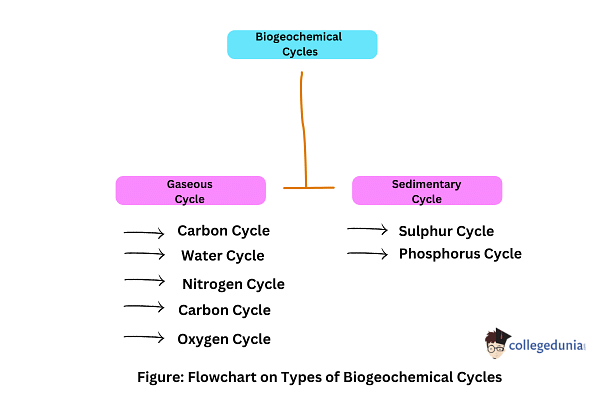
Understanding the concept and types of biogeochemical cycles requires a thorough understanding of biology and chemistry as well as geology. Biogeochemical cycles are categorized on the basis of reservoirs or source. There are two fundamental types of biogeochemical cycles: Gaseous and sedimentary cycles.
Gaseous Biogeochemical Cycles
[Click Here for Sample Questions]
This is an important category of biogeochemical cycle in which the air and ocean acts as reservoirs. Carbon, Nitrogen, Oxygen, and the Water Cycle are the examples of gaseous cycle which are explained below in detail:
What is Nitrogen Cycle?
The nitrogen cycle is a biogeochemical cycle in which nitrogen is transformed into different chemical forms as it moves through the atmospheric, land, and sea ecosystems. Nitrogen conversion can take place through both biological and physical mechanisms. Fixation, nitrification, ammonification, and denitrification are all vital processes of the nitrogen cycle. Atmospheric nitrogen makes up the bulk of the Earth's atmosphere (78%) and is hence the most abundant source of nitrogen.
What is Water Cycle?
A biogeochemical cycle in which upward and downward movement of water from the surface of earth takes place is called water cycle. Sunlight raises the temperature of water bodies, causing them to evaporate.
- The amount of moisture in the air and the direction of the wind have an impact on the evaporation process.
- Sublimation releases water vapour from ice into the atmosphere.
- Evapotranspiration is the mechanism by which the water from the leaves is evaporated through their stomata.
- The process of precipitation takes place when water vapour present in the atmosphere condenses to form water droplets.
- The water subsequently makes its way into both terrestrial and marine environments.
- Water penetrates through the earth and is stored as groundwater.
- The rest either evaporates into the sky or is collected as runoff in the ocean.
What is Carbon Cycle?
Photosynthesis is carried out by all green plants using carbon dioxide and sunlight. As a result, the plant stores carbon. When green plants die, they are buried in the soil, where they are transformed into carbon-based fossil fuels. When these fossil fuels are further burned, carbon dioxide is released into the atmosphere. This natural phenomenon in which carbon is transferred and used between the biosphere, geosphere, hydrosphere, and atmosphere is called the carbon cycle.
- Animals that eat plants also get the carbon that is stored in the plants.
- When these creatures decompose after death, the carbon is released back into the atmosphere.
- Carbon is also returned to the environment via animals' cellular respiration.
Huge amounts of carbon dioxide are generated, which are stored as fossil fuels (coal and oil) and might be exploited for a variety of commercial and non-commercial applications. When these fuels are used in factories, the carbon is discharged back into the atmosphere.
What is Oxygen Cycle?
The atmosphere, lithosphere, and biosphere are all active participants in this biogeochemical cycle. Oxygen is an element that is abundantly present on our planet. It is present in the atmosphere in the elemental form of up to 21%.
Photosynthesis causes plants to release oxygen. Humans and other creatures consume oxygen and exhale carbon dioxide, which is absorbed by plants anew. They utilize carbon dioxide in the process of photosynthesis to produce oxygen, and thus this cycle continues.
Sedimentary Biogeochemical Cycles
[Click Here for Sample Questions]
Phosphorus and sulphur cycle are the two examples of sedimentary cycle where earth crust’s act as a main reservoir. The decomposition of dead and decaying organic matter releases phosphorus and sulfur into the soil and thus begins its own biogeochemical cycle.
What is Sulphur Cycle?
The movement of sulphur-based components between the lithosphere, hydrosphere, and atmosphere is known as the sulphur cycle. Cysteine and methione are two sulphur-rich amino acids. Through the process of weathering the sulfur is converted into sulphates which are then released into the atmosphere. Microorganisms and plants further converts sulphates into organic sulphur compounds. When animals eat plants, organic sulphur compounds are absorbed into their bodies. Thus, sulphur is released back into the earth when organisms decompose.
What is Phosphorus Cycle?
The biogeochemical cycle that explains the flow of phosphorus through the lithosphere, hydrosphere, and biosphere is known as the phosphorus cycle. The atmosphere has no role in the transportation of phosphorus, unlike many other biogeochemical cycles, since phosphorus and phosphorus-based compounds are generally solids at the temperatures and pressures prevalent on Earth. Only specific, local circumstances allow for the generation of phosphine gas. As a result of this, the phosphorus cycle should be examined from the perspective of the entire Earth system before specifically focusing on the cycle in the aquatic and terrestrial systems.
Importance of Biogeochemical Cycles
[Click Here for Sample Questions]
In nature, biogeochemical cycles are important for maintaining ecological balance and supporting ecosystems. It is mainly impacted by excessive human activities which includes burning fossil fuels, clearing of forests, harmful gas emissions from factories, etc. The three major benefits of proper maintainance of biogeochemical cycles are as follows:
- Maintainence of Soil Fertility: Soil fertility is improved by the release of nutrients through various nutrient cycles. Thus, proper maintenance of soil fertility also increases agricultural productivity.
- Climate Control: Harmful gases like methane, carbon dioxide which cause global warming are all controlled through biogeochemical cycles.
- Detoxification of Harmful Gases: Gases that cause various environmental problems are detoxified through microbial actions through biogeochemical cycles.
Things to Remember
- The biogeochemical cycle refers to the flow of nutrients along with other components between biotic and abiotic components of the ecosystem.
- Macroscopic cycles, such as the rock cycle, and human-induced cycles for synthetic chemicals like polychlorinated biphenyls are also present (PCBs).
- There are reservoirs in some cycles where a chemical can stay or be tucked away for a long period of time.
- Biogeochemical cycles and geochemical cycles can be compared.
- Even if certain processes from both are overlapped, the latter exclusively deals with crustal and subcrustal reservoirs..
- There are two fundamental types of biogeochemical cycles: Gaseous Cycles and Sedimentary Cycles.
- The various biogeochemical cycles are the water cycle, carbon cycle, oxygen cycle, sulphur cycle, nitrogen cycle, and phosphorus cycle.
Sample Questions
Ques. What is the greenhouse effect? (2 marks)
Ans. Burning fossil fuels raise carbon dioxide levels in the atmosphere, resulting in a rise in carbon dioxide concentration. The greenhouse effect, therefore, refers to the increase in CO2 concentration and the resulting increase in global temperature.
Ques. What is nitrogen biogeochemical cycle? (3 marks)
Ans. One of the most prevalent chemicals in the air is molecular nitrogen. The nitrogen is transported from the atmosphere to the soil and aquatic environments. Thus, nitrogen fixation in the form of (NH4+), nitrification (NO2– and NO3–), and assimilation into plants as (R – NH2), which is passed on to animals, resulting in ammonification upon the death of the animal and again fixation of NH3 to N02– and NO3–. NH3– and NH4+ in the soil might be broken down to molecular nitrogen by microorganisms.
Ques. What are the most frequent nitrogen-fixing symbiotic bacteria? (1 mark)
Ans. Leguminous plants are associated with Rhizobium and Bradyrhizobium. Root nodules are formed when these infect the roots.
Ques. How does methane synthesis, by a specific subset of methanogenic archaea, reflect a deviation from regular carbon cycling? (2 marks)
Ans. As methane generated by archaea cannot be utilized by most heterotrophic species, it is lost from the biological community to the atmosphere, and therefore the methanogens are a deviation of the system of the normal CO2 cycle.
Ques. What is the phosphorous biogeochemical cycle? (2 marks)
Ans. The flow of phosphorus through the lithosphere, hydrosphere, and biosphere is known as the phosphorus biogeochemical cycle. The atmosphere has no role in the transportation of phosphorus. Phosphorus and phosphorus-based compounds are generally solids at the temperatures and pressures prevalent on Earth.
Ques. Explain the water cycle? (2 marks)
Ans. The water cycle is the natural cycle for circulation. Sunlight raises the temperature of water bodies, causing them to evaporate. It is the mechanism by which the water from the leaves is evaporated through their stomata.
The process of precipitation takes place when water vapour present in the atmosphere condenses to form water droplets.



Comments