



Content Curator
Monocot and Dicot Plants are categorised under Flowering plants, depending on the presence of the number of cotyledons in the growing seed. This article will cover the key difference between Monocot and Dicot stem. Different plants have different anatomical structure of stem which creates the difference between them, like in Dicots and Monocots they have huge differences in the components and organelles present in them, how they proceed towards the process of maturation and other such characteristics.
| Table of Content |
Read about: Difference between Dicot and Monocot Root
Monocot Stem
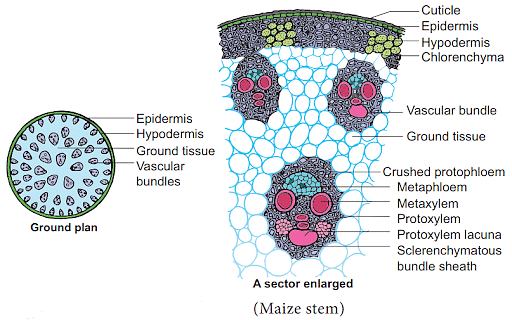
Monocots or Monocotyledonous flowering plants are the one where there is only one cotyledon in the seed like in wheat, ginger, onions and grass. These stems are circular in shape with a layer of epidermis and have lateral branches. They have a layer of Epidermis as the outermost layer, followed by a sclerenchymatous hypodermis.
After the hypodermis it has parenchymatous ground tissue which contains a large number of scattered vascular bundles, surrounded by sclerenchymatous bundle sheath. The below diagram of the Transverse Section of Monocot stem will provide a clear understanding of its major components.
Dicot Stem
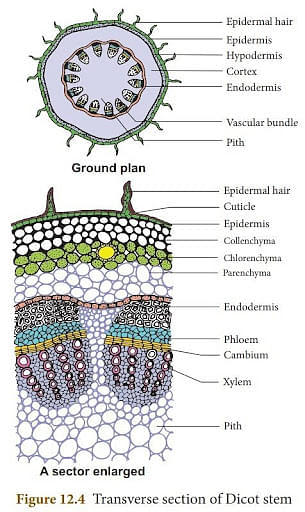
Dicot or Dicotyledons flowering plants are those who have two Cotyledons in the seed like in peas, peanuts, beans and lentils. The stem has a layer of epidermis on the outermost layer which is covered by a layer of cuticle and may bear trichomes and a few stomata. After the epidermis layer, there is a multilayered cortex region consisting of 3 different types of layers of Collenchyma, Parenchyma and Endodermis.
The cells of endodermis store Starch grains and are known as starch sheath. Besides this layer, there are other components as well like the Pericycle, the vascular bundles and pith. The below diagram of the Transverse section of Dicot stem will provide a better understanding of the location of all the layers of the cell.
Read also: Double Fertilization
Difference Between Monocot and Dicot Stem
There are certain crucial differences between a Monocot and a Dicot Stem, at both internal and external level of the structure. Some of the important differences are tabulated below:
| Monocot Stem | Dicot Stem |
|---|---|
| Usually the monocot stems are hollow at the centre. | Mostly the stem is solid. |
| Epidermal hairs are present. | Epidermal hairs may or may not be present on the surface of epidermis. |
| Trichomes are not present. | It may bear Trichomes on the surface. |
| Hypodermis cells are formed of sclerenchymatous cells. | Below the epidermis, hypodermis is a present form of collenchymatous cells. |
| The layers are not arranged in a concentric manner. | All the internal layers of tissues are arranged in a concentric manner leaving a central region. |
| The ground tissue consists of parenchymatous cells. | The ground tissue is differentiated into different layers of tissues as endodermis, Pericylce, cortex, medullary rays between the bundle sheaths. |
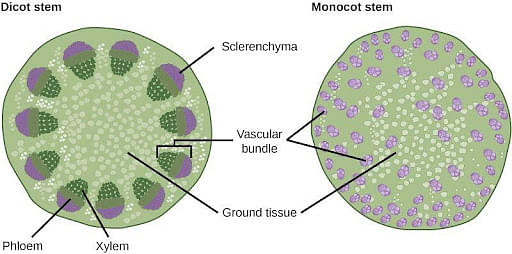
| Vascular bundles are scattered and are surrounded by Sclerenchymatous bundle sheath in the ground tissue. | Vascular bundles are arranged in a ring-like arrangement above the pith region. |
| One of the components of Phloem, Phloem Parenchyma is absent in Monocot Stem. | Phloem Parenchyma is present and supported in the translocation process of plants. |
| The Pith region is not developed. | At the central region Pith is well developed. |
| The scattered vascular bundles are closed and conjoint. | The vascular bundles are Open and conjoint. |
| No layer of endodermis is present. | Layer of endodermis is rich in Starch grains and is called a starch sheath. |
| Monocot stems do not undergo secondary growth. | Dicot stems undergo secondary growth and form Medullary rays, Protoxylem and Metaxylem. |
Things to Remember
- Vascular bundles of Monocot stems have water containing cavities in it.
- The conjoint Open vascular bundles have a layer of cambium in between the Phloem and Xylem.
- The conjoint Close vascular bundles do not have any layer of cambium in between them.
- In Dicot Stem, the medullary rays are radially arranged in a few layers.
Sample Questions
Ques: What are the constituents of ground tissue of Monocot Stem? (2 Marks)
Ans: The ground tissue of Monocot stem constitutes vascular bundles which are surrounded by a sclerenchymatous bundle sheath and large parenchymatous ground tissues. The arrangement of vascular bundles are closed and conjoined with no layer of cambium between them.
Ques: When does the vascular tissue stop functioning in case of Dicot stem? (2 Marks)
Ans: In case of Dicot stem, the vascular tissues stop functioning when they are matured and are replaced by new vascular tissues. They undergo secondary growth to form secondary xylem and secondary phloem.
Ques: Why is the endodermis layer called starch sheath? (2 Marks)
Ans: Only in case of Dicot stem, the endodermis layer present as the innermost layer of cortex contains starch grains in it and hence they are called as starch sheath. These are utilised by the plant for ATP production and sometimes during stress conditions of plants. This sheath is not present in the Monocot stem as there is no further differentiation after Hypodermis in terms of different tissue layers except for ground tissues.
Ques: What are the layers present between epidermis and pericyle in a Dicot stem? (3 Marks)
Ans: There are three layers present between the Epidermis and Pericylce layer of Dicot stem. These three layers constitute the cortex and they are :
- The outer Hypodermis, which consists of a few layers of collenchymatous cell just below the epidermis.
- Next is the cortical layer composed of thin walled parenchymatous cells with small intercellular spaces between them.
- And the last layer of Endodermis which contains the starch sheath in it.
Ques: Why Monocot stems have no secondary growth? (2 Marks)
Ans: Monocot stems do not undergo secondary growth because there is no cambium present in the vascular bundle between the xylem and phloem. Therefore they do not undergo formation of secondary xylem and secondary phloem.
Ques: What is the role of Phloem Parenchyma in Dicot Stem? (2 Marks)
Ans: Phloem Parenchyma is an important component of Phloem tissue. It functions to store food materials and other materials like latex, resins and mucilage. They translocate the food prepared by photosynthesis to both the upper and lower direction in the plant system.
Ques: What are the basic characteristics to differentiate between a Monocot and a Dicot plant? (3 Marks)
Ans: To differentiate between a monocot and a Dicot plant, some of the characteristics include leaf venations, number of cotyledons, root system and others.
| Parameter | Monocotyledon | Dicotyledon |
|---|---|---|
| Meaning | Plants with the seed having only one cotyledon are called monocotyledons. | Plants with the seed having two cotyledons are called dicotyledons. |
| Flower parts | Flower parts are present in multiples of three. | The flower parts are present in multiples of four or five. |
| Leaves | The leaves are isobilateral. | The leaves are dorsiventral. |
| Pollen | Pollen tubes contain a single pore or furrow (monocolpate). | It has three or more pore or furrow in the pollen tube (tricolpate). |
Learn more about Flower Structure: Parts of a Flower, Importance and Example



Comments