



Education Journalist | Study Abroad Lead
The difference between dicot and monocot roots is that monocot roots are fibrous roots, they have a wide network of thin roots that emerges from the stem. Dicots, on the other hand, have taproots, which means that they form a single thick root from which small, lateral branches emerge. On the basis of the number of cotyledons, vascular plants have been classified into dicots and monocots. Monocots have a single cotyledon whereas dicots have double cotyledons.
Read Also: Difference between Monocot and Dicot Leaf
| Table of Content |
Dicot Root
[Click Here for Previous Year Questions]
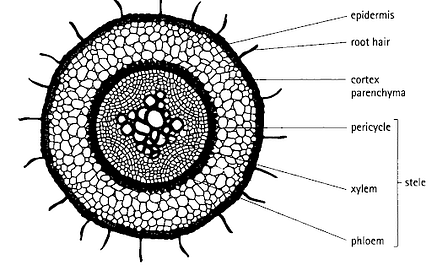
The anatomy of the Dicot root system is explained in detail.
- The outermost layer of Dicot root is known as epiblema and the cells of epiblema emerge in the form of unicellular root hairs.
- The cortex is composed of multiple layers of thin-walled parenchyma cells.
- The endodermis is the innermost layer of the cortex and comprises barrel-shaped cells without any intercellular space.
- The tangential and radial walls of endodermal cells have a coating of a waxy material known as Casparian strips.
- Next to the endodermis is the pericycle, which includes layers of thick-walled parenchymatous cells.
- It is in these cells that the initiation of the vascular cambium and lateral roots take place during secondary growth.
- The parenchymatous cells lying between the phloem and xylem are known as conjunctive tissues.
- It has two to four xylem and phloem patches.
- All tissues present inside the endodermis such as pericycle, vascular bundles and pith constitute the stele.
Read More:
| Important Topics | ||
|---|---|---|
| Apomixis | Asexual Reproduction | Difference between Monocot and Dicot Stem |
| Binary Fission | Budding | Sexual Reproduction in Flowering Plants |
Monocot Root
[Click Here for Sample Questions]
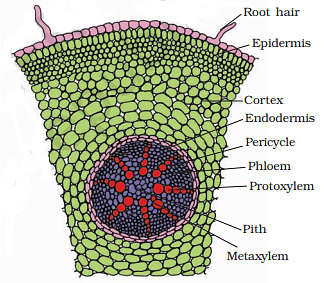
The anatomy of the monocot root is almost the same as that of the dicot root in many respects.
- Monocot root also has cortex, epidermis, endodermis, pericycle, pith, and vascular bundles.
- The difference lies in the number of Xylem bundles.
- In comparison to the dicot root which has fewer xylem bundles, monocot roots usually have more than six (polyarch) xylem bundles.
- Pith is large and well developed and monocotyledonous roots do not undergo any secondary growth.
Read More: Double Fertilization
Difference between Monocot and Dicot Roots
[Click Here for Previous Year Questions]
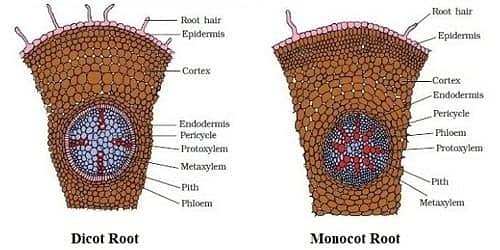
The difference between monocot and dicot roots are as tabulated below.
| Basis | Monocot Root | Dicot Root |
|---|---|---|
| Cortex Area | It has a wide cortex area. | It has a narrow cortex area. |
| Pericycle | It gives rise to just lateral roots. | It gives rise to cork cambium, lateral roots, and parts of the vascular cambium |
| Vascular Tissues | More numbers of Xylem and Phloem. | Less number of Xylem and Phloem. |
| Shape of Xylem | It has a round or oval shape. | It has an angular or polygonal shape. |
| Secondary Growth | Secondary growth is absent. | Secondary growth takes place to support vascular cambium and cork. |
| Pith | It has a well-developed pith. | The pith is absent or very small. |
| Number of Xylem and Phloem | The number of Xylem and Phloem may be more than 8. | The number varies from 2 to 8. |
| Cambium | It is absent. | It is present and formed due to the conjunctive parenchyma. |
Read More: NCERT Solutions for Class 11 Anatomy of Flowering Plants
Things to Remember
[Click Here for Sample Questions]
- Monocotyledons have one embryonic leaf.
- Dicotyledons have two embryonic leaves.
- The main difference between monocot and dicot root is that monocot roots are fibrous roots, while dicot roots are taproots.
- Monocot and dicot roots can be differentiated on various bases, like, cambium, pith, cortex area, etc.
- Monocotyledons have a well-developed pith, while dicotyledons have a small or undeveloped pith.
- Secondary growth is the growth that results from vascular and cork cambium.
Read More:
| Important Chapter Related Topics | ||
|---|---|---|
| Flower Structure | Anatomy of Leaf | Regions of Root |
| Pistil | Vascular Cambium | Secondary Growth |
| Fragmentation | Gemmule Formation | Protoplasm |
Previous Year Questions
- Read the following statements A and B … [KCET 2011]
- In the monocotyledonous seeds the endosperm is separated … [KEAM]
- The monocotyledonous seed contains one large … [KEAM]
- The diagram represents the L.S. of monocot seed … [KEAM]
- Duramen is present in …
- Why are vascular bundles termed …
- In a woody dicotyledonous tree … [NEET 2005]
- In the dicot root the vascular cambium originates … [NEET 2019]
- Collenchyma occurs in the stem and petioles of … [NEET 1990]
- Which meristem helps in increasing girth … [NEET 1998]
- As compared to a dicot root, a monocot root has … (NEET 2012)
- Vascular bundles in monocotyledons are considered closed … (NEET 2015)
- Two cross - sections of stem and root appear simple...(AMUEEE 2005)
- The diagram represents the L.S. of monocot seed….(KEAM)
- Duramen is present in…
- Conjunctive tissue is present between...(KCET 2008)
- Organs of aquatic plants are made of a...(KCET 2012)
- Passage cells help in…. (WBJEE 2015)
- Assertion: Libriform fibres are true fibres...(MU OET 2010)
Sample Questions
Q1. Define the following terms- (3 Marks)
Angiosperms
Dicotyledons
Monocotyledons
Ans- Angiosperms: The flowering plants are known as angiosperms. They are the most diverse group of terrestrial- habitat plants and are seed-producing plants.
Dicotyledons: The dicotyledons, also known as dicots, are flowering plants or Angiosperms, which produce seeds that have two cotyledons. Grains are an example of dicotyledons.
Monocotyledons: The monocotyledons, also known as monocots, are flowering plants or Angiosperms, which produce seeds that have just one cotyledon. Ginger is an example of monocotyledons.
Q2. How is the cortex area in monocot and dicot roots? (1 Mark)
Ans- Monocot roots have a wide cortex area, while dicot roots have a narrow cortex area.
Q3. Seema observed leaf venation and reticulation on tulsi and parallel on maize. Name the type of roots both the plants to have. (1 Mark)
Ans- Since dicot plants have reticulate venation and taproot system. Therefore, tulsi is a dicot plant with a tap root system. While maize is a monocot plant with a fibrous root system.
Q4. Do monocot roots have a pitch? (1 Mark)
Ans- Pith region is not present in monocot roots. Even if it is present, it would be very small. It is formed of polygonal parenchymatous cells that act as a food storage unit.
Q5. What do you mean by secondary growth in roots? (1 Mark)
Ans- Secondary growth in roots can be defined as the growth that results due to cell division in the cambia or lateral meristems.
Q6. State a difference between monocot and dicot roots. (2 Marks)
Ans- Monocotyledons are angiosperms and have one embryonic leaf, while dicotyledons contain two embryonic leaves. Ginger and onion are examples of monocotyledons and pea, lentils and beans are examples of dicotyledons.
Q7. What is epiblema? (1 Mark)
Ans- In a dicot root, the outermost layer is known as epiblema and the cells of epiblema emerge in the form of unicellular root hairs.
Q8. What are the features of a monocot root? (1 Mark)
Ans- Monocot roots are fibrous roots, which means that they have a wide network of thin roots emerging from the stem. Monocotyledons have one embryonic leaf.
Do Check Out:



Comments