



Content Curator
Polyp and Medusa both are different body forms with different types of characteristics, one body form is the nonmotile in it’s nature while the other is free swimming in its nature. These are two stages of types of animals in their lives. Basically, these two structures are found in the invertebrates phylum Cnidaria that are Coelenterates.
| Table of Content |
There is a very rare case that both types of body forms are seen in the same animal. So, different animals of these kinds have different body forms. Throughout the article we will see about both the body forms along with their characteristics, similarities, differences etc.
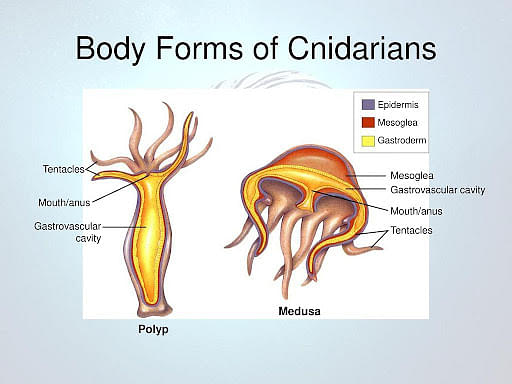
Polyp Body Form
Polyp is the body form of the phylum cnidaria type of species. Polyps are formed as a mouth surrounded with tentacles and head is attached at bottom at the foot. Basically, sexuality of polyp species is eiyhr sexual or asexual. Only the corals have their own sex organ while others have a female sex organ which attracts the coral sex organs for the reproduction purpose. In

their body structure the direction of the mouth is always towards the water. In their reproduction process asexuality means like budding and sexuality means a spawning process.
Medusa Body Form
Basically, medusa is also a form of the cnidaria phylum types of species. If we have to talk about the most common example of the medusa then we can say that a jellyfish is the best suitable example for this type of species. The body shape of the medusa species is bell shaped and they are always used to swim. In this species the mode of reproduction is always sexual.
Differences between in Polyp and Medusa
There are many differences between the polyp and medusa according to their characteristics, movements and because of their other body organs. So, the differences between them are mentioned below.
- Movements :-
Polyp have a stable life cycle to live in the water but the life cycle of medusa is totally opposite from the polyp life cycle.
- Morphology :-
Morphological features of the polyp species are the tabular in their body shape but they are fixed at one place only. And their mouth is on the opposite hand.
- Reproduction procedure :-
As we saw above, the reproduction ability of polyp is an asexuality mode while the reproduction ability of the medusa is the sexuality mode.
- Evolution :-
Basically, medusa itself evolved from polyp. And there is a large diversity in between them.
Comparison between Polyp and Medusa
| Polyp | Medusa |
|---|---|
| Their nature is sessile. | Their nature are free swimming |
| They have both reproduction schemes secually and asexuallly. | They are only sexual. |
| Polyp species can produce polyp and medusa both. | While medusa species can produce the medusa species only. |
| They are living without sex organs. | They have many sense organs like tentacles. |
| They are primitive. | They are not primitive but evolved from the polyp species. |
Points to Remember
- Polyp species are tabular in their body shape while medusa are not in the tabular in body shape.
- Polyp and medusa both have an opposite life cycle.
- Sexuality of the polyp species is maybe asexual or sexual also but the sexuality of medusa species is always sexual.
- Medusa evolved from polyp only.
- Polyp have a stable life cycle to live in the water but the life cycle of medusa is totally opposite from the polyp life cycle.
- Basically, medusa itself evolved from polyp. And there is a large diversity in between them.
Also Read:
Sample Questions
Ques: Both polyp and medusa forms are present in the life cycle of ? (1 mark)
(a) Obelia
(b) Physalia
(c) Aurelia
(d) Adamsia
Ans: B) Physialia
Ques: Pick the most suitable terminology to designate life cycle of Obelia(1 mark)
(a) Metamorphosis
(b) Neoteny
(c) Metagenesis
(d) None of the above
Ans: c) Metagenesis
Ques: This does not belong to Phylum Coelenterata(1 mark)
(a) Sea cucumber
(b) Sea feather
(c) Sea pen
(d) Sea fan
Ans: a) Sea cucumber
Ques: A coelenterate that is commonly referred to as ‘fresh water polyp’ is(1 mark)
(a) Obelia
(b) Physalia
(c) Hydra
(d) Aurelia
Ans: C) Hydra
Ques:The characteristic larva in coelenterates is(1 mark)
(a) Oncosphere
(b) Rhabditiform
(c) Planula
(d) Cysticercus
Ans: C) Planula
Ques: Oxygen in coelenterates is supplied to different tissues by(1 mark)
(a) Plasma
(b) Diffuses through integuments
(c) Blood pigment
(d) Tracheal tubes
Ans: B) Diffuses through integuments
Ques: This is a characteristic feature of coelenterata(1 mark)
(a) Polyp
(b) Gastrovascular cavity
(c) All are marine
(d) Presence of tentacles around mouth
Ans: B) Gastrovascular cavity
Ques: Medusae are formed by:(1 mark)
(a) Gastrozooids through asexual reproduction
(b) Blastostyles through asexual reproduction
(c) Both through sexual reproduction
(d) None of these
Ans: B) Blastostyles through asexual reproduction
Ques: While collecting specimens, a marine biologist finds a sessile Cnidarian. The medusa's that bud from it swim by contracting a ring of muscle in their bells. To which class does this specimen belong?(1 mark)
(a) Class Hydrozoa
(b) Class Cubozoa
(c) Class Scyphozoa
(d) Class Anthozoa
Ans: c) Class Scyphozoa
Ques: Which pair of cells is present in epidermis of Hydra but not in its endoderm?(1 mark)
(a) Stinging cells and interstitial cells
(b) Gland cells and germ cells
(c) Stinging cells and germ cells.
(d) Stinging cells and gland cells
Ans: D) Stinging cells and gland cells.



Comments