



Exams Prep Master
Pound and kilogram are the units for the measurement of solid physical quantities. The measurement of any physical quantity involves some comparison among them. The measurement result is annotated with a numeric value and its Unit followed by it. Such worldwide accepted units are known as Base or fundamental units. One of such basic units is Pound and kilogram. They are used to measure the mass primarily. A pound is an imperial system of measuring weight or mass. The kilogram is the Unit that was adopted from the international system or SI of units in 1995. Even though they both are used for the exact measurement, still there are some differences between them. They both show some incremental differences when calculated. Let’s see how pound can be differentiated from kilogram.
| Table of Content |
Key Takeaways: Kilogram, Pound, Units, Measurement, derived Unit, basic Unit
Also check: Relation Between Elastic Constants
What is Kilogram?
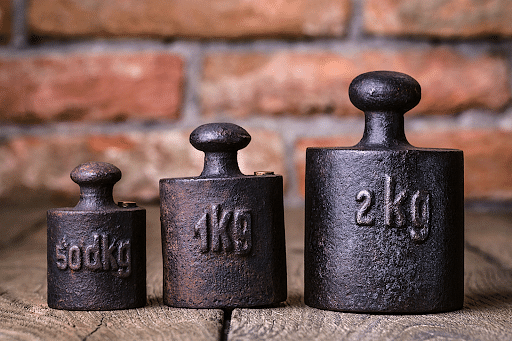
The kilogram is abbreviated as Kg. It is a unit used to measure mass. A kilogram is considered equal to the mass of one litre of water under the SI system of measurement. IPK is a standard Iridium-Platinum cylindrical figure equal to 1 kg. It is stored in a vault at the International Bureau of Weights and Measures, France.
Also read:
What is Pound?
A pound is also a unit of measurement for mass. But unlike Kg, the Pound is a measuring unit under the Imperial system. Some of the other branches of measuring mass are stone and ounce. The Pound is abbreviated as ‘Ib’ because the Pound is associated with the Roman Libra. Hence, this Unit has different varieties in different units. To be exact, one Pound is around 0.45359237 Kg. This value is too significant to be remembered. Hence, we consider one pound=0.450 Kg.

Also read:
Difference between Kilogram and Pound
The major differences between Kilogram and Pound are as follows:
| Kilogram | Pound |
|---|---|
| A Kilogram is a metric unit for measuring mass or a solid physical quantity. | A Pound is an imperial unit for measuring mass or a solid physical quantity. |
| The Kilogram is abbreviated as Kg. | The Pound is abbreviated as ‘Ib’ and ‘Ibm’. |
| Mass is even internationally expressed as Kg or Kilograms. | A pound is a common term in the USA and UK. |
| The one Kg is almost equal to 2.204 Pounds. | One Pound is equal to 0.453 Kg. |
| The Kilogram unit is fully dedicated to the mass. | Pound unit can be used to express force and mass both. |
| The word “Kilogram” is derived from a Greek term, where Kilo means thousand. | The Pound is derived from a German word. |
Pounds to Kilogram Formula
In order to answer how many kg in one pound is not sufficient. It is also important to know how to convert pounds into kilograms quickly. To do so, simply multiply the mass in kg with 0.453. For example, 3 pounds will be equal to 3 x 0.453 kg.
Also Read:
Kilogram to Pounds Formula
In a similar way, while converting mass from kilogram to pounds, we need to multiply the weight in kg with 2.204.
Also read:
Things to Remember
- Units are a way to measure physical quantities. Kilogram and Pound both are used for measuring bodily solid amounts. Still, they have some differences.
- A kilogram is considered equal to the mass of one litre of water under the SI system of measurement. IPK is a standard Iridium-Platinum cylindrical figure equal to 1 kg.
- A kg is a metric unit, whereas a Pound is an imperial unit.
- The Pound is used primarily in the USA and Uk. The Pound is abbreviated as ‘Ib’ because the Pound is associated with the Roman Libra.
- One kilogram equals 2.204 pounds, or one Pound is equivalent to 0.453 kg.
Also check:
Sample Questions
Ques: What do you understand by Unit? (2 marks)
Ans: Any physical quantity is measured in a combination of a numeric value and a unit. So, a Unit is a way to express the amount of any physical portion. For example, Pound and kilograms are two units to measure a solid physical quantity.
Ques:Define the types of Units? (2 marks)
Ans: There are two types of units as mentioned below:
- Fundamental / base Unit: the units for the fundamental or Base quantities are known as the base units.
- Derived Unit: the units which are derived from the base units are known as the derived units. Derived units can be represented as the combination of the base units.
Also check:
Ques: How much Kg is equal to one Pound? (2 marks)
Ans: One Pound is equal to about half a kilogram.
In formula: 1 Pound = 0.453 Kg
Further, you may solve all the questions with the conversion of Kg into Pound or vice-versa.
Ques: How much Pound is equal to 1 Kg? (2 marks)
Ans: One Kg is equivalent to 2.204 Pound.
So, you may use the above question formula or this formula. Both the formulas work the same way. You may solve all the questions with the conversion of Kg into Pound or vice-versa.
In formula: 1 kg = 2.204 pounds
Also check:
Ques: David sold 10 pounds of apples. How many kgs would it be? (3 marks)
Ans: Given: apples David sold = 10 Pounds
As we know:
One pound=0.450 Kg
Therefore, 10 Pound = 10 x 0.450 Kgs
10 Pound = 4.5 Kg
Hence, David has sold about 4.5 Kgs of apples.
Also check:
Ques: What are some of the main differences between Kilogram and Pound? (4 marks)
Ans: Some of the main differences between Kilogram and Pound are mentioned below:
| Kilogram | Pound |
|---|---|
| A Kilogram is a metric unit for measuring mass or a solid physical quantity. | A Pound is an imperial unit for measuring mass or a solid physical quantity. |
| The Kilogram is abbreviated as Kg. | The Pound is abbreviated as ‘Ib’ and ‘Ibm’. |
| Mass is even internationally expressed as Kg or Kilograms. | A pound is a common term in the USA and UK. |
| The one Kg is almost equal to 2.204 Pounds. | One Pound is equal to 0.453 Kg. |
| The Kilogram unit is fully dedicated for the mass. | Pound unit can be used to express force and mass both. |
| The word “Kilogram” is derived from a Greek term, where Kilo means thousand. | The Pound is derived from a German word. |
Ques: What do you understand by Base or fundamental Unit? (2 marks)
Ans: The measurement of any physical quantity involves some comparison among them. This comparison is made on the basis of some basic, arbitrarily, and internationally accepted standards to be referred to. The measurement result is annotated with a numeric value and its Unit followed by it. Such worldwide accepted units are known as Base or fundamental units.
Also check:
Ques: Stuti orders 45 pounds of cement for the construction of her home. But she receives only 13 kg of cement. Find out how many pounds of cement does she need to complete her order? (3 marks)
Ans: Convert 45 pounds into kg.
Thus, cement ordered (in kg) = 45 x 0.453 = 20.38kg
Stuti received 13 kg of cement from her order.
Therefore, cement still to be delivered is (20.41 - 13) kg.
She is yet to receive 7.38 kg of cement.
Pounds of cement yet to be delivered = 7.38 x 2.20 = 16.236 pounds.
Also check:



Comments