



Education Journalist | Study Abroad Lead
Electric flux is the number of electric field lines that cross a particular region. Electric field lines are thought to begin with positive electric charges and end with negative charges. Electric field lines going toward a closed surface are regarded as negative, whereas those directed away from a closed surface are regarded as positive. The SI unit of electric flux is volt-metres (Vm) which is also denoted as newton meters squared per coulomb (Nm2C-1). The base units to measure electric flux are kg·m3·s-3·A-1.
| Table of Content |
Key Terms: Electric Flux, Electric Field, Electric Charges, Formula of Electric Flux, Derivation of Electric Flux, Volt metres, Coulomb, Electric Field lines, Surface Area, Force
What is Electric Flux?
[Click Here for Sample Questions]
The idea of flux is usually related to the lines of force passing through a certain region. Electric flux is the property of an electric field that denotes the number of electric field lines that intersect a given area. The lines of force traveling through a surface of a certain area are thus dependent on three factors:
- The Electric Field's Strength
- Surface Area
- Surface orientation with relation to the lines of force.
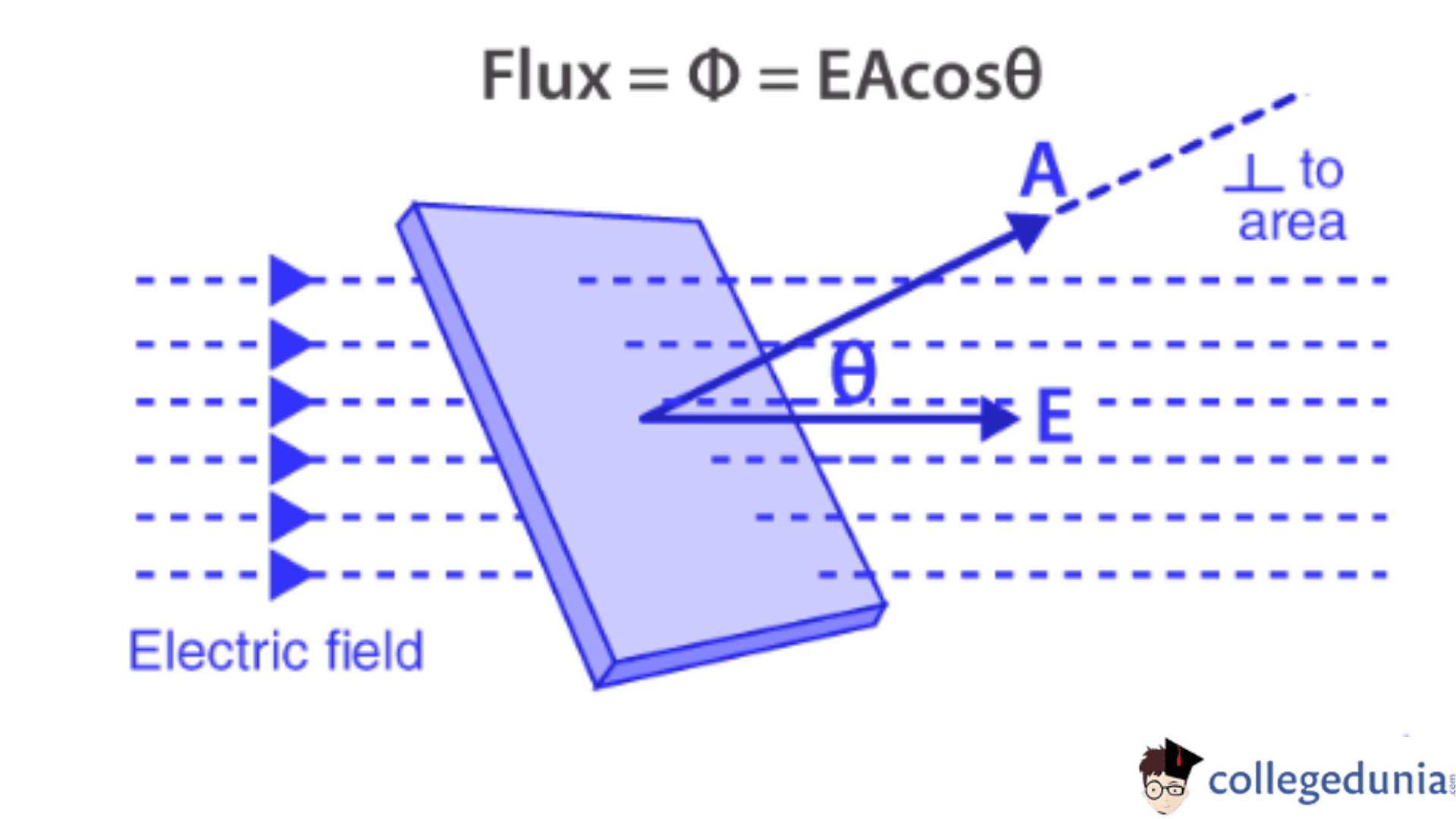
Electric Flux
SI Unit of Electric Flux
[Click Here for Previous Year Questions]
The SI base unit of Electric flux is volt-meters (V.m)
- Vm is also equal to newton-meters squared per coulomb (N m2 C-1).
-
Electric flux is measured in the fundamental base unit is kg·m3·s-3·A-1
Also Read:
Electric Flux Formula
[Click Here for Sample Questions]
The electric flux is defined as the total number of electric field lines passing through a specific region in a unit of time. If a plane is slanted at an angle, the projected area is denoted by cos θ, and the total flux across this surface is denoted by: \(\Delta \Phi_e = \overrightarrow{E}.\overrightarrow{\Delta A }\)
Where,
- \(\overrightarrow {E}\) denotes the magnitude of the electric field
- A denotes the area of the surface through which the electric flux is to be determined
- Θ is the angle formed by the plane and the axis parallel to the direction of the electric field's flow.
Dimensional Formula of Electric Flux
[Click Here for Previous Year Questions]
The dimensional formula of electric flux is [M1 L3 T-3 I-1]
Where,
- M = Mass
- I = Current
- L = Length
- T = Time
Derivation of Dimensional Formula of Electric Flux
[Click Here for Sample Questions]
Electric Flux (ΦE) = E × A× cos θ … (1)
Where,
- E = Magnitude of the electric field
- A = Surface Area
The dimensional formula of area (A) = [M0 L2 T0] …(2)
Since, Electric Field = [Force × Charge-1]
So, dimensional formula of Electric Field = [M1 L1 T-2] × [I1 T1]-1
The dimensional formula of Electric Field = [M1 L1 T-3 I-1] …(3)
Substitute equations (2) and (3) in equation (1)
⇒ Electric Flux (ΦE ) = E × A × cos θ
Or, ΦE = [M1 L1 T-3 I-1] × [M0 L2 T0] = [M1 L3 T-3 I-1]
Thus, the dimensional formula of electric flux is [M1 L3 T-3 I-1].
Calculating Electric Flux
[Click Here for Previous Year Questions]
The steps of calculation for Electric Flux are as follows:
- Use the electric flux formula. The dot product of the electric field and the area vectors E and A yield Electric Flux across a surface A. The product of two vectors is equal to the product of their magnitudes multiplied by the cosine of the angle between them.
- The size and direction of the surface area vector A have to be determined. It is important to note that the surface area vector is always perpendicular to and outward from the surface.
- Add the magnitude of the surface area vector to the magnitude of the electric field vector and the cosine of the angle between them.
- The component of the electric field that is perpendicular to the surface area vector is equal to the cosine of the angle between the two vectors multiplied by the electric field vector.
- Include the appropriate units. Electric flux is measured in unit – Newton meters squared per coulomb.
Properties of Electric Flux
[Click Here for Sample Questions]
Electric fields or Flux Lines are lines of force that exist around a charge and have the following properties:
- Flux lines often begin with positive charges and end with negative charges.
- The number of flux lines determines the intensity of the electric field.
- The flux lines are all parallel to one another.
- Flux lines normally enter or exit a charged surface.
Also Read:
Things to Remember
- The electric flux is defined as the total number of electric field lines passing through a specific region in a unit of time. It is denoted by the symbol ΦE.
- The formula of electric flux is, (ΦE) = E × A× cos θ
- The electric flux is measured for a non-uniform electric field.
- The SI unit for electric flux is Volt metres (V m).
- Newton-meters squared per coulomb (N m2 C-1) is also the unit of electric flux.
- The fundamental base unit of electric flux is kg·m3·s-3·A-1
- The dimensional formula of electric flux is [M1 L3 T-3 I-1]
Sample Questions
Ques: Is the electric flux affected by distance? (1 Mark)
Ans: The flux is independent of the distance r. We would have the same outcome regardless of the size of the closed surface surrounding the point charge.
Ques: Is electric flow a vector or a scalar quantity? (1 Mark)
Ans: Electric flux is a scalar quantity because it is the dot product of two vector values, the electric field and the perpendicular differential area, it is a scalar.
Ques: What is electric flux? When is the highest electric flux? (2 Marks)
Ans: The total number of force lines passing across a surface is defined as the electric flux. When the area vector of a surface is parallel to the direction of the electric field, the electric flow is greatest.
Ques: Is electric flux the same as charge? (2 Marks)
Ans: The charge divided by the permittivity equals the total electric flux out of a closed surface. The electric flux through an area is calculated by multiplying the electric field by the surface area projected in a plane perpendicular to the field.
Ques: What is the significance of electric flux? (2 Marks)
Ans: Electric flux determines the total charge contained within any arbitrary surface. The greater the electric flux, the more charge must be present inside the surface in order to generate the required number of electric field lines.
Ques: Is there a relationship between electric flux and area? (2 Marks)
Ans: The numerical value of the electric flux is determined by the magnitudes of the electric field and the area, as well as the area's relative orientation to the direction of the electric field. Each surface is crossed by the same number of field lines.
Ques: Is there a relationship between electric flux and radius? (2 Marks)
Ans: The total electric flux across a closed surface is proportional to the total electric charge contained inside the surface. Inside the spherical surface of a point charge, the flow is independent of the sphere's radius R.
Ques: a) Define electric flux. Write its S.I. unit.
(b) A small metal sphere carrying charge +Q is located at the centre of a spherical cavity inside a large uncharged metallic spherical shell as shown in the figure. Write the expressions for the electric field at points P1 and P2.

(c) Draw in this arrangement. (Comptt. All India 2012, 5 Marks)

Ans:
- Electric flux: The electric flux is the measure of the electric field lines of force passing through a given area held inside an electric field. Mathematically,
Electric Flux (ΦE ) = E × A × cos θ
The SI unit of electric flux= NC-1m2 = Nm2C-1 or Vm
- Consider a thin, infinite plane sheet of charge with uniform surface charge density σ. We need to determine the electric field at a point P which is placed at a distance r from it.
The electric field E is in the outward direction and normal to the sheet. The magnitude of the electric field at two points P and P’ is the same and is in the opposite direction.
Consider a cylindrical Gaussian surface of cross-sectional area A and length 2r. The axis should be perpendicular to the sheet.
The flux through the plane-end faces of the cylinder is :
ΦE = EA + EA = 2EA (Since angle is zero and cos0 is 1)
Charge enclosed by the Gaussian surface,
q = σA
According to Gauss’s theorem,
ΦE = q/ε0
Since,
ΦE = 2EA
So,
2EA = q/ε0
Clearly, E is not depended on r
- For positively charged sheet away from the sheet
- For negatively charged sheet towards the sheet
- Calculation of electric field at point P1:
Net charge enclosed by the Gaussian surface is +Q

As the electric field of positive charge is radially outwards, it is parallel to the area vector on the surface chosen.
\(\therefore \oint \overrightarrow{E} .d \overrightarrow{s} = \oint E. ds cos 0^o =\frac{Q}{\varepsilon_0}\)
\(E \oint ds =\frac{Q}{\varepsilon_0} \implies E \times 4 \pi r^2 = \frac{Q}{\varepsilon_0}\)
\(\therefore E =\frac{Q}{4 \pi \varepsilon_0 r^2}\)
As point P2 lies inside the metal, therefore the electric field at point P2 is zero.

For Latest Updates on Upcoming Board Exams, Click Here: https://t.me/class_10_12_board_updates
Do Check Out:



Comments