



Content Curator
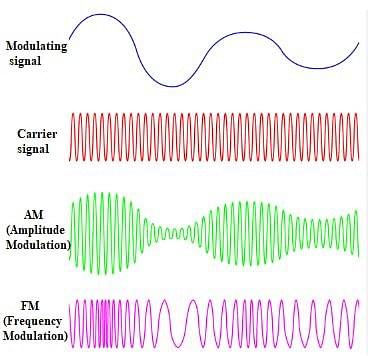
The difference between AM and FM lies in how the carrier wave, or electromagnetic wave, is modulated.
- Modulation is a method of changing one or more properties of a periodic wave known as the carrier signal with another signal known as the modulation signal, which carries information to be transmitted.
- The process of modulation is performed by a device known as the modulator.
- In AM (amplitude modulation), the amplitude of the carrier signal changes in proportion to the amplitude of the message signal, such as an audio signal.
- In FM (frequency modulation), the frequency of the carrier signal changes in proportion to the frequency of the message signal.
Read more: Difference Between AM and FM
| Table of Content |
Key Terms: Amplitude modulation, AM radio signal, Lower carrier frequencies, Frequency modulation, Wave, Ionosphere, Modulator, Demodulator, Modulating signal
What is Amplitude Modulation (AM)?
[Click Here for Sample Questions]
The technique of changing the amplitude of a carrier depending on the information signal is known as AM (Amplitude modulation).
- AM was the first modulation technology used in radio transmission for transmitting audio.
- It was invented in the first quarter of the 20th century, commencing with the radiotelephone experiments of Roberto Landell de Moura and Reginald Fessenden in 1900.
- The earliest form of AM is sometimes referred to as double-sideband amplitude modulation (DSBAM).
- AM radio broadcast signals travel long distances as they use lower carrier frequencies.
- AM signals can sometimes bounce off from the ionosphere.
- AM can travel distances greater than FM can.

Also Read:
What is Frequency Modulation?
[Click Here for Sample Questions]
The technique of modifying the frequency of the carrier signal in proportion to the frequency of the message signal is known as FM (Frequency modulation).
- FM technology is widely used for FM radio broadcasting.
- The main advantage of frequency modulation in radio transmission is that it has a higher signal-to-noise ratio.
- Therefore it rejects radio frequency interference better than an equal power amplitude modulation (AM) signal.
- These radio signals have larger bandwidth as compared to AM radio signals, which provides greater sound quality.
- Stereo signals can also be transmitted through FM.

Frequency Modulation
Read more: What is internet history of internet
What are Differences Between AM and FM?
[Click Here for Sample Questions]
Amplitude Modulation and Frequency Modulation differ on many factors:
| Factors | AM | FM |
|---|---|---|
| Abbreviations | Amplitude modulation | Frequency modulation |
| Way of Origin | Audio transmission through the AM method was successfully carried out in the mid-1870s. | Edwin Armstrong developed the FM radio in the 1930s in the United States of America. |
| Differences in Modulation | A transmitting signal modulates the amplitude of the radio wave known as the "carrier wave" or “carrier”. | A transmitting signal modulates a radio wave known as the "carrier" or "carrier wave" in frequency. |
| Parameters that are Constant | The phase and frequency stay the same. | The phase and amplitude stay the same. |
| Quality | It has poor sound quality, with low bandwidth as compared to FM, but it is cheaper and due to its lower bandwidth it can be transmitted over long distances, so it can hold more stations available in any frequency range. | It is less bothered by interference, but these signals are affected by physical obstacles. They have better sound quality as they have high bandwidth. |
| Range of Frequency | It has a range of 535 to 1700 kHz or even up to 1200 beats/sec. | It has a range of 88.1 to 108.1MHz. Or even up to 1200 to 2400 bits/sec |
| Bandwidth | BW is less compared to FM. BW is 2 FM. | BW is huge and requires a wide channel. BW is 2 times (δ + FM) |
| Requirements for Bandwidth | Bandwidth is less and it doesn’t depend on the modulation index. Its requirements are two times the highest modulating frequency. The bandwidth and amplitude modulated signal is 30 kHz if the modulating signal is 15 kHz. | Bandwidth requirement depends on the modulation. The requirement is two times the sum of the frequency deviation and the modulating signal frequency. So, if the modulating signal frequency is 15kHz and the frequency deviation is 75kHz then the required bandwidth will be 180kHz. |
| Sidebands Number | Constant and equal to 2. | It depends on the modulation index. |
| Modulating Signal consisting of zero crossing | It is Equidistant. | It isn’t equidistant. |
| Complexity | They are less complex but need synchronization for SSBSC carriers. | They are more complex because the variation of the modulating signal has to be converted and detected from the corresponding variation in frequencies. |
| Noise | Their receivers are much disturbed by noise as noise affects the amplitude which contains information in AM signals. | Their receivers are not affected by noise and it can decrease by even further deviation. |
| Efficiency | Transmitting the carrier wastes a lot of power. | It is very efficient as all transmitted power is useful. |
| Application | Video transmission on T.V. Medium wave and short wave and band broadcasting. | Audio transmission on T.V., Broadcasting FM. |
| Function | The frequency of the carrier wave deviates as per the voltage of the modulating signal input. | As the amplitude or voltage of a modulating signal changes The amplitude of a carrier wave in AM diverges. |
| Types | Digital FM like GFSK, offset PSK, and FSK | AM like VSB, SSB, DSB-SC, etc. |
Also Read: Pulse Amplitude Modulation
Things to Remember
- The amplitude of the signal is varied to integrate the sound information, in AM.
- A radio emission referred to as the "carrier" is modulated in amplitude by the signal that's to be transmitted, in FM.
- The phase and frequency stay the same in AM.
- The phase and amplitude stay the same in FM.
- AM gets disturbed by noise.
- FM doesn’t get affected by noise.
- Frequency modulation (FM) and Amplitude Modulation (AM) use the method of modification of carrier signals to transmit data.
For More PYQ Examples, Check:
Sample Questions
Ques. What is Amplitude modulation? (1 Mark)
Ans. AM (Amplitude modulation) is the process of altering the amplitude of a carrier according to the modulating signal.
Ques. What is Frequency modulation? (1 Mark)
Ans. FM (Frequency modulation) is the process of altering the frequency of a carrier according to the modulating signal.
Ques. What is modulation? (2 Marks)
Ans. Modulation is the process of altering certain characteristics of a periodic wave known as the carrier signal with another signal known as the modulation signal, which carries the information to be transmitted.
Ques. What is demodulation? (2 Marks)
Ans. Demodulation is the process of obtaining the original information-carrying signal from a carrier wave. A demodulator is a type of electrical circuit that recovers the information content of a modulated carrier wave.
Ques. What is carrier signal? (2 Marks)
Ans. Carrier signals are high-frequency signals with specified amplitude, frequency, and phase levels, but they do not carry any data.
Ques. What is the modulating signal? (2 Marks)
Ans. A message signal is another name for a modulating signal. It contains the data that needs to be broadcast and is hence referred to as a message signal.
Ques. Draw a block diagram of a detector for amplitude modulated signal. (1 Mark) [Comptt. Delhi 2012]
Ans.

Block diagram of a detector for amplitude modulated signal
Ques. What are the various techniques used in analogue modulation? (1 Mark)
Ans. These are the three ways analogue modulation is used:
- Phase modulation (PM)
- Amplitude modulation (AM)
- Frequency modulation (FM)
Ques. Differentiate between a detector and a demodulator. (2 Marks)
Ans. A detector is defined as a device that recovers information of interest that's contained during a modulated wave.
The demodulator is defined as the device which is an updated sort of detector that's used for extracting the first information from a modulated carrier.
Ques. What is the need for modulation and demodulation? (2 Marks)
Ans. Modulation and demodulation are needed so that the information can be transferred from one place to another. Modulation is used to send data over long distances because low-frequency signals are not able to cover big areas. Demodulation contributes to receiving the data sent through modulation at the receiver’s end.
Ques. What are the advantages of using an RF amplifier? (2 Marks)
Ans. The advantages of using an RF amplifier are as follows:
- RF has better selectivity when the rejection rate is compared to other amplifiers.
- When compared to other amplifiers, the signal-to-noise ratio of RF amplifiers is better.
- RF amplifiers have better sensitivity.
Ques. What are digital modulation and its types? (3 Marks)
Ans. The modulation technique which uses discrete signals for modulating a carrier wave, is known as digital modulation. It is used for transferring signals with high frequency over an analog channel.
The four types of digital modulation are given below:
- Phase Shift Keying (PSA)
- Amplitude Shift Keying (ASK)
- Frequency Shift Keying (FSK)
- Quadrature Amplitude Modulation (QAM)
Ques. Write briefly any two factors which demonstrate the need for modulating a signal. Draw a suitable diagram to show amplitude modulation using a sinusoidal signal as the modulating signal. (3 Mark) [All India 2011]
Ans. Need for modulation :
(i) Audio frequencies below 20 kHz are poor to radiate. They die out after covering a small distance in the air. Hence they cannot travel a large distance from the point of transmission.
(ii) To transmit audio waves, a very small antenna is needed. For example, if a 15 kHz signal is to be broadcasted then it requires a vertical antenna of heights 5 km which is impossible to even think about.
Diagram showing amplitude modulation:

Ques. Draw a block diagram of a simple amplitude modulation. Explain briefly how amplitude modulation is achieved. (4 Marks) [All India 2017]
Ans. Production of Amplitude Modulated wave: A conceptually simple method to produce an AM wave is shown in the following block diagram:

This signal is passed through a bandpass filter which rejects dc. The output of the bandpass filter is, therefore, Am wave
Ques. Draw a plot of the variation of amplitude versus ω for an amplitude-modulated wave. Define modulation index. State its importance for effective amplitude modulation. (4 Marks) [Delhi 2017]
Ans. (i) Plot of ‘amplitude’ versus ‘ω’ for an amplitude modulated signal


(ii) Modulation index: It is the ratio of the amplitude of the message or modulating signal to the amplitude of the carrier wave

(iii) Importance :
- The modulation index determines the strength and quality of the transmitted signal.
- Distortions are avoided by keeping p < 1.
For Latest Updates on Upcoming Board Exams, Click Here: https://t.me/class_10_12_board_updates
Do Check Out:



Comments