


.jpg?h=35&w=35&mode=stretch)
“Diffusion is the net movement of substances like atoms, ions, molecules, or energy from a region of higher concentration to one of lower concentration.”
| Table of Content |
Key Terms: Diffusion, Concentration Gradient, Facilitated diffusion, Semi permeable Membrane, Osmosis
What is Diffusion?
[Click Here for Sample Questions]
The movement of molecular level chemicals or particles from a location of higher concentration to a region of lower concentration is defined as diffusion. Diffusion is a natural and physical phenomenon that occurs without the use of any kind of energy. Diffusion occurs in liquids and gases because molecules can move around at random. The molecules clash and shift direction, resulting in a passive mode of transportation. Diffusion is a stochastic process due to the inherent randomness of the diffusing entity.
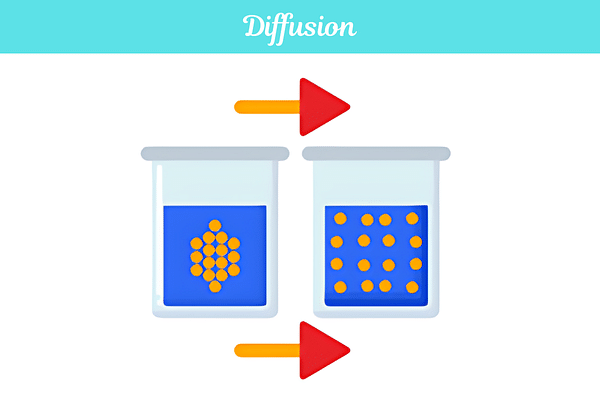
Diffusion
Example:
When perfume is sprayed, its fragrance diffuses into the air and spreads throughout the room because the perfume bottle carries a higher concentration of the ingredient. The chemical diffuses into the atmosphere when air is dispensed from the bottle because the ambient air has a lower concentration than the bottle. The odour of the perfume is disseminated across the area thanks to the diffusion mechanism.
Types of Diffusion
[Click Here for Sample Questions]
Diffusion is a vital biological and chemical process. Diffusion can be divided into two main types: Simple diffusion and Facilitated diffusion.
Simple diffusion
Simple diffusion is the unassisted movement of molecules, atoms, or ions that pass directly through spaces in a semipermeable membrane from an area of higher concentration to an area of lower concentration. The simple diffusion rate is comparably slower than the facilitated diffusion rate.
Example:
Diffusion of oxygen, carbon dioxide, water, and other small molecules across cell membranes.
Facilitated diffusion
Facilitated diffusion involves the movement of larger or polar molecules through a membrane with the help of transport proteins. It's also a selective process, in that the membrane only permits certain types of molecules to flow through while preventing others from doing so. This is significant because enhanced diffusion allows plants to segregate different minerals from the soil through their roots. Facilitated diffusion occurs at a faster rate than simple diffusion. However, depending on the sort of carrier contributing to the diffusion, this form of diffusion might be passive or active.
Example:
Diffusion of glucose and water across cell membranes.
Osmosis
Osmosis is a special type of diffusion where water molecules diffuse through a semipermeable membrane from an area of lower solute concentration (higher water concentration) to an area of higher solute concentration (lower water concentration).
The main difference between simple and facilitated diffusion is that simple diffusion occurs passively and without assistance, whereas facilitated diffusion requires transport proteins to promote the movement of molecules that cannot cross the membrane on their own.
Causes of Diffusion
[Click Here for Sample Questions]
The primary cause of diffusion is the random thermal movement of particles. Because of this kinetic energy, there are collisions, which cause the particles to disperse from areas of higher to lower concentration. It is a natural and physical process that occurs without the need to mix or shake the solutions.
Examples of Diffusion
[Click Here for Sample Questions]
Following are some examples of Diffusion:
- When you put a teabag in a cup of hot water, the tea will diffuse into the water and change color.
- The scent of a perfume or room freshener will be spread into the air, and we will be able to detect it.
- Sugar dissolves evenly in the water and sweetens it without the need to stir it.
- The smoke from the incense stick is diffused into the air and travels over the room when we light it.
- When you pour boiling water over dry noodles, the water diffuses, rehydrating them and making them plumper and more saturated.
Diffusion Pressure
[Click Here for Sample Questions]
Diffusion pressure refers to the pressure imposed by particles' tendency to spread from areas of higher concentration to areas of lower concentration. It is proportional to diffusing particle concentration. A permeable pot is attached to a glass tube with one end submerged in water.
A hydrogen-filled gas jar is inverted over the porous pot. The ability of hydrogen to diffuse into porous pots is faster than the ability of air to diffuse out of porous pots. This creates pressure inside the porous pot, pushing air into the water in the form of air bubbles from the glass tube's tip.
Factors Affecting Diffusion
[Click Here for Sample Questions]
Diffusion is a somewhat slow process that happens largely in gases and liquids. This energy-free mode of transportation does not require any energy. However, the rate of diffusion is influenced by several factors, including those listed below:
- Density: Graham's Law states that the rate of diffusion of a material is inversely related to the square root of its relative density.
- Permeability of Medium: The rate of diffusion decreases with the density of the medium.
- Temperature: The rate of diffusion increases as the temperature rises, with Q10 = 1-2-1-3. Sugar crystals do not dissolve as easily in ice-cold water as they do in warm water as a result of this.
- Diffusion Pressure Gradient: The difference in diffusion pressure at the two extremities of a system determines the rate of diffusion, which is inversely proportional to the distance between them.
Significance of Diffusion
Diffusion is an essential function that affects how molecules move throughout a cell's metabolic process. Diffusion is a natural phenomenon that occurs in liquids and gasses without using energy.
Diffusion is an essential process for the following reasons:
- Diffusion helps in the exchange of gases like oxygen and carbon dioxide during respiration.
- The diffusion is important for pollination as it spreads the aroma of flowers, attracting insects and animals.
- Diffusion drives the process of transpiration.
- Diffusion keeps the cell walls of internal plant tissues moist by allowing water molecules to move between cells.
Things to Remember
Following are some important points:
- Diffusion keeps the inside plant tissues' cell walls wet.
- It's a way for ions and other chemicals to spread throughout the protoplast.
- Diffusion is the process of water loss in the form of vapour.
- Diffusion is the process by which gases (CO2 and O2) are exchanged between the plant interior and the outside air.
- Water diffuses over a semi-permeable membrane through osmosis, a unique type of diffusion.
- The fragrance of flowers comes from the diffusion of volatile aromatic molecules that attract pollinators.
Sample Questions
Ques: What is facilitated diffusion? (3 Marks)
Ans: Facilitated diffusion is the passive transport of molecules across the cell membrane with the aid of a carrier molecule from an area of higher concentration to a region of lower concentration. Molecules that are unable to freely cross the phospholipid bilayer (for example, big, polar molecules and ions) make use of it. Glucose molecules, sodium ions, and potassium ions all use carrier proteins to travel across cell membranes in the human body.
Ques: Does facilitated diffusion produce ATP? (3 Marks)
Ans: Because it is the passive flow of substances such as glucose and amino acids across the cell membrane, it does not require ATP. Because glucose is such a large molecule, it does so with the help of a membrane protein. Because it is passive, assisted transport does not require chemical energy from ATP hydrolysis in the transport stage; instead, molecules and ions move along their concentration gradient, reflecting the diffusive nature of the process.
Ques: Why does diffusion not use energy? (3 Marks)
Ans: Molecules are believed to flow down a concentration gradient spontaneously. This form of diffusion takes place without the need for any energy. Small, uncharged molecules can freely flow through a cell membrane by simple diffusion. They easily pass through the membrane of the cell. Diffusion is known as the movement of various molecules from a higher level of concentration to a lower level of concentration.
Ques: What is the main cause of the diffusion process in plants? (3 Marks)
Ans: Diffusion happens in plant cells as well. Water from the soil diffuses into the roots of all green plants via their root hair cells. Diffusion is the passage of ions across neurons that generates electrical charges. During photosynthesis, plants consume carbon dioxide. During photosynthesis, the concentration of carbon dioxide inside a leaf is this low. The increasing carbon dioxide content in the air around the plant allows the gas to diffuse into the leaf.
Ques: Is diffusion active or passive? (2 Marks)
Ans: Diffusion is a type of passive transport. A single chemical will tend to travel from a high-concentration location to a low-concentration area until the concentration is uniform throughout the space. You've heard of stuff diffusing through the air. Simple diffusion and osmosis, both of these methods are passive and they do not use ATP energy of cells.
Ques: How does distance affect diffusion? (2 Marks)
Ans: Diffusion occurs more quickly when the diffusion distance is modest since the particles do not have to go as far. Diffusion can happen quickly over short distances but take a long time over big distances. A molecule of glucose, for example, can diffuse across a 50-micrometre diameter cell in 2.5 seconds, while it takes 32 years to diffuse a distance of one meter.
Ques: How can you speed up diffusion? (2 Marks)
Ans: The faster the rate of diffusion, the higher the concentration difference. This is due to the higher kinetic energy of the particles due to higher temperature and this results in quick movement of them. The faster the rate of diffusion, the larger the surface area. Because heavier molecules move slower, they diffuse more slowly. For lighter molecules, the opposite is true.
Ques: Is diffusion always from high to low concentration? (3 Marks)
Ans: Diffusion is a type of passive transport. When a single substance moves from a high-concentration area to a low-concentration area, this is referred to as "moving solutes down the concentration gradient." The end outcome is an equal concentration of molecules on both sides of the membrane or equilibrium. Movement of molecules cannot stop till the system is in equilibrium. You've heard of stuff diffusing through the air.



Comments