



Content Curator
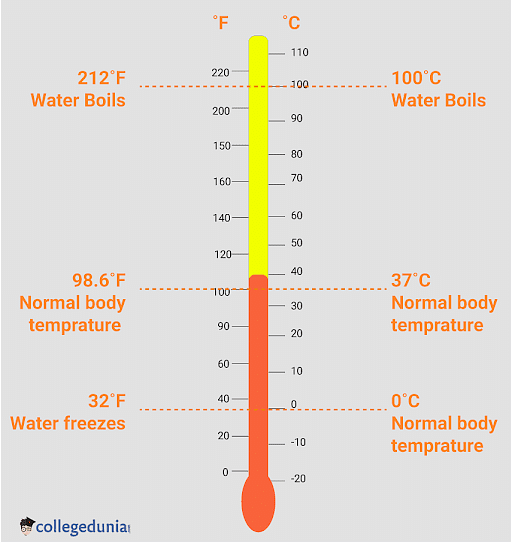
The unit of temperature is relatively of three types, that is, Celsius, Kelvin, and Fahrenheit. Temperature is a physical quantity which measures the warmth or the coldness of a substance with reference to some standard value. The relation between Celsius Fahrenheit and Kelvin can be represented as:
\(^o C = \frac{(^oF-32)}{1.8}\) and Celsius to Kelvin: K = °C + 273
Celsius, Kelvin, and Fahrenheit are the three most commonly used measuring scales with different values. The unit of temperature is usually measured in relation to the consisting particles, such as the high temperature of the substance depicts the faster flow of the particles of the substance.
Read More: Magnetic Poles
Key Terms: Temperature, Celsius, Kelvin, Fahrenheit, Absolute Zero, Thermodynamics, International System of Units
What is Temperature?
[Click Here for Sample Questions]
The temperature usually refers to the physical property of an object or body. Temperature can be defined as:
| “A concept of measuring the level of warmth or coldness of the surface of a body or object.” |
When the temperature of any substance is measured, it is represented using the various units of temperature. The use of the units of temperature makes the quantity universally acceptable by giving it standardization.
- Temperature is usually measured by means of the kinetic energy of the particles.
- It further explains the movement rate of particles moving within a material.
- Typically, it is considered to be an average measure.
- Which is to say that higher the temperature, the faster is the particle movement composing the substance.
Temperature
- The temperature refers to the average kinetic energy of the molecules of the object which undergo heating and generate movement.
- Scientifically, the high temperature of any object or substance is recognized via higher kinetic energy.
- Multiple types of scales are used for measuring the temperature using different units such as the Celsius scale, Fahrenheit scale, or the Kelvin scale.
- Although, the temperature in all three scales is represented using the ‘degree’ symbol.
Read More: Rotational Kinetic Energy
Concept of Absolute Zero
Absolute zero refers to a situation when the kinetic energy becomes zero, thus, defining the lowest temperature possible. Usually, the scientists have figured out 0 Kelvin, - 273.15 degrees Celsius, or the – 460 degrees Fahrenheit as the absolute zero temperature.
| Do You Know? During the invention of temperature scales, several scientists discovered that there were distinct things which remained around the same temperature:
|
Read More: Kelvin Planck Statement Example
SI Unit of Temperature
[Click Here for Sample Questions]
The SI unit of the temperature is Kelvin.
- All the standard measurements of the temperature of any substance or the body across the world are done using the unit of temperature which is known as kelvin.
- The kelvin is denoted using the symbol ‘K’.
- Mainly, Kelvin is considered as the base unit for the thermodynamics measurement of the temperature in the international system of units.
Relation between Celsius, Fahrenheit and Kelvin
Here is the relation between Celsius, Fahrenheit, and Kelvin:
\(^o C = \frac{(^oF-32)}{1.8}\)
Celsius to Kelvin: K = °C + 273
Applications of Kelvin scale:
- Kelvin scale is used in lightning.
- It is used in Scientific measurements.
- It is used in Colour temperature determination.
Applications of Celsius scale:
- the Celsius scale is used in the Metric system.
- It is also used in the Scientific measurements.
| Concept Related Topics | ||
|---|---|---|
| Newton's Law of Cooling | System of Units | Barometer |
| Constellations | Proton mass | Specific Gravity |
Celsius, Fahrenheit, Kelvin
[Click Here for Sample Questions]
The units of the temperature can be measured using different scales which prove to be useful in determining the different temperatures from one scale to another. Such as,
- The temperature in the b is denoted by °C, for instance, 2 degrees Celsius.
- The temperature in the Fahrenheit scale is denoted by °F, for instance, 2 degrees Fahrenheit.
- The temperature in the Kelvin scale is denoted by K, for instance, 2 Kelvin.
The Units of Temperature can be summarized as:
| From | To Fahrenheit | To Celsius | To Kelvin |
|---|---|---|---|
| Fahrenheit (°F) | °F | 5/9 × (°F-32) | °F – 32 × 5/9 + 273.15 |
| Celsius (°C) | (°C × 9/5) + 32 | °C | °C + 273. 15 °C |
| Kelvin (K) | (K − 273.15) × 9/5 + 32 | K − 273.15K | K |
Temperature Conversions
[Click Here for Sample Questions]
The different Temperature Conversions are listed below:
From Celsius to Fahrenheit
The conversion of units from Celsius to Fahrenheit could be done using a mathematical equation as mentioned below.
F = (9/5 × C) + 32
In the above formula,
- F refers to the temperature in Fahrenheit.
- C refers to the temperature on the Centigrade scale.
For instance,
In order to convert 2 degrees Celsius into Fahrenheit, the above-given formula shall be used such as –
⇒ F = (9/5 x 2) + 32
Therefore, the value of F shall be 35.6 degrees Fahrenheit.
Read More: Electrical Current
From Fahrenheit to Celsius
The conversion of units from Fahrenheit to Celsius could be expressed using a mathematical equation as mentioned below.
C = 5/9 (F − 32)
In the above formula,
- F refers to the temperature in Fahrenheit.
- C refers to the temperature on the Centigrade scale.
For instance,
In order to convert 2 degrees Fahrenheit into Celsius, the above-given formula shall be used as:
⇒ C = 5/9.(2 – 32)
Therefore, the value of C shall be: 16.666 degrees Fahrenheit.
From Kelvin to Fahrenheit
The conversion of units from Kelvin to Fahrenheit could be expressed through a mathematical equation as mentioned below.
F = (K − 273.15) × 95 + 32
In the above formula,
- F symbolizes the temperature in Fahrenheit.
- K symbolizes the temperature on the Kelvin scale.
For instance,
In order to convert 2 Kelvin into Fahrenheit, the above-given formula shall be used such as:
⇒ F = (2 – 273.15) x 95 + 32
Therefore, the value of F shall be: 25,727.25 degrees Fahrenheit.
From Kelvin to Celsius
The conversion of units from Kelvin to Celsius could be expressed through a mathematical equation as mentioned below.
C = K − 273.15
In the above formula,
- K symbolizes the temperature in Kelvin.
- C symbolizes the temperature on the Centigrade scale.
For instance,
In order to convert 2 Kelvin into Celsius, the above-given formula shall be used as:
⇒ C = 2 – 273.15
Therefore, the value of C shall be – 271.15 degrees Celsius.
Read More:
Temperature Units
[Click Here for Sample Questions]
There are various other units of temperature as well which are used by the scientists to express the temperature. Such as Rankin, Newton, etc. Follow the table to understand the relations between different units of temperature.
| Units | From Celsius | To Celsius |
|---|---|---|
| Kelvin | [K] = [°C] + 273.15 | [°C] = [K] − 273.15 |
| Fahrenheit | [°F] = [°C] × 9 ⁄ 5 + 32 | [°C] = ([°F] − 32) × 5 ⁄ 9 |
| Rankine | [°R] = ([°C] + 273.15) × 9 ⁄5 | [°C] = ([°R] − 491.67) × 5 ⁄ 9 |
| Newton | [°N] = [°C] × 33 ⁄ 100 | [°C] = [°N] × 100 ⁄ 33 |
| Rømer | [°Rø] = [°C] × 21⁄40 + 7.5 | [°C] = ([°Rø] − 7.5) × 40 ⁄ 21 |
| Réaumur | [°Ré] = [°C] × 4 ⁄ 5 | [°C] = [°Ré] × 5 ⁄ 4 |
| Delisle | [°De] = (100 − [°C]) × 3 ⁄ 2 | [°C] = 100 − [°De] × 2 ⁄ 3 |
Read More: Layers of the Earth
Things to Remember
- The SI unit of the temperature is Kelvin which is represented using the symbol ‘K’.
- The Celsius and Fahrenheit are directly proportional to each other, in a way that, if the equivalent temperature in the Celsius unit increases then the temperature in Fahrenheit will also increase and vice – versa.
- In terms of kinetic energy, the temperature refers to the average kinetic energy of the molecules of the object which undergo heating and generate movement.
Sample Questions
Ques. What is the relation between Celsius and Fahrenheit? (1 mark)
Ans. The Celsius and Fahrenheit are directly proportional to each other, such that, if the equivalent temperature in the Celsius unit increases then the temperature in Fahrenheit shall also increase and vice – versa.
Ques. What is Kelvin Scale? And mention the freezing point and the boiling point on the Kelvin scale. (2 marks)
Ans. Just like the Centigrade scale and the Fahrenheit scale, the kelvin scale is also used for measuring the temperature and owns relation between the other two scales.
The freezing point on the kelvin scale is 273K while the boiling point is 373K. Here, K represents the unit of kelvin.
Ques. What is the boiling point of water on the Fahrenheit scale and the centigrade scale? (2 marks)
Ans. The Fahrenheit scale and the centigrade scale use different thermometers and hence the values on their scale that are used for measuring the temperature are also different, hence the boiling point of water varies in both the scales, such as, the boiling point of water in the Centigrade scale is 100 degrees Celsius and on the Fahrenheit scale it is 212 degrees Fahrenheit.
Ques. Explain the concept of absolute zero in context with the temperature. (2 marks)
Ans. Absolute zero refers to a situation when the kinetic energy becomes zero, thus, defining the lowest temperature possible. Usually, the scientists have figured out 0 Kelvin, - 273.15 degrees Celsius, or the – 460 degrees Fahrenheit as the absolute zero temperature. The Anthropocene era hasn’t yet experienced the absolute zero level of temperature.
Ques. How is the temperature measured using the thermometer? (2 marks)
Ans. The numerical scale and the mercury bulb help in measuring the temperature of a body using the thermometer. A thermometer usually works on the concept of thermal sensing using mercury. If the thermometer experiences the change in temperature, the mercury undergoes the movement on the numerical scale, marking the temperature level in Celsius, Fahrenheit, or Kelvin depending upon the type of thermometer.
Ques. What is the relation between the kinetic energy and the temperature increase? (4 marks)
Ans. The relationship between the kinetic energy and the temperature is as follows:
- Kinetic energy refers to a form of energy that is derived through the movement of the body.
- Therefore, the temperature refers to the average kinetic energy of the molecules of the object which undergo heating and generate movement.
- Thus, the higher the heat, the more shall be the kinetic energy which results in increasing temperature.
- This heat and rise in temperature results in the expansion of the solid object. Thus, establishing the relation between temperature and kinetic energy.
Ques. Prove the relation between Celsius and Fahrenheit, the two units of the temperature. (5 marks)
Ans. The derivation relation between the two units of the temperature, that is, the Celsius and the Fahrenheit, could be proved with the help of the mathematical equation as mentioned below.
C − 0 = F − 32
(C − 0)/100 = (F − 32)/180
C/100 = (F − 32)/180
C/5 = (F − 32)/9
In the above equations,
- F symbolises the temperature in Fahrenheit.
- C symbolizes the temperature on the Centigrade scale.
Ques. What is temperature? Explain in relation to the units of temperature. (5 marks)
Ans. The temperature usually refers to the physical property of an object or body. It is defined as a concept of measuring the level of warmth or cold of the surface of a body.
- When the temperature of any substance is measured, it is represented using the various units of temperature.
- The use of the units of temperature makes the quantity universally acceptable by giving it standardization.
- Scientifically, the high temperature of any object or substance is recognized via higher kinetic energy.
- Multiple types of scales are used for measuring the temperature using different units such as the Celsius scale, Fahrenheit scale, or the kelvin scale. Although, the temperature in all three scales is represented using the ‘degree’ symbol.
Check Also:



Comments