



Content Curator
Iron is an element of the periodic table which is represented by the symbol Fe and has an atomic number 26. The symbol Fe is taken from a latin word ‘Ferrum’. It is a member of the group 8 and its oxidation state is from -2 to +6. Iron in its elementary form is not too reactive normally, but it reacts to oxygen and water. Iron, by mass, ranks among the most commonly available elements on earth since it is a major component of the inner and outer cores of earth. It ranks fourth among the most commonly found elements on the surface of earth and it is also used in satisfying daily needs of humans since it is used in machines or textile.
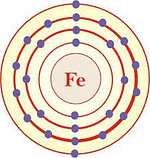
Iron is known for having the ability to create various oxidation states which vary in distinguishable forms. For the whole group of transition metals, iron is selected as the standard or representative element since it is available and present in abundance. Iron II refers to ferrous compounds, while iron III refers to ferric compounds. Compounds containing iron exist at oxidation states of +3 and +2. Sometimes, they occur at a higher oxidation state of +6. Potassium ferrate is a suitable example where iron exists in +6 oxidation state. Iron cannot obtain a +8 oxidation state, however. Iron is also known for being an intermediary substance in a few instances. The electronic configuration of iron is represented as Ar 3d6 4s2. Iron has a typical crystalline framework and electronic configuration which makes it attractive towards most metals. Iron is considered as a ferromagnetic material. The element showcases various kinds of allotropic structures although they are devoid of a lone crystalline framework. Iron has the allotropic structures at alpha and gamma. Iron contains a lot of allotropic forms even though they do not contain any crystalline structure. The full electronic representation of Fe2+ is 1s22s22p63s23p63d6 and Fe3+ is 1s22s22p63s23p63d5. Fe’s electronic configuration consists of 2 more electrons compared to Fe2+. In case of Fe3+ ion, a total of 3 electrons are removed (two from the 4s2 and one form the 3d6) leaving the configuration of 1s22s22p63s23p63d5 1s22s22p63s23p63d5.
Read Also: Class 12 Gauss's Law
| Table of Content 2.1. Residential uses |
Valency of iron
[Click Here for Sample Questions]
Valency is usually defined as the number of electrons obtained or given up by an element to achieve a stable configuration or a noble gas configuration. A fully filled outermost shell of an electron usually determines the stability of an element, therefore the number of electrons shared, gained or lost is called the valency of an element. Iron has an atomic number of 26 as previously mentioned. Therefore, there are 26 electrons in total and the electronic configuration is shown as 1s2 2s2 2p6 3s2 3p6 3d6 4s2. 4s and 3d orbitals have almost similar energy. In the case of 3d orbitals, there are lone pairs of electrons while the other electrons are unpaired. Iron exists in the valence states +3 and +2. When iron loses the two 4s electrons, it obtains a +2 valency. Sometimes iron also has the capability of losing one of the paired electrons from the 3d orbital, leaving the 3d orbital with unpaired electrons. In that case, the unpaired electrons provide a more stable configuration of +3 valency. Iron noticeably has a variable valency, which can be explained. Iron has a similar outermost shell configuration as the rest of the elements of group 8. The inner 3d orbitals vary in the elements of that group while the 4s orbital remains similar for the similar outermost electronic arrangement. 4s and 3d orbitals also have similar energy. There are cases in which iron loses 2 electrons from the outer 4s orbital, and there are also cases where it loses an extra electron from the 3d orbital. Thus, iron has either of the two positive charges: Fe2+ and Fe3+.
Also Read:
Applications of iron
[Click Here for Sample Questions]
The applications of iron can be divided into two major subtypes: Residential uses and Industrial applications. They are explained below.
Residential uses
Iron has undeniably a lot of uses in houses, or specifically residential zones. Almost every household item we see is made up of some amount of iron in it, since the element has a strong and lasting quality. Iron has found its use in various substances which proves the saying or notion ‘Iron is everywhere’. Sometimes, it is not even visible to the naked eye but it is still very much available in a lot of items or places. It is a very, very essential element. The chemical element of iron is used in our homes- especially in kitchens, living rooms and bathrooms for building specific appliances. Many machines or operating devices have iron in it for sustainability and smooth running. Iron has a lot of consumer value because of its versatility.
Alloys of iron display resistance to corrosion and formation of rust in most cases, and it can be structured or restructured, which proves why it is used in the creation of several household items. Gardens, terraces, balconies require a significant amount of iron for a strong display and items such as fences, stands, poles, arbors and most furniture can be built with iron. Kitchen items such as pots, pans, skillets, ovens, trays, or other silverware are built with cast iron, another variety of iron that has a high resistance to heating. Therefore in these items, food can be cooked with ease. Kitchen cutlery and other electrical appliances also witness the use of iron in the form of stainless steel, another alloy consisting of iron as the major element
Read More: Coulomb's Law Key Points
Industrial applications
Iron has major industrial applications for the hard quality and sustainability it provides. Iron, in its proper form or in alloys, can be of various industrial uses all over the world. Various transport services require iron for building machines or vehicle parts. A diverse number of items and products get built from scratch with iron. Iron can be combined with metallic and non-metallic elements, which makes it beneficial for use since its capability to mix with other elements gives a plethora of options. It can be mixed with various elements to form a different variety of steel or iron, such as stainless steel or cast iron which find uses in a lot of industrial applications.
Silicon, nickel, carbon can be mixed with iron in various proportions to produce the different kinds of steel, meant for different purposes. Steel is a very essential constituent since it is required in almost all construction-related jobs, for its reliability. Bridges, buildings, skyscrapers all require iron. No other element would be able to fulfill these needs since none of them have the same qualities as iron. Airplanes, ships, submarines, automobiles, heavy machinery, all need steel or more specifically, iron. Iron has undoubtedly changed the world for the better.
Eco-friendly aspect of steel
[Click Here for Sample Questions]
Iron has a lot of uses, but one important characteristic iron has is that it is also recyclable. All the varieties of steel or iron can be easily recycled for various uses, for which it has a noteworthy eco-friendly nature. By recycling iron-based products, one can contribute a lot to the betterment of society. Reduced carbon footprint and energy required to create more metal from raw material can be generated. Thus, it will lead to less pollution. Thus, the recycling property of iron is a very notable factor.
Things to remember
[Click Here for Sample Questions]
- Atomic number of number of electrons in the nucleus of an iron atom is 26.
- Atomic symbol of iron on the periodic table is Fe.
- Atomic weight or the average mass of iron is 55.845.
- Density of iron is 7.874 grams per cubic centimetre.
- The electronic configuration of iron is 1s22s22p63s23p63d64s2
- Phase of iron at room temperature is solid.
- The melting point of iron is 2,800.4 degree Fahrenheit or 1,538 degree celsius.
- The boiling point of iron is 5,181.8 Fahrenheit or 2,861 degree celsius.
- The most common isotopes of iron are Iron-56, which is abundant naturally and its purity is 91.754 percent.
Also Check:
Sample questions
Ques. What is the atomic number of iron? (1 mark)
- 25
- 26
- 27
- 28
Click here for the answer
Ans. b. 26
Ques. What is the symbol of iron? (1 mark)
- Fe
- I
- Ir
- In
Click here for the answer
Ans. a. Fe
Ques. What is the scientific name of iron? (1 mark)
- Ferrum
- Ferrous
- Ferric
- Ferroan
Click here for the answer
Ans. a. Ferrum
Ques. What is the electronic configuration of iron? (1 mark)
- [Ar]3d54s1
- [Ar]3d54s2
- [Ar]3d44s2
- [Ar]3d34s2
Click here for the answer
Ans. b. [Ar]3d64s2
Ques. What is the highest oxidation of iron? (1 mark)
- 3
- 4
- 5
- 6
Click here for the answer
Ans. d. 6
Ques. Write electronic configurations of Fe, Fe2+, Fe3+. (3 marks)
Click here for the answer
Ans. Since Fe metal belongs to the d-block of elements, the electronic configuration of the d-block element is (n-1)d1−10ns. It is a third period and eight group element. So, the outermost shell of Fe will be 3d4s and the valence electron will be eight. The atomic number of iron is 26. So, the electronic configuration of Fe is as follows:
1s22s22p63s23p63d64s2.
Fe is a neutral atom, and the oxidation number of Fe in Fe2+ is +2 which means Fe loses 2 electrons in the process. Upon losing two electrons, it forms Fe2+. Therefore, the electronic configuration of Fe2+ is as follows:
1s22s22p63s23p63d6.
The oxidation number of Fe in Fe3+ is +3, which means that the Fe atom loses 3 electrons. Upon losing 3 electrons, it forms Fe3+. The electronic configuration of Fe3+ is as follows:
1s22s22p63s23p63d5.
Note: Block displays the outermost orbitals of the element and also represents the general configuration. The period number tells the principal quantum number of the outermost shell. Group number indicates the electrons present in the outermost valence shell of the electron. The group number can also be represented in roman numbers. S and P-block are represented by ‘A’ and the d-block is represented by ‘B’. The subscript on the representation of the element symbol tells the number of atoms.
Ques. Write about the types of ores of iron. (2 marks)
Click here for the answer
Ans. Iron generally has two types of ores: Oxide ores and carbonate ores.
Oxide ores- Magnetite or (Fe3O4) It is usually black in colour. It is the richest ore of iron and contains upto 70% of Fe metal. Haematite ore or Fe2O3, is red in colour. Limonite or hydrated ferric oxide (Fe2O3.3h2O) is yellow, brown or red in colour.
Carbonate ores- FeCO3, which is siderite or spathic iron, also called clay-ironstone, is called so due to the presence of excess amounts of clay in it.
Chemistry Related Links:



Comments