



Content Curator
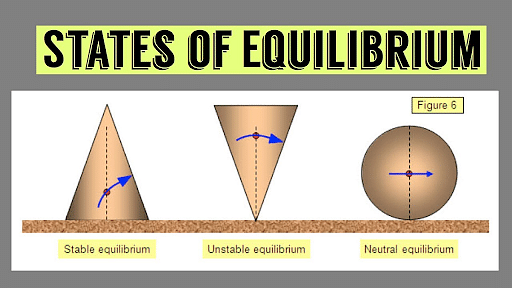
Equilibrium or balance is a fundamental concept in dealing with forces. Many forces can act on an item at the same time. A force is a vector quantity, which implies that it has a magnitude (size) and a direction. There is no net force exerted on an item if the direction and magnitude of the forces that act on it are precisely balanced, and the body is said to be in Equilibrium.
Read Also: Homogeneous Equilibria
| Table of Content |
Key Terms: Force, Concurrent forces, equilibrium, static equilibrium, dynamic equilibrium, coplanar forces
State of Equilibrium
[Click Here for Sample Questions]
Equilibrium means "no acceleration." Because a force is a "push" or "pull" applied to a body, Equilibrium requires that the sum of all forces acting on it be zero.
F = m * a, according to Newton's second law.
If a = 0, F must also be zero.
(Note: F is the TOTAL force on the body in Newton's second law.)
Read More: Balanced Force
Concurrent Forces Equilibrium
[Click Here for Sample Questions]
The first step in comprehending the Equilibrium of a concurrent force system is understanding what Equilibrium is. Equilibrium is the state of the body in which all of the forces operating on it are in balance. This cancels out, resulting in a net impact of zero.

Forces that cross at a common location are referred to as concurrent forces. We can combine them as vectors when dealing with concurrent forces to yield the net resultant. It's important to note that its acceleration is zero when a body is at Equilibrium. This is one of the equilibrium conditions for concurrent forces.
Also Check:
Various Kinds of Concurrent Forces Equilibrium
[Click Here for Sample Questions]
There are two forms of Equilibrium: Static and Dynamic.
Static Equilibrium
This is the form of Equilibrium in which the sum of all forces acting on the body is zero, i.e., the body's net acceleration is zero, and its velocity is likewise zero. It denotes that the body is in a state of rest. When a body is at rest and its net acceleration is zero, it is said to be in static Equilibrium.
Example - Assume a slab is laying on the ground and two 5 N forces are operating from opposite directions. The forces would balance one another out, leading to zero net force on the slab. The slab will be in static Equilibrium since it is at rest.

Read: Differences between acceleration and velocity
Dynamic Equilibrium
This kind of Equilibrium is when the sum of all forces acting on the body is zero, i.e., the body's net acceleration is zero, but its velocity is not zero. It indicates that the object is traveling at a steady speed. The body is considered in dynamic Equilibrium if the net force exerted on it is zero and still traveling at a constant velocity.
Example - A popular illustration of dynamic Equilibrium is a block tied to a spring under the effect of Simple Harmonic Motion (S.H.M.). The net force exerted on the block is zero at the mean position, but the block's velocity is greatest, indicating that the block is in dynamic Equilibrium at that point.
Special Contact Points
[Click Here for Sample Questions]
We must include any forces that cross the body's border (outline) while designing the Free Body Diagram. In addition, some touch places provide unique information about the force's direction and location.
- Cable Joint: The force must pass through the cable's centreline.
- The force must be perpendicular to the surface in a frictionless joint.
- Wheels and rollers: The force must be transmitted through the axle's center. Because free-running wheels have no friction, force is applied perpendicular to the surface, and all forces flow through the axle's center.
- Pulleys: The cable tension is the same on both sides of the pulley, and all forces may be directed via the axle's center.
- Friction is a force that may be applied in any direction.
- The force can be applied in either direction at a pin joint.
- Support Reactions are another name for contact points.

Read More: Oscillatory Motion and Simple Harmonic Motion
Number of Forces Acting on a Body
[Click Here for Sample Questions]
The number of forces acting upon a body result in changes in state of rest. These forces can also be called unbalanced forces.
Single force
This is unachievable to achieve balance. Unless the body is speeding, the forces should sum up to zero. For example, a falling rock.
Two Forces in Play
If just two forces act on a body, they must be collinear. A connection between two pivot pins, for example, must have the force traveling via the pins' line. (This implies that gravity isn't considered; otherwise, you'll have three forces.)

Three Forces in Play
If a body contains precisely three forces, they must all be acting simultaneously. The Three Force Principle is what it's called. Because many systems have bodies with two or three forces, this may be quite useful in addressing difficulties.
Four or More Forces
Unless the forces are specifically designed to be contemporaneous, we cannot assume they will be.
Also Check More:
Coplanar Forces in Equilibrium
[Click Here for Sample Questions]
- Forces that act on the same plane are known as coplanar forces. For Coplanar Forces to be in balance, several requirements must be met. These are some of them:
- The total force must equal zero.
- The total of the moments of forces around a point in the clockwise direction equals the sum of the moments of forces around the same point in the anticlockwise direction.
- Coplanar forces come in a variety of shapes and sizes. The forces in one plane must cross in concurrent coplanar forces of Equilibrium at one point. Graphical and algebraic approaches can be used to compute it.
- Non-concurrent and parallel coplanar forces are the other forms of coplanar forces. The vectors of non-concurrent coplanar forces do not meet at a single location and are not parallel. The forces in parallel coplanar forces are all parallel to one another.

Conditions of Static Equilibrium of Concurrent Forces
[Click Here for Sample Questions]
- In the y-direction or vertical, the total of all forces is zero. ΣFy=0 or ΣFV=0
- In the x-direction or horizontal, the total of all forces is zero. ΣFx=0 or ΣFH=0
Also Read Further:
Things to Remember
[Click Here for Sample Questions]
- When two forces are equal and oppositely directed, they are in Equilibrium.
- The vectors are not parallel to each other and do not meet at a location for non-concurrent coplanar forces.
- Three parallel coplanar forces are in balance.
- It is impossible to achieve Equilibrium when only a single force is applied to the body.
- When three or more equilibrium forces are coupled head-to-tail, they create a close polygon.
Sample Questions
Ques: What are the Conditions for Concurrent Forces Equilibrium? (2 marks)
Ans: Equilibrium is the condition of a body in which all forces are equal in size, resulting in zero. When it comes to the Equilibrium of concurrent forces, the same notion applies, with the total of all forces in the x and y directions equalling zero. Static concurrent Equilibrium is the term for this situation. The distinction with dynamic concurrent Equilibrium is that the vector is not zero.
Ques: What exactly do you mean when you say "coplanar forces"? (4 marks)
Ans: The forces on a single plane are known as coplanar forces. The numerous forms of coplanar forces are:
- All forces must meet at one point in the plane to be concurrent coplanar forces.
- Non-Concurrent Coplanar Forces: The vectors are not parallel and do not meet at a location.
- Parallel Coplanar Forces: In this case, all forces are parallel to one another.
- Forces that cross at one location are known as concurrent coplanar forces. This is a critical requirement that must be followed at all times to grasp the idea of coplanar forces fully.
Ques: What are the potential causes of inaccuracy connected with the non-concurrent force static equilibrium slab? (3 marks)
Ans: The presence of friction would constitute a systemic mistake. Even if the forces you're trying to employ don't balance, this would leave things motionless. Another aspect that contributes to solution inaccuracy is a unit error. Carefully record the numbers and readings in the correct units. Every force, mass, location, angle, and another variable in your experiment is subject to uncertainty. This mistake would be estimated using proper data analysis, which would result in a final statistical uncertainty.
Ques: What is the condition of Equilibrium of the coplanar system of non-concurrent parallel forces? (2 marks)
Ans: The following are the equilibrium conditions:
- There should be no net force.
- There should be no net torque.
Ques: What are three real-world instances of coplanar concurrent pressures in Equilibrium in the manufacturing industry? (3 marks)
Ans: The three instances are:
- The functioning of a table saw while slicing a piece of plywood against a gate at a steady speed.
- The functioning of a tower crane during the vertical lifting of cargo at constant velocity.
- A ratchet strap is used to secure cargo on a transport vehicle.
Ques: What are the conditions of Equilibrium for a particle when a system of coplanar when concurrent forces are implemented? (2 marks)
Ans: The forces are parallel and coplanar. The force polygon must then shut-in order to achieve Equilibrium. To put it another way, ∑Fx=0 And ∑Fy=0.
Ques: What are the two types of Equilibrium of concurrent forces? (3 marks)
Ans: There are two forms of Equilibrium: Static Equilibrium: This is the form of Equilibrium in which the sum of all forces acting on the body is zero, i.e., the body's net acceleration is zero, and its velocity is likewise zero, and dynamic Equilibrium is a kind of Equilibrium in which the sum of all forces acting on the body is zero, i.e., the body's net acceleration is zero, and its velocity is not zero.
Physics Related Links:



Comments