



Content Writer
System of Units is a complete set of fundamental and derived units. Measurements can not be made without comparison, to measure any physical quantity comparison with certain basics is made. This basic amount for comparison is arbitrarily chosen and accepted as a standard reference internationally.
- The standard reference chosen is called the unit of the physical quantity.
- System of Unit plays a significant role in scientific and technological advancements.
- It is composed of 7 base units, from which 22 derivative units are generated.
- Either a standard multiple or a fractional quantity can be used to express SI units.
- Prefix multipliers with powers of 10 in the range from 10-24 to 1024 are used to define these numbers.
Read More: Class 11 Fundamental Forces in Nature
| Table of Contents |
KeyTerms: Units, Standard, Physical Quantity, Velocity, SI Units, Mass, Length
What are Fundamental Units?
[Click Here for Sample Questions]
Fundamental units are the basic quantities that serve as the foundation for additional derived quantities. Since there are a very large variety of physical quantities, fundamental physical quantities limit the number for expressing all physical quantities.
- These limited numbers of units for fundamental physical quantities are known as fundamental units.
- Fundamental physical quantities are the basic quantities that requires no other physical quantities to express. Mass, length, and time are fundamental physical quantities.
- The units of the fundamental physical quantities are called fundamental units. Kilograms (kg), grams (g), centimeters (cm), meters (m), minutes (min), seconds (s), etc. are the fundamental units for the fundamental physical quantities of mass, length, and time.
Units and Measurements Video Lecture
Read More: Dimensions of Physical Quantities
What are Derived Units?
[Click Here for Previous Year Questions]
Physical quantities that can be derived from the combination of two or more fundamental physical quantities are called derived physical quantities. Velocity, density, force are some examples of the derived quantities. The units of the derived quantities are called derived units. For velocity, density, and force it is m/s, kg/m3, kg-m/s2.
Read More: Unit of Density
System of Units
[Click Here for Sample Questions]
A complete set of fundamental and derived units is called a system of units. There are different systems of units, among which MKS, CGS, and FPS were used extensively. They are as follows:
| System of Units | Physical Quantities | Unit |
|---|---|---|
| CGS System | Length | Centimetre (cm) |
| Mass | Grams (g) | |
| Time | Seconds (s) | |
| MKS System | Length | Metre (m) |
| Mass | Kilograms (kg) | |
| Time | Seconds (s) | |
| FPS System | Length | Foot (ft) |
| Mass | Pound (Lb) | |
| Time | Seconds (s) |
Read More: Class 11 Gravitation
International System of Unit (SI)
[Click Here for Previous Year Questions]
International system of units is abbreviated as SI. It was developed and recommended by the General Conference on Weights and Measures in 1971 for international usage in scientific, technical, industrial, and commercial work.
The SI system has 7 fundamental units or base units.
| Physical Quantities | Unit | Definition |
|---|---|---|
| Length | Metre (m) | The meter is the length of the path traveled by light in a vacuum during a time interval of 1/299,792,458 of a second. |
| Mass | Kilogram (kg) | The kilogram is equal to the mass of the international prototype of the kilogram (a platinum-iridium alloy cylinder) kept at the International Bureau of Weights and Measures, at Sevres, near Paris, France. |
| Time | Second (s) | The second is the duration of 9,192,631,770 periods of the radiation corresponding to the transition between the two hyperfine levels of the ground state of the cesium-133 atom. |
| Temperature | Kelvin (K) | The kelvin is the fraction 1/273.16 of the thermodynamic temperature of the triple point of water. |
| Electric Current | Ampere (A) | The ampere is that constant current which, if maintained in two straight parallel conductors of infinite length, of negligible cross-section area, placed 1 meter apart in a vacuum would produce between these conductors a force equal to 2x10⁻⁷ newton per meter of length. |
| Amount of substance | Mole (mol) | The mole is the amount of substance, which contains as many elementary entities as there are atoms in 0.012 kilograms of carbon-12. |
| Luminous Intensity | Candela (cd) | The candela is the luminous intensity, in a given direction, of a source that emits monochromatic radiation of frequency 540x1012 hertz and that has a radiant intensity in that direction of 1/683watt per steradian. |
Besides the 7 base units, there are 2 supplementary units.
| Supplementary Quantity | Unit |
|---|---|
| Plane angle | Radian (rad) |
| Solid Angle | Steradian (sr) |
The following picture is a description of (a) plane and (b) solid angle.

Description of (a) plane angle d\(\theta\) and (b) solid angle d\(\Omega\)
- Radian- One radian is an angle subtended (d\(\theta\)) at the center of the circle by an arc of length (ds) equal to the radius (r) of the circle.
- Steradian- One steradian is the solid angle subtended (d\(\Omega\)) at the center of the sphere by its surface whose area (dA) is equal to the square of the radius (r2) of the sphere.
Advantages of SI Units
[Click Here for Sample Questions]
The advantages of SI Units are as follows:
- It is accepted at the international level and brings uniformity.
- One unit is used for one physical quantity thus it is a rational system of units.
- Interconversion of units is easy as physical quantities are related to each other through elementary relationships.
- With a metric system, it is easy to express a very small or very large quantity as the power of 10. An example size of the proton is ~ 10-15 m.
Read More:
Guidelines for Writing SI Units and Symbols
[Click Here for Previous Paper Questions]
Derived units are obtained by dividing, multiplying, or powering the base units.
For example, the derived unit for acceleration is obtained in the following steps.
| Formula of acceleration= Velocity/time --(1) |
The velocity is not the fundamental quantity so it can be further expressed in fundamental quantities.
| Velocity= Distance/Time --(2) |
Now in this equation, distance and time, both are fundamental quantities
From equations (1) and (2) acceleration can also be written in the form of fundamental quantities.
| Acceleration= (Distance/time)\(\div\)time = Distance/time2 |
Now, write the fundamental units of fundamental quantities distance and time. For distance, it is meter (m) and for the time it is seconds (s)
So the derived unit for acceleration will be m/s2.
Read More: Sphere Formula
Prefixes Used in SI System
Prefixes are used to form decimal multiples and submultiples of units. Prefixes are added before a unit, like megameter, microsecond, etc.
Here are the prefixes used in the SI system.
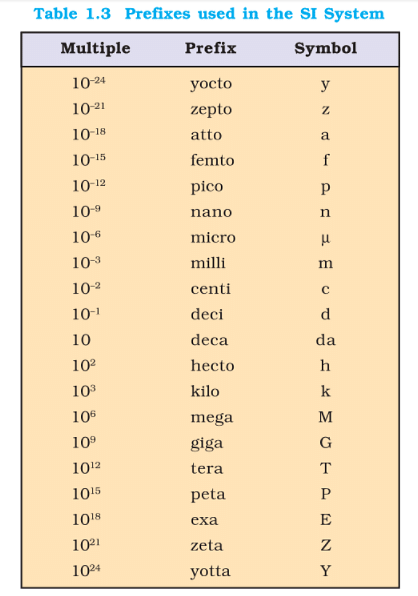
Meaning of the Prefixes Used in SI System
Prefixes are added before the units like Megameter, centimeter, microseconds, etc.
1 Megameter (Mm) = 1 x 10⁶ m = 10,00,000 m
So to avoid too long or short magnitudes, prefixes are used.
General Rules for the Notation of SI Units and Symbols
Here are some general rules for the notation of SI units and symbols:
- All units and symbols should be in small letters, meter (m), not M, centimeter (cm) not (CM), etc.
- Units named after scientists' names should be written in small letters only, not as the first initial in the capital. However, the symbol of the unit is written in capital letters. For example, the unit of force should be written as Newton or N, not Newton or n.
- Full stop should be omitted after the symbol.
- Plural form of unit or symbol should not be used.
Read More:
| Related Topics | ||
|---|---|---|
| Unit of Force | Micrometer | Exponent Powers |
| Screw Gauge | Unit of Time | Number System |
Things to Remember
- System of Units is a complete set of fundamental and derived units.
- Fundamental physical quantities are the basic quantities that do not need other physical quantities to express. Mass, length, and time are fundamental physical quantities.
- Physical quantities that can be derived from the combination of two or more fundamental physical quantities are called derived physical quantities. Velocity, density, and force are some examples of the derived quantities.
- International system of units abbreviated as SI, is internationally accepted for measurement.
- Certain general rules or guidelines must be followed for the notation of units and their symbols.
- Derived unit for acceleration will be m/s2.
- With a metric system, it is easy to express a very small or very large quantity as the power of 10.
Get Live Updates on Board Exams 2023: https://t.me/class_10_12_board_updates
Previous Years’ Questions
- A screw gauge has least count of 0.01 mm and… [NEET – 2020]
- Dimensions of stress are… [NEET – 2020]
- Lumen is the unit of… [UPSEE – 2019]
- A quantity z, to be estimated has a dependency… [TS EAMCET – 2019]
- A student measured the diameter of a small… [NEET – 2018]
- The nearest star to our solar system is… [AMUEEE – 2018]
- Planck’s constant (ℎ), speed of light in vacuum… [NEET – 2016]
- What is the dimensional formula for universal… [COMEDK UGET – 2014]
- If x=at+bt2 where x is measured… [COMEDK UGET – 2012]
- A body weighs 22.42 g and has a measured… [WBJEE – 2010]
Sample Questions
Ques. Who introduced the international system of units? (1 Mark)
Ans. The international system of units was developed and recommended by the General Conference on Weights and Measures in 1971 for international usage in scientific, technical, industrial, and commercial work.
Ques. Name the two supplementary quantities and their units. (1 Mark)
Ans. Plane angle and solid angle are the two supplementary units. Plane angle has the unit of a radian (rad) and solid angle is expressed with the unit steradian (sr).
Ques. Convert 756 milliseconds into seconds. (2 Marks)
Ans. As 1 millisecond (ms) = 1 x 10⁻³ seconds.
756 milliseconds (ms) = 756 x 10-3 seconds (s)
=0.756 (s)
Ques. Find the derived unit for velocity. (2 Marks)
Ans. As velocity = Displacement/Time
Displacement (length) and time are fundamental quantities. Displacement has a SI unit of length meter (m) and Time has a SI unit of second (s).
Thus Unit of velocity= meter per second= m/s.
Ques. What are the advantages of the SI unit system? ( Marks)
Ans. The advantages of the SI unit system are as follows:
- It is accepted at the international level and brings uniformity.
- One unit is used for one physical quantity thus it is a rational system of units.
- Interconversion of units is easy as physical quantities are related to each other through elementary relationships.
- With a metric system, it is easy to express a very small or very large quantity as the power of 10. An example size of the proton is ~ 10-15 m.
Ques. What is the common System of Units used in measurements? (2 Marks)
Ans. The following are some examples of commonly used measurement systems:
- CGS System
- MKS System
- SI System
Ques. Name the fundamental physical quantities. (1 Mark)
Ans. There are seven basic physical quantities: length, mass, time, electric current, temperature, amount of substance, and light intensity.
Ques. Define Radian. (1 Mark)
Ans. One radian is an angle subtended (d\(\theta\)) at the center of the circle by an arc of length (ds) equal to the radius (r) of the circle.
Ques. What is a measurement? (3 Marks)
Ans. A component's size is determined through measurement using common units of measurement.
- For instance, measures of length, diameter, height, thickness, etc., including both internal and external measurements, are taken in linear measurement.
- When the magnitude (quantity, length, time, etc.) of a number to be measured is taken, then the same number is expressed in a pre-determined quantity.
- This fixed predetermined quantity is called the unit.
Ques. Define the Unit and mention the properties. (5 Marks)
Ans. The unit is defined as the measurement’s standard of reference. The properties of Units are as follows:
- The unit needs to be an appropriate size.
- The unit must have clear boundaries.
- The product should be easily reproducible everywhere.
- The unit must remain static over time.
- Physical parameters like pressure, temperature, etc. should not cause the unit to alter.
- The unit must be simple to compare experimentally to physical quantities of a similar nature.
Check-Out:



Comments