



Education Journalist | Study Abroad Lead
Exophthalmic Goitre, also known as Graves' disease, Base Dow’s disease, or Toxic Diffuse Goitre, is a disease caused by the over-activity of the thyroid gland resulting in an enlarged thyroid. Hormones released by the thyroid gland are responsible for regulating the body's various functions, such as metabolism, heartbeat, and many more. This disease affects the physiology of the body. If left untreated, the disease can lead to severe consequences.
| Table of Content |
Read Also: Pineal Gland Important Notes
What Is Exophthalmic Goitre?
Exophthalmic Goitre is an endocrine disorder, i.e., disorders caused by the malfunctioning of endocrine glands of the body. The disease is caused by increased secretion of thyroid hormones from the thyroid, leading to the thyroid's enlargement.

Causes of Exophthalmic Goitre
The primary cause of exophthalmic goitre is hyperthyroidism. Hyperthyroidism is a condition in which the thyroid gland results in an over-secretion of the thyroid hormones such as thyroxine. Exophthalmic goitre is an autoimmune disease in which the immune system malfunctions so that it attacks the cells of our own body. It stimulates the thyroid gland to produce and over-secrete thyroid hormones. Over secretion causes the thyroid region to enlarge. The exact causes of the immune system functioning in this way are still unknown. However, other probable causes of the disease are:
- Genetic causes - The disease can be inherited from a family member to the person. The pattern of inheritance from an affected member to a healthy person is unknown.
- Environmental causes - Smoking increases the chances of the development of this disease.
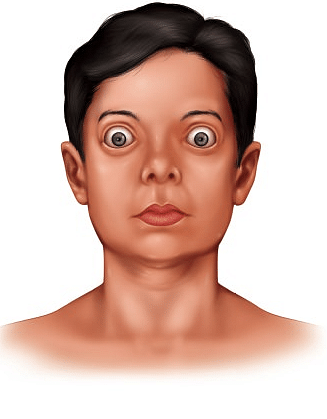
Symptoms of Exophthalmic Goitre
Exophthalmic goitre has several symptoms, which can be categorized into various aspects. The primary symptom of this disease is the protrusion of the eyes, which may cause puffiness around the eyes. This protrusion may result in double vision or partial blindness.
Symptoms that affect the whole body include losing weight and intolerance to heat, which may lead to excessive sweating. The affected person may also experience hand tremors or shaking of hands. Hair loss is another symptom of exophthalmic goitre.
The disease can also affect the mood by increasing anxiety as well as nervousness.
The body's physiology is also affected as this disease results in irregular heartbeat and increased basal metabolic rates. Women may experience irregularity in their menstrual cycles.
People Vulnerable to the disease
People vulnerable to this disease are those who already have any other autoimmune disease. Women are more prone to the disease as compared to men. The disease mainly affects young children. However, people of all ages can be affected.
Precautions must be followed by people who are vulnerable to the disease. Such people should prohibit excessive smoking.
Read Also: Difference Between Diabetes Mellitus and Diabetes Insipidus
Treatment of Exophthalmic Goitre
The treatment of exophthalmic goitre focuses on inhibiting the over-secretion of thyroid hormones from the thyroid gland. It also focuses on reducing the symptoms of the disease. Various and effective treatment methods for exophthalmic goitre are:
- Anti-Thyroid Medications
Anti-Thyroid Medicines inhibit the oxidation of iodine from preventing the thyroid gland from over-secretion of thyroid hormones. These medicines take 4-6 weeks to reduce the symptoms. Common drugs prescribed to prevent the symptoms are propylthiouracil, methimazole, and carbimazole.
- Radioactive iodine therapy
Radioactive iodine therapy is a highly effective method because it is non-invasive. In this method, the patient is asked to take radioactive iodine orally. Iodine helps in the production of thyroid hormones. Radioactive iodine reduces the size of the thyroid gland by slowly destroying the overactive thyroid cells. This results in the production of fewer thyroid hormones. The risks accompanied by this method are increased chances of thyroid cancer.
- Beta-Blockers
Beta-blockers act on our body's adrenaline levels and help reduce symptoms such as sweating, shaking, increased heart rate, and anxiety. They should not be used alongside other treatment methods as they can cause side effects because of the drugs interacting.
- Surgery
Surgery, being less common, is done when other treatments are unsuccessful in curing this disease. Surgery is the fastest and permanent way to regain normal thyroid hormone levels. Difficulty in speaking and neck pain can be the temporary after-effects of the surgery. Surgery can be responsible for the removal of the whole or a part of the thyroid gland. Partial removal of the thyroid gland does not hamper the functioning of the other gland parts that are not removed in the surgery.
Diagnosis of Exophthalmic Goitre
Exophthalmic Goitre can be difficult to diagnose. But here are a few tests that can identify the thyroid hormone levels secreted by the thyroid gland.
- Radioactive Iodine Uptake is a test taken to identify Graves' disease. In this test, less radioactive iodine in the form of liquid or capsule is asked to consume by the patient. The iodine collects the thyroid once eaten up.After that, multiple scans are carried out by the doctor with the help of a radioactive tracer. The first scan is performed after 4-6 hours of iodine consumption, and the second scan is performed after 24 hours.
- Thyroid-Stimulation Hormone (TSH) activates the thyroid gland to release Triiodothyronine (T3) and Thyroxine (T4). Blood samples of the patient are taken to determine the levels of these hormones. Increased levels of T3 and T4 and low levels of TSH are indicative symptoms of Graves' disease.
Diet
Diet plays an essential role in having control over Graves' disease. Some foods may worsen the immune system of a person having Graves' disease if consumed. Consumption of foods that are you are allergic to should be avoided to reduce the symptoms.
Foods to avoid
A doctor may be of great help for you to build up the appropriate diet chart. Tracking and managing the daily diet routine can also help better understand the quality and quantity of the food. Food that includes high levels of iodine should be avoided. Also, gluten, meat, and other animal products should not be consumed.
Foods to eat
It is advisable to consume food that is high in Vitamin D, magnesium, and calcium-rich foods like broccoli, almonds, tuna, salmon, mushrooms, avocados, dark chocolate, and many more.
Things To Remember
- Exophthalmic Goitre is a disease caused by the over-activity of the thyroid gland resulting in an enlarged thyroid. Fast heartbeat, rapid breathing, protrusion of the eyes, and neck swelling are all indications of excessive thyroxin secretion.
- It is the most common disease which can affect 1 in 200 people. Primarily, it affects women who are below 40 as compared to men. Puffiness around the eyes can be caused due to protrusion of eyes, resulting in double vision or partial blindness. The disease can also affect the mood by increasing anxiety as well as nervousness.
- People who are at risk of this disease are those who already have any other autoimmune disease. Exophthalmic goitre focuses on hampering the over-secretion of thyroid hormones from the thyroid gland. It also focuses on reducing the symptoms of the disease.
- Though this disease is difficult to diagnose, the two major tests that can be undertaken to identify the levels of thyroid hormone secreted by the thyroid gland are Radioactive Iodine Uptake and blood samples of the patient are taken to determine the levels of hormones, i.e., Triiodothyronine (T3) and Thyroxine (T4).
- Diet has always played a crucial role in every disease. Similarly, people with this disease have to avoid food that includes a high level of iodine, gluten, meat, and other animal products. On the other hand, food items that should be consumed must be rich in Vitamin D, magnesium, and calcium-rich foods like broccoli, almonds, tuna, salmon, mushrooms, avocados, and dark chocolate.
Sample Questions
Ques. What hormones are secreted in exophthalmic goitre?
Ans: The hormones secreted by the thyroid gland in excessive amounts in exophthalmic goitre are thyroid hormones such as thyroxine and triiodothyronine.
Ques. Why is exophthalmic goitre called an autoimmune disease?
Ans: Autoimmune diseases are diseases in which the immune system malfunctions so that it attacks the cells of our own body. Exophthalmic goitre is an autoimmune disease because the immune system stimulates the thyroid gland to produce and over-secrete thyroid hormones such as thyroxine.
Ques. Explain hyperthyroidism. Also, explain the two causes of exophthalmic goitre.
Ans: Hyperthyroidism is a condition in which the thyroid gland results in an over-secretion of the thyroid hormones such as thyroxine. The two other causes of exophthalmic goitre are:-
- Genetic causes-The disease can be inherited from a family member to the person. The pattern of inheritance from an affected member to a healthy person is unknown.
- Environmental causes- Smoking increases the chances of the development of this disease.
Ques. How can exophthalmic goitre lead to double vision or partial blindness?
Ans: The primary symptom of exophthalmic goitre includes protrusion of eyes in which the person's eyes bulge out and become more significant than usual. In this condition, the light rays do not fall on the retina of the eye. The image formed is not clear, which leads to double vision or partial blindness.
Ques. Describe any 2 ways to diagnose exophthalmic goitre.
Ans: The diagnosis of exophthalmic goitre is as follows:
- Radioactive Iodine Uptake is a test taken to identify Graves' disease. In this test, less radioactive iodine in the form of liquid or capsule is asked to consume by the patient. The iodine collects the thyroid once eaten up. After that, multiple scans are carried out by the doctor with the help of a radioactive tracer. The first scan is performed after 4-6 hours of iodine consumption, and the second scan is performed after 24 hours.
- Thyroid-Stimulation Hormone (TSH) activates the thyroid gland to release Triiodothyronine (T3) and Thyroxine (T4). Blood samples of the patient are taken to determine the levels of these hormones. Increased levels of T3 and T4 and low levels of TSH are indicative symptoms of Graves' disease.
Ques. Why can radioactive iodine methods for treating exophthalmic goitre be dangerous?
Ans: Radioactive iodine directly attacks the activity and size of the thyroid gland, due to which it causes increased chances of thyroid cancer.
Ques. What are the responsibilities of the thyroid gland?
Ans: The responsibilities of the thyroid gland are:
Thyroid hormones play an essential role in the regulation of the basal metabolic rate. These hormones also support the process of red blood cell formation.
Thyroid hormones control the metabolism of carbohydrates, proteins, and fats. Thyroid hormones also influence the maintenance of water and electrolyte balance. The thyroid gland also secretes a protein hormone called thyrocalcitonin (TCT) which regulates blood calcium levels.
Ques. How can diet influence the risk of this disease?
Ans: Too much iodine in your diet can result in a significant symptom of Exophthalmic goitre. It stimulates the thyroid gland to produce and over-secrete thyroid hormones, which can lead to exophthalmic goitre.



Comments