



Content Curator
The factors of 36 are the numbers that divide 36 completely with zero remainders. 36 has a total of 9 factors of which two are prime numbers. 36 itself is the largest factor and 1 is its smallest factor. The factors of 36 are both, positive and negative but it does not have any decimal or fraction factor.
Also Read: Real Numbers
| Table of Content |
Key Terms: Factors, Prime Numbers, Prime Factorization, Remainders, Natural Numbers, Decimals, Fractions
What are Factors of 36?
[Click Here for Sample Questions]
When a number divides another second number with zero remainders, it is said to be the factor of the latter’s one. Thus:
- Factors of 36 are the numbers that divide it completely, leaving no remainder.
- Two numbers when multiplied, if give 36 then they’re its factors.
The factors of 36 have 9 positive factors and 9 negative factors.
- Positive Factors: 1, 2, 3, 4, 6, 9, 12, 18, 36
- Negative Factors: -1, -2, -3, -4, -6, -9, -12, -18, -36

Factors of 36
How to find Factors of 36
[Click Here for Sample Questions]
The most widely used method to find factors of a number is the multiplication method. To find factors of 36 using multiplication, follow these steps.
- Divide 36 by natural numbers starting from 1 till 9.
- Make a list of numbers that completely divide 36 along with their pairs. This way we get the other factor as 36 as well.
- Through the list we can get all the factors starting from 1 up to 36.
Also Read:
| Related Topics | ||
|---|---|---|
| Multiplication and Division | Natural numbers and Whole numbers | Integers |
| Quotient rule | Remainder Theorem | Closure Property |
Prime Factorization of 36
[Click Here for Sample Questions]
Prime factorizations of a number is its representation in the form of products of its prime factors. Follow the given steps to find the prime factorization of 36.
- Divide 36 with its smallest prime factor. Here, the smallest prime factor of 36 is 2. So, 36 ÷ 2 = 18
- Repeated division of obtained quotient by 2 until we get a number that is not divisible by 2. Dividing 18 again by 2, 18 ÷ 2 = 9
- 9 is not completely divisible by 2, hence, we proceed with the next prime factor of 36, which is 3. Thus, 9 ÷ 3 = 3
- Dividing the quotient by 3 again, 3 ÷ 3 = 1
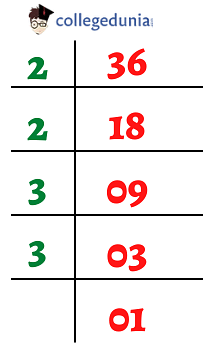
Prime Factorisation of 36
As we got the quotient as 1, there is no need for further division. The prime factorization of 36 is expressed as:
2 × 2 × 3 × 3 = 22 × 32
where 2 and 3 are prime numbers and the prime factors of 36.
Also Read: HCF and LCM
Pair factors of 36
[Click Here for Sample Questions]
Pair factors of 36 are the pairs of numbers that when multiplied by each other give 36 as the product. As there are both positive and negative factors of 36, there are also both positive and negative pair factors. Both the pair factors individually are discussed below.
Positive Pair Factor
The table below shows the positive pair factors of 36.
| Positive Factors of 36 | Positive Pair Factors of 36 |
|---|---|
| 1 × 36 | (1, 36) |
| 2 × 18 | (2, 18) |
| 3 × 12 | (3, 12) |
| 4 × 9 | (4, 9) |
| 6 × 6 | (6, 6) |
Also Read: Decimal Expansion
Negative Pair Factors
The table below shows the negative pair factors of 36.
| Negative Factors of 36 | Negative Pair Factors of 36 |
|---|---|
| -1 × -36 | (-1, -36) |
| -2 × -18 | (-2, -18) |
| -3 × -12 | (-3, -12) |
| -4 × -9 | (-4, -9) |
| -6 × -6 | (-6, -6) |
Also Read: Algebra
Things to Remember
- Factors are defined as numbers that divide another second number with zero remainders.
- Factors of 36 are the numbers that leave no remainder when dividing 36.
- When a number is represented by its prime factors, it is known as prime factorization.
- 36 has both positive and negative factors but none in decimals or fractions.
Sample Questions
Ques: Find the common factors of 36 and 38. [2 marks]
Ans: The factors of 36 are 1, 2, 3, 4, 6, 9,12,18, 36
Th factors of 38 are 1, 2, 19, and 38
Thus the common factors of 36 and 38 are 1 and 2.
Ques: Find the greatest common factor of 45 and 36. [2 marks]
Ans: The factors of 36 are 1, 2, 3, 4, 6, 9,12,18, 36
The factors of 45 are 1, 3, 5, 9, 15, and 45
Therefore, the greatest common factor of 36 and 45 is 9.
Ques: What is prime factorization? [1 mark]
Ans: Prime factorization is representing a number as a product of its prime factors.
Ques: Find common factors of 36 and 72. [2 marks]
Ans: The factors of 36 are 1, 2, 3, 4, 6, 9, 12, 18, 36
The factors of 72 are 1, 2, 3, 4, 6, 8, 9, 12, 18, 24, 36, and 72
Thus, the common factors of 36 and 72 are 1, 2, 3, 6, 8, 9, 12 and 18.
Ques: What are the positive pair factors of 36? [2 marks]
Ans: The positive pair factors of 36 are (1, 36), (2, 18), (3, 12), (4, 9) and (6, 6).
Ques: What are the negative pair factors? [2 marks]
Ans: The negative pair factors of 36 are (-1, -36), (-2, -18), (-3, -12), (-4, -9) and (-6, -6).
Also Read:



Comments