



Education Journalist | Study Abroad Lead
Fish Production or Fish Farming is a form of Aquaculture which involves the process of cultivating and raising a variety of fish species. Fish is highly rich in proteins, vitamins such as vitamin D and B2, calcium and other minerals. In earlier days fish production consisted of only capturing fish from freshwater. Nowadays Pisciculture or fish farming is a more popular and widely used method of fish production.
| Table of Contents |
Key Terms: Fish Production, Fish Farming, Aquaculture, Pisciculture, Fish Capturing, Fish Culture
Fish Production/ Fish Farming
[Click Here for Sample Questions]
Pisciculture is a method of fish farming, breeding, and transporting them for commercial benefits. In earlier days, fish capturing was the most used method and the fish were captured majorly for industrial purposes only. China alone contributes more than 60% of the world’s fish production. Global fish requirements are increasing day by day which led to overfishing which led to decrease in fish species in some regions. Therefore, nowadays fish are farmed after establishing fish colonies with controlled breeding, safe from predators and are well fed for sustenance.
Types of Fish Farming
[Click Here for Sample Questions]
There are mainly three types of fish farming:
- Monoculture
- Polyculture
- Monosex culture
Monoculture: Monoculture is the practice of cultivating one fish species at a place. It requires more area and provides a better quality product. This farming method is normally done by small industries and the fish are popular among consumers. Shrimps are an example of monoculture production.
Polyculture: Polyculture, also called mixed farming, is the process of farming multiple fish at the same place at the same time. Polyculture in a way creates an artificial ecosystem for fish by adding diversity to it. Different fish with different feeding habits are kept in the same pond so that all can survive and will not fight for food from a common source. It also requires good management as different species have different growth rates, harvest requirements, environment, etc. Large industries and big farmers rely on this method of pisciculture for industrial purposes. This method provides high production in small areas but requires good management.
Monosex Culture: In the Monoculture farming method, either male or female fish species are cultivated. Only one of the male and female kind are cultivated, so it is named as Monosex culture.

Types of Fish Culture
Read More: Cattle Farming
Fish Farming Methods
[Click Here for Sample Questions]
There are various types of fish farming methods. Some of them are:
- Cage Method
- Pond Method
- Integrated Recycling System
- Classic Fry Farming
Cage Method: In this method, a net or metal cage is established in an existing water body or pond which allows water to pass but not the fish. There are four types of fish rearing cages, namely, fixed cages, floating cages, submerged cages, and submersible cages. This method is economically sustainable because it doesn’t require separate land with a regular flow of water. It can be established in existing ponds and water bodies. Many locations in India’s coastal region are suitable for fish production but are not utilized. These can be utilized by the cage method. Since investment is low, fishermen can adopt this method easily.
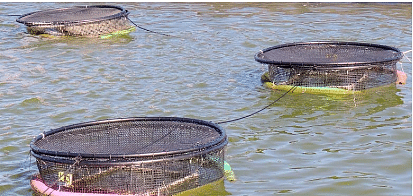
Cage Culture
Pond Method: This method requires a pond or tank to set up. The location and environment of the pond plays a very important role in this method. There are two types of pond methods - watershed and levee systems. In the regions where rainfall is adequate, the watershed system should be adopted and in regions where groundwater is the main source of water, the levee system should be adopted. The major things considered in this process are soil type, characteristics, topography, and water supplies.

Pond Method
Integrated Recycling System: This system of farming is designed such that there is no waste. This system uses large plastic tanks inside a greenhouse. It also contains hydroponic beds that are positioned near them. It reduces waste because the water after usage is slowly transferred to the hydroponic beds and provides nutrients to the plants in those beds. The reason to keep this in the greenhouse is that it adjusts to almost all climates.

Integrated Recycling System
Classic Fry Farming: In Classic Fry Farming in, the fish are reared from eggs to fingerlings after which they are released in stream water.

Classic Fry Farming
Read More: Strategies for Enhancement in Food Production
Fish Production Methods
[Click Here for Sample Questions]
The most common methods of Fish Production are:
- Capture Fishery
- Culture Fishery
Capture Fishery:
Capture fishery is a method where naturally occurring fish are produced. It is also known as wild fishery.

Capture Fishery
Culture Fishery:
It is a controlled process of fish production. Selected fish are kept in confined areas with utmost care to get the utmost yield. Culture Fishery is further of two types:
- Inland Fishery: In Inland Fishery, fishing is done in reservoirs, rivers, ponds, etc. It also uses pisciculture methods but the production level is low. Some species of fish that are produced in this way are rohu, grass carp, common carp, etc.

Inland Fishery
- Marine Fishery: People use fishing nets around coasts to harvest fish since we have huge land around seas and oceans. Some common examples of fish produced through marine fishery are hilsa, tuna, prawns, etc.

Marine Fishery
Advantages of Fish Farming
[Click Here for Sample Questions]
Here are some of the benefits of fish farming:
- Fish produced through this method are a very cheap source of vitamins, proteins, and minerals.
- Fish growth can be controlled, the farmer can select the species of fish he/she wants to cultivate.
- Effective use of land, unused land can be used for fish farming at low cost provided that is suitably prepared.
- Demand for fish is increasing day by day, farming fish is going to be profitable as it has low setup cost and good returns.
- Fish farming doesn’t require a lot of resources, only a small tank or pond will do.
- Fish farming also has a low risk because they are under confinement. An outsider cannot get access to fish easily.
Things to Remember
- Fish Production is the process of cultivating and raising a variety of fish species.
- Pisciculture comprises fish production, breeding, and transportation.
- In the cage method of fish farming, cages are made alongside a water body.
- The cage method is easy to adapt and can be useful in using unutilized land.
- The pond method requires a pond or a concrete tank.
- An integrated recycling system is a modern system that produces almost no waste.
- Fish Farming can also be categorised into Extensive Fish Farming, Semi-intensive Fish Farming, Intensive Fish Farming.
Sample Questions
Ques. What is Fish Production? Explain Pisciculture. (2 marks)
Ans. Fish production is the process of raising and breeding fish for industry or consumer purposes. Fish are highly rich in vitamins and minerals and are cheap also. Earlier Fish production was only capturing fish in freshwater. Nowadays Pisciculture is adopted by various industries. Pisciculture is a method of fish farming, consisting of raising, breeding, and transporting fish.
Ques. Differentiate between monoculture and polyculture. (3 marks)
Ans. Tabulated below is the major difference between monoculture and polyculture:
| Monoculture | Polyculture |
|---|---|
| In this method, one kind of fish is raised | In this method, multiple species of fish are raised at one place. |
| There is no fight for food because of one species. | Fish species of different food habits are raised to prevent the fight for food resources. |
| This is popular with consumers. | This is used for industrial purposes. |
Ques. Explain Extensive Fish Farming, Semi-intensive Fish Farming, Intensive Fish Farming. (3 marks)
Ans. Extensive Fish Farming, Semi-intensive Fish Farming, Intensive Fish Farming are the three methods of Fish Farming. Here are the details:
- Extensive Fish Farming: This method involves production of fish with low economic and labour inputs. Fertilizers are added to increase fertility and production of fish.
- Semi-intensive Fish Farming: This method involves production of fish with moderate economic and labour inputs. Supplementary feeding or or addition of fertilizers plays a vital role in this type of farming. Production of fish is higher through this method.
- Intensive Fish Farming: This method involves production of fish by feeding them supplementary food. A large number of fish are stocked together.
Ques. What is Inland Fishery? (3 marks)
Ans. Inland Fishery involves capturing fish from freshwater bodies, such as lakes, ponds, rivers, and tanks. Reservoirs where freshwater bodies and seawater bodies meet also contribute to inland fisheries. The fish production yield through this method is not very high. Around 5-6 species of fish are reared in the same water body. Selection of fish species is such that they have different food habits to avoid competition for food. Common varieties reared are Rohu, Catla, Grass Carp, Common Carp, etc are the most common available varieties obtained from inland fishery practice.
Ques. What is Marine Fishery? (3 marks)
Ans. Marine Fishery involves capturing of marine fishes, i.e, fishes of sea and ocean using nets. Marine Fishery is further divided into coastal fisheries which includes fish found near the shore and off-shore and deep-sea fisheries which includes fish found deeper in the sea. Sardines, mackerel, hilsa, tuna, Pomfret, mussels, prawns, oysters, etc are some of the common examples of fish variety obtained through marine fishery practice. It also uses echo-sounders and satellites to detect the location of large fish to increase the yield.
Ques. What are the effects of Fish Farming on the environment? (3 marks)
Ans. Fish Farming has a negative impact on marine environment as it leads to water's eutrophication, water quality, alteration or destruction of natural habitats, introduction and transmission of aquatic animal diseases. Fish-farming practices which lead to marine waters’ eutrophication, faeces and uneaten food pellets from fish farms causes a significant alteration in the quality of organic matter in the sediment. This leads to change in consumption of oxygen which probably leads to local eutrophication.
Read More:



Comments