



Content Curator
Freefall is a common type of motion that everyone can see in their everyday lives.When an object is at rest, it has energy stored in it; when the thing begins to move, it is said to be in motion. We may see the motion of something we accidently drop. It will have a modest speed at the start, increase speed until the end, and then reach its maximum speed before colliding. There are numerous elements that influence the speed of an object in free fall.
Also read: Equations of Motion
| Table of Content |
Key Terms: Free fall, motion, speed, gravity, velocity, height, time, acceleration
Free Fall Concept
[Click Here for Sample Questions]
A free-falling object is one that is falling only due to impact of gravity. When a fruit ripens, for example, the earth's gravitational attraction pulls it away from the tree. The fruit that has been removed from the tree then falls to the ground in a free fall. "In a state of free fall" refers to any item that is moving and being affected solely by gravity. A downward acceleration of 9.8 ms-2 is experienced by such an object.
Note that If the item is solely influenced by gravity, its acceleration value will always be 9.8 ms-2, whether it is falling or climbing towards its peak. So, in free fall, 'a' always equals 'g,' according to the free-fall acceleration formula. Consider an object body falling freely from a height ‘h’ with a final velocity ‘v’ for ‘t’ seconds due to gravity ‘g’. It will move according to the following equations:
Motion of Object under free fall
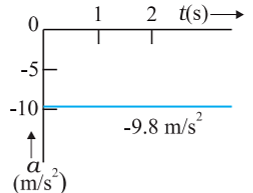
Variation of acceleration with time

Variation of velocity with time

Variation of distance with time
Free Fall Formula
[Click Here for Sample Questions]
Free fall formula is v2= 2gh. v=gt. Free Fall Equations of Motion are specified below:
-
First Law of Motion
Because the object's starting velocity in free fall is 0 m/sec and the acceleration acted upon is gravity's acceleration (g= 9.8 m/sec2), The equation will be
v=u+ at
u=0m/sec, a= g= 9.8 m/sec2
v= gt
-
The Second Law of Motion
S = ut+ 1/2(at2)
S = H, u=0m/sec, a= g= 9.8 m/sec2
H = 1/2(gt2)
Also read: Newton’s second law of motion
-
Motion's third equation
v2 = u2+ 2aS
S= H, u=0m/sec, a= g= 9.8m/sec2
v2 = 2gH, the third equation of motion in free fall.
Also read: Newton’s third law of motion
Where,
h height travelled
v final velocity
g acceleration due to gravity
t time taken
Things to Remember
[Click Here for Sample Questions]
- A state of free fall is defined as an object that is only affected by the force of gravity.
- Air resistance doesn't really exist for free-falling objects.
- On Earth, all free-falling objects accelerate at a velocity of 9.8 m/s/s.
- Since objects are pulled towards the centre of the earth,the acceleration of free-falling objects is called the acceleration due to gravity,
- In free fall, a body travels an orbit in which the total of gravitational and inertial forces is zero.
Sample Questions
Ques. Calculate the height of a body with a mass of 2 kg that falls to the earth after 5 seconds. [3 marks]
Ans. The following parameters are provided:
t = 5 seconds
We need to figure out how tall we are. As a result, we can use the first equation as shown above.
e.g., h=12gt2
By substituting the values, we get
h= 12gt2
h= 12 x 9.8 x 52
h= 4.9 x 25.
h = 122.5 m
Ques.Cotton falls after 3 seconds and iron after 5 seconds. Which is moving at a faster rate? [2 marks]
Ans. In free fall, velocity is independent of mass.
V (iron velocity) = gt = 9.8 m/s2 x 5s = 49 m/s
V (Cotton Velocity) = gt = 9.8 m/s2 x 3s = 29.4 m/s
Hence, Iron has a higher velocity than cotton.
Ques. You're on the edge of a precipice when you drop a ball. The time it takes to hit the ground is 10 seconds.[4 marks]
Ans. 1) How high do you stand?
You already know that gravity is 9.8 m/s2 and the time is 10 seconds.
h = 1/2 gt2
h = 1/2 (9.8 m/s2) X (10 sec)2
h = 490 m
2) What was the ball's velocity?
You already know that gravity is 9.8 m/s2 and time is 10 seconds.
v = gt
v = 9.8 m/s2 x 10 sec
v = 98 m/s
Ques. When a ball is dropped from a specific height and takes 10 seconds to reach the ground, what is the final velocity of the ball? There is no consideration for air resistance. [take g=10 m/sec2] [2 marks]
Ans.Using the first equation of motion in free fall
u= 0m/sec, S=H, a= g= 10 m/sec2, (given)
v= u+ at
v= gt
v= 10 x 10
v= 100m/sec
Ques. Rohan threw his ball from a height of 5 meters and then dashed downstairs to see if he could grab it; it took him one minute to get to the ground. Will he be able to catch the ball? Note that air friction is not taken into account. [3 marks]
Ans. Using the second equation of motion in free fall,
S= ut+ 1/2(at2)
u=0 m/sec, a= g= 9.8 m/sec2, S=H
H= 1/2(gt2)
5= 1/2(9.8 t2)
t2= 10/9.8
t= 1.01 second,
As can be seen, Rohan takes an entire minute to reach the ground, whilst the ball takes only 1.01 seconds.Hence, he will be unable to catch the ball.
Ques. What will be the velocity of an object on the 10th second if it is in free fall?
Ans. Under free fall, the first equation of motion is applied. [2 marks]
v= gt
v= 9.8 x 10
v = 98 m/s
As a result, the object's velocity on the 10th second will be 98m/sec.
Ques. Find the height at which a toy is dropped if it is in free fall and the toy's ultimate velocity is 20 meters per second. [3 marks]
Ans. Using the third equation of motion.
v2= u2+ 2aS
Under free fall,
u= 0m/sec, a= g= 9.8m/sec2, S=H
v2= 2gH
202 = 2 x 9.8 x H
400 = 19.6 x H
H = 20.40 meters
Ques. Assume that a free-fall attraction at an amusement park begins at rest and then drops. After 2.3s, what is the speed of the ride? During the 2.3-s time span, how far do participants on the ride fall? [4 marks]
Ans. Let the positive direction be upward.
Vf = Vi + at
= (0 m/s)+(-9.8 m/s2)(2.3 s)
=-23 m/s
=23 m/s downwards
Where xi = 0 m and vi = 0 m/s,
xf =1/2 at2 = 1/2(-9.8 m/s2)(2.3 s2)
= -26 m
During the 2.3-s time span, the people fell 26 meters.
Ques.Why do we sometimes feel weightless? Is it determined by the center of gravity? [3 marks]
Ans. When there is no force to support your body, you will experience weightlessness. The support you feel from the floor, the seat, and other surfaces gives you a sense of weight. Weightlessness occurs if your body loses contact with these supports or is in free fall. The center of gravity is the location at which the body's weight is thought to act. The sensation of being weightless has nothing to do with the location of one's center of gravity.
Also Read:



Comments