



Content Curator
Average acceleration is defined as the rate of change of the velocity of the object and is given by the following equation. In the real world, everything is always in motion. Objects move at a variable or a constant speed. When someone steps on the accelerator or applies brakes on a car, the speed of the car increases or decreases and the direction of the car changes. In physics, these changes in velocity or directional magnitude of a moving object are represented by acceleration.
| Table of Content |
Keyterms: Acceleration, Velocity, Motion, Straight Line, Speed, Magnitude, Time, Interval of time, Circular orbit, Centripetal acceleration
Read More: Motion in a Straight Line
What is Average Acceleration?
[Click Here for Sample Questions]
The rate of change of velocity is known as acceleration. It is indicated by "a" and is measured in units of m/s2. Average acceleration is defined as the change in velocity at a particular interval of time. Unlike acceleration, the average acceleration at a particular interval is calculated.
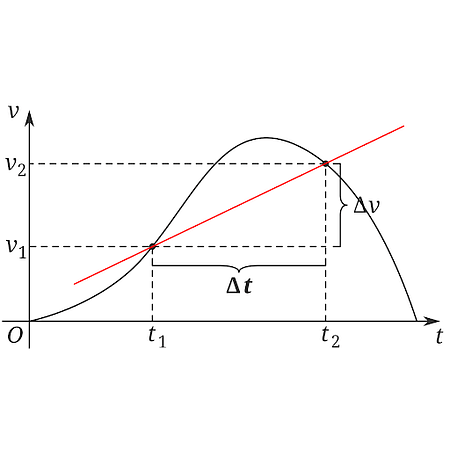
Velocity is a vector quantity, having both direction and magnitude. If any of these change over a while, there is acceleration. An object with a constant (constant) velocity in a circular orbit can have a satellite-like acceleration around the earth that moves in a constant motion but experiences a kind of acceleration called centripetal acceleration.
Check More:
Average Acceleration Formula
[Click Here for Previous Year Questions]
Average acceleration is calculated according to the following formula.
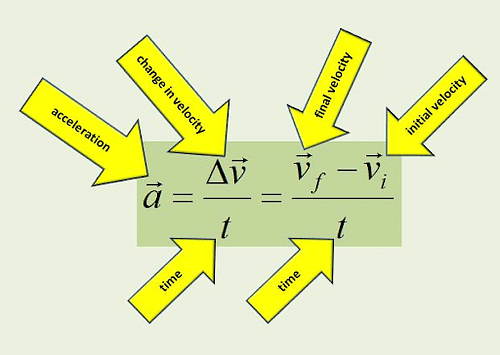
\(a = \frac{v - v_0}{t} = \frac{ \Delta v}{\Delta t}\), a is average acceleration, Δv is change in velocity and Δt is change in time.
The change in velocity is Δv and Δt is the total time the speed changes. where,
The final velocity is Vf
The initial Velocity is Vi
The initial time is Ti
The final time is Tf
If the object also shows different velocities such as v1, v2, v3 ... vn at different time intervals such as t1, t2, t3 ... t3, the average acceleration is calculated according to the following formula:
In other words, the average acceleration is defined as the rate of change of the velocity of the object and is given by the following equation.
Average Acceleration = Change in velocity/Time Elapsed
The unit of acceleration is meters/second square.
Since the velocity change Δv occurs at a finite time interval Δt, it is necessary to define the average acceleration. When the time interval becomes infinitely small, there is immediate acceleration or short acceleration, which is given by the following equation.
When the object moves in a straight line, the magnitude of the velocity vector is only partly because there is no change in direction in this case. Therefore, the direction symbol can be omitted.
Also Check:
| Related Topics | ||
|---|---|---|
| Displacement Formula | Unit of Speed | Relative Speed |
| Drift Velocity | Difference between Speed and Velocity | Plane |
| System of Units | Unit of Time | Equations of Motion |
Things to Remember
- The rate of change of velocity is known as acceleration. It is indicated by "a" and is measured in units of m/s2.
- Unlike acceleration, the average acceleration at a particular interval is calculated. Velocity is a vector quantity, having both direction and magnitude.
- An object with a constant (constant) velocity in a circular orbit can have a satellite-like acceleration around the earth that moves in a constant motion but experiences a kind of acceleration called centripetal acceleration.
- The average acceleration is defined as the rate of change of the velocity of the object and is given by the following equation. Average Acceleration = Change in velocity/Time Elapsed. The unit of acceleration is meters/second squared.
Previous Years’ Questions
- The nature of a graph drawn for a freely falling body … [TS EAMCET 2019]
- In a vertical circular motion, the ratio of the kinetic energy of a particle … [MHT CET 2016]
- Speeds of 20m/s and 15m/s relative to the ground … [BITSAT 2019]
- An object is thrown vertically upward with a speed of 30m/s … [TS EAMCET 2017]
- An automobile travelling at 50 km/h … [JCECE 2005]
- A rifle shoots a bullet with a muzzle velocity of … [JCECE 2005]
- Preeti reached the metro station and found that the escalator … [NEET 2017]
- An eagle flies at constant velocity horizontally across the sky … [UPSEE 2018]
- Consider a ship travelling due east along the equator … [TS EAMCET 2018]
- The position x of a particle with respect to time t along … [NEET 2007]
- The apparent frequency observed by a moving observer away … [KEAM]
- A child is swinging a swing. Minimum and maximum … [JCECE 2004]
Sample Questions
Ques: The bus accelerates at an initial velocity of 10 m / s for 5 seconds, then at 20 m / s for 4 seconds, and finally at 15 m / s for 8 seconds. What can you say about the average acceleration of the bus? (3 marks)
Ans: Bus velocities at various time intervals are v1 = 10 m / s, v2 = 20 m / s, v3 = 15 m / s.
The time intervals for objects to have these velocities are t1 = 5s, t2 = 4s, t3 = 8s.
Therefore, the total velocities during the interval can be given as the sum of these velocities.
Similarly, the total time interval can be given as the sum of these intervals.
Ques: A sparrow accelerates from 3 m / s to 6 m / s in 5 seconds while returning to the nest. What can you say about that average acceleration? (3 marks)
Ans: Given: Initial velocity, vi = 3 m / s
Final velocity, vf = 6 m / s
Total time for acceleration, t = 5 seconds
Ques: The car drives in a straight line for 10 seconds along the freeway at a constant speed of 8080 mph. Find its acceleration. (3 marks)
Ans: The average acceleration is the change in velocity divided by the time required. Since the speed (size and direction) of the motor is constant during riding, it is defined as zero average acceleration.
Ques: A friend's new car can go from 0 to 60 m / s in 7 seconds. What is acceleration? (4 marks)
Ans: Final speed, vf = 60 m / s; Initial speed, vi = 0; Last time, tf = 7 seconds. And the first time, ti = 0.
Aavg = Δv / Δt
Average = (60 m / s) / 7 seconds
Average = 12.86 m / s2
Ques: If you drive on the sidewalk at 45 m / s, you will see the child running down the street and rapidly decelerating to 3 m / s in 1.5 seconds. What is your gear? (2 marks)
Ans: Final velocity, vf = 3 m/s; initial velocity, vi = 45 m / s; time t = 1.5 seconds.
Check-More:



Comments