



Content Curator
Homolytic and Heterolytic fission are the types of covalent bond fission. In an organic reaction, an organic molecule (also known as a substrate) combines with an attacking reagent, resulting in the production of one or more intermediates and, eventually, a product(s). A covalent relation between two carbon atoms or carbon and another atom is broken and a new bond is generated in this process. The chemical reactions mostly include breaking and forming new chemical bonds. Chemical bonds, on either side, may be broken in several different ways. The breaking of a chemical bonding, usually a covalent bond, is referred to as bond fission.
Read Also: Carbon and Its Compounds
| Table of Content |
Key Terms: Homolytic, Heterolytic, fission, covalent bond, energy, chemical, cleavage, molecule.
Homolytic Fission
[Click Here for Sample Questions]
Homolytic fission, also known as hemolysis, is a kind of bond fission in which the fragments maintain one of the initially linked electrons during the process of exchanging atoms or molecules.
Homolytic fission is a kind of bond fission that entails the dissociation of a molecule where each of the original pieces maintains one electron. As a result of homolytic fission, two free radicals are produced. Two free radicals are created when neutrally substances undergo homolytic fission, with each chemical species carrying one electron gained from the bond pair.
The required energy to induce homolytic fission in a molecule is known as the molecule's homolytic bond dissociation energy. Homolytic fission of a molecular AB, which produces two free radicals, is seen in the diagram below (A° and B°).

Homolytic Fission
Check Important Notes for Hund’s Rule of Maximum Multiplicity
Condition for Homolytic Fission
A large amount of energy is normally required for Homolytic fission of a molecule. This is why, as explained below, this type of bond fission only occurs in a few circumstances.
- Photosynthesis occurs when a molecule is exposed to UV light, which is electromagnetic energy in the ultraviolet section of the electromagnetic spectrum.
- When a molecule receives enough heat to overcome the bond dissociation energy necessary for homolytic fission to occur.
- Pyrolysis is the process of heating carbon compounds to exceptionally high temperatures in the absence of oxygen to assist pyrolysis.
Example of Homolytic Fission
\(Cl_2 \rightarrow Cl. + Cl.\)
One such example is Homolytic breakage of the chlorine-chlorine bonds in peroxides.
The bond dissociation energies of these intramolecular bonds are quite low, indicating that they are weak. As a result, just a little amount of heat energy is needed to break through this barrier.

Example of Homolytic Fission
Read More: Alpha-particle Scattering and Rutherford’s Nuclear Model of Atom
Heterolytic Fission
[Click Here for Sample Questions]
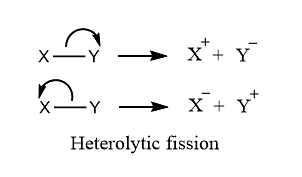
The term 'heterolysis' is Greek in origin and approximately translates to 'unequal breaking.' Another name for it is homolytic cleavage. The two ways that a molecule XY might undergo Heterolytic fission are depicted in the diagram below. Y preserves the bond pair of electrons in the first case, making it an anion and X a cation. In the second circumstance, X preserves the bond pair and becomes the anion, while Y becomes the cation.
Heterolytic Fission
Heterolytic fission also referred to as heterolysis, is a kind of bond fission in which a covalent connection between two reactive species is broken unevenly, with one chemical species retaining the bond pair of electrons while the other does not. One of the products of heterolytic fission of a neutrally charged molecule has a positive charge, whereas the other has a negative charge.
Condition for Heterolytic Fission
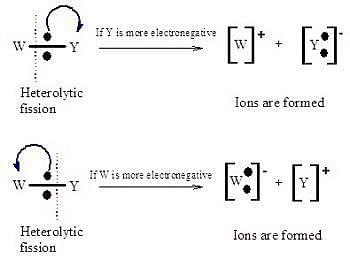
Whenever a positive charge is present on the carbon in an organic molecule, the cation is called a carbocation. The anion is called carbanion when the carbon has a negative charge. The reaction has two intermediates: a carbocation and a carbanion. Here between reactants and products, an intermediate is created, which is a narrow unstable species.
Condition for Heterolytic Fission
Assume WY is a covalently bound molecule. If Y is the more electronegative atom, it will take both electrons during heterolytic fission. Both electrons will migrate onto W if it is more electronegative. In heterolytic fission, the two-electron displacement is indicated by the curved arrow.
The condition heterolytic cleavages, such as:
- The presence of a low temperature
- Differences in electronegativity between the bonding atoms
- A polar solvent is present.
Important Notes On Particle Physics
Example of Heterolytic Fission
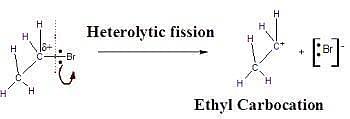
Consider the following example of bromoalkane heterolysis:
CH3CH2Br + H2 O = CH3CH2OH + HBr
The electron-withdrawing effect of halogens weakens the carbon-halogen bond in bromoalkane, making it weaker than the carbon-hydrogen and carbon-carbon bonds.
Example of Heterolytic Fission
In this process, the carbon-halogen bond is broken. During this bond breaking, the formation of an ethyl carbocation transition and a free bromide ion was ethanol and hydrogen bromide are produced.
Difference between in Homolytic and Heterolytic Fission
[Click Here for Sample Questions]
| Homolytic Fission | Heterolytic Fission |
|---|---|
| The breakdown of a chemical substance into two chemically equivalent pieces is known as homolysis. | The breakdown of a chemical substance into two chemically distinct pieces is known as heterolysis. |
| The energy required for homolysis is determined by Homolytic bond dissociation energy. | The energy required for heterolysis is determined by the heterolytic bond dissociation energy. |
| One bond electron is given to each fragment. | It gives one fragment two bond electrons while giving the other none. |
| The generation of free radicals, or uncharged species with unpaired electrons, occurs in this sort of fission. | The generation of charged species termed ions, such as carbonation of carbonium ions, occurs in this kind of fission. |
| In a nonpolar solution, this happens more easily. | In a polar solution, this happens more easily. |
Check Also: Carbon and Its Compounds
Things to Remember
[Click Here for Sample Questions]
- The capacity of a molecule to receive energy from light or heat, as well as the bond dissociation energy, drive homolytic cleavage (enthalpy).
- The energy of the Singly Occupied Molecular Orbital will be reduced, as would the bond dissociation energy if the radical species is better able to stabilize the free radical.
- Bond dissociation takes a simpler path in the gas phase, termed homolysis.
- Heterolysis is the favored kind of breakdown in an ionizing solvent.
- Multiple variables influence the bond dissociation energy in homolytic fission: Resonance, Hyperconjugation, Electronegativity, Polarizability, Orbital Hybridization
Sample Questions
Ques. When a covalent bond is photochemical haemolysed, which intermediate is formed? (2 marks)
Ans. Photolysis is a critical step in the cycle of the compounds in habitats. This has a considerable influence on the penetration depth of damaging UV-A and UV-B irradiation in aquatic systems, the transmission of photosynthesis active radiation, and the vertical dispersion control of planktonic primary production.
Ques. What exactly do you mean when you say "free radicals"? (1 mark)
Ans. When a single bond is homolytically split, neutral intermediates are formed. C-Cl, C-O, C-I, C-Br, C-H, and C-C are some of the most common bonds that cleave to create free radicals in organic chemistry.
Ques. Determine the difference between homolytic and heterolytic cleavage. (1 mark)
Ans. In Homolytic cleavage, two electrons are evenly distributed amongst the products, but in a heterolytic cleavage, a covalent connection breaks as one fragment receives both of the shared electrons.
Ques. What are the causes of homolytic and heterolytic cleavage? (2 marks)
Ans. Heterolytic or ionic fission is the breakage of covalent bonding in such a manner that one atom receives both of the shared electrons, whereas homolytic cleavage is the breakage of covalent bonding in such a way that each fragment receives one of the shared electrons.
Ques. Which one-Homolytic or heterolytic cleavage has the higher bond dissociation energy? (3 marks)
Ans. The bond dissociation energy for homolytic cleavage is higher than for heterolytic cleavage. Bond cleavage between similar atoms, such as H2, or atoms with extremely minor electronegativity differences, such as CH, is the cause of homolytic cleavage. Heterolytic cleavage, on the other hand, is bond breaking between two distinct atoms with a large electronegativity differential, such as HCl.
Ques. Why do non-polar solvents and higher temperatures promote homolytic fission above heterolytic fission? (3 marks)
Ans. When a molecule performs heterolytic fission, it forms bonds more quickly than when it undergoes homolytic fission. So, in non-polar liquids, charges decay quickly. Another thing to consider is salvation. The enthalpy of solvation enhances the ease with which charges may be produced in polar liquids by stabilizing the created charges. The solvation of non-polar solvents, on the other hand, is quite low. As a result, they are unable to maintain charge stability.
Ques. Is heterolytic fission always more energy-dense than homolytic fission? (1 mark)
Ans. The energy required for homolytic fission in the gas phase and non-polar solvents is lower than in a polar solvent.
Ques. Is it easier to do homolytic or heterolytic fission? (2 marks)
Ans. One that is heterolytic. This is because they all occupy the same common pair of electrons. The elements/groups are the same in homolytic fission, however, they are different in heterolytic cleavage.
Ques. What is fission, and how does it work? During a fission reaction, what happens? (5 marks)
Ans. Atomic nuclei would not be conceivable if gravity and electromagnetism were the sole fundamental forces in the cosmos. This would be hard to acquire all of those positive ions without them resisting each other and bursting apart. Fortunately, the Weak and Strong Nuclear Forces and atomic nuclei can stay together. The larger the nucleus, and more positive charge protons it contains, as well as the neutrons and binding energy it requires
If you discharge neutrons at a uranium-235 nucleus and it splits into two parts (one barium nucleus and one xenon nuclear, for example), you've succeeded in fission.
Ques. What causes homolytic and heterolytic cleavage? (5 marks)
Ans. Cleavage by homolytic enzymes
When each atom in a covalent bond withdraws its individual electron, the bond splits. As a result, a free radical is formed. It may be seen in molecular formations where the electronegativity difference in the two atoms in bonding is minimal.
Heterolytic fission is a kind of fission that occurs when two or more
When cleavage happens between two atoms with considerable variations in electronegativity, it leads to the production of cation and anion. More electronegative elements take the shared electron pair (2 engaged in the covalent connection, one of each atom).



Comments